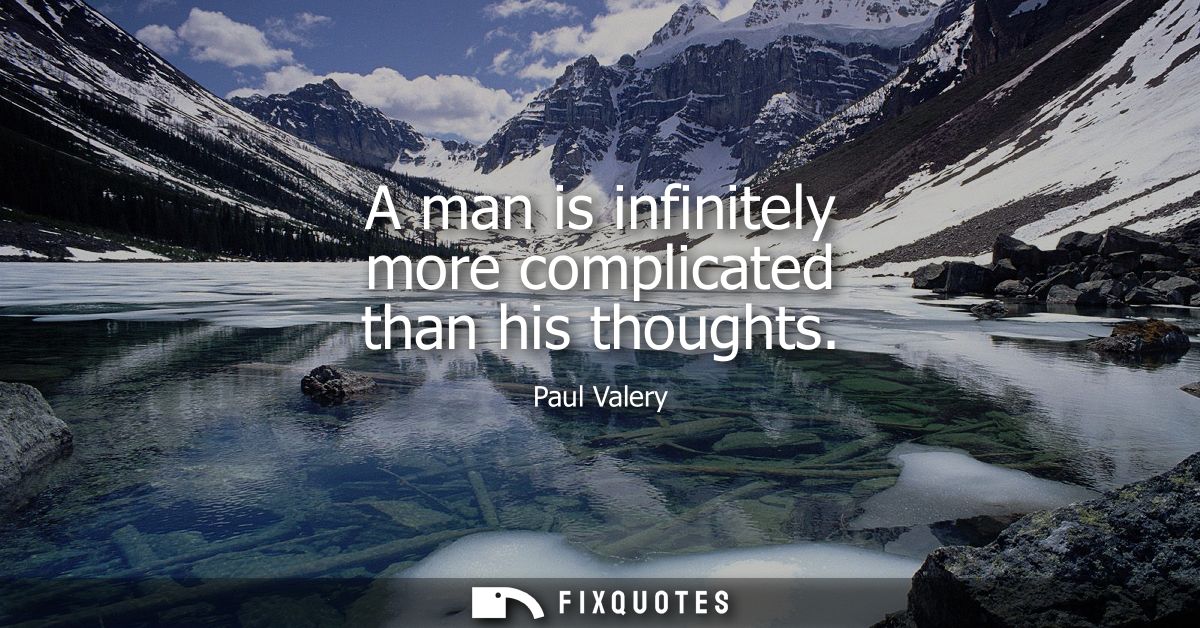
"A man is infinitely more complicated than his thoughts"
About this Quote
Valery’s line lands like a cool rebuke to the modern habit of treating people as walking position papers. “A man is infinitely more complicated than his thoughts” isn’t anti-intellectual; it’s anti-reductionist. It insists that thought, for all its prestige, is a thin slice of the human animal: the polished surface that gets language, logic, and public credit, while the rest of us-the body, the reflexes, the half-formed desires, the inherited fears, the private contradictions-keeps running the show offstage.
The phrasing matters. “Infinitely” is not casual emphasis; it’s a mathematical dare. Valery, steeped in a late-19th- and early-20th-century French world where rational systems were being both worshipped and dismantled, uses the word to puncture the fantasy that we can finish a person through explanation. In an era of manifestos, ideologies, and the rising authority of psychology, he’s warning that even our most sincere ideas are often after-the-fact narrations: we call them beliefs, but they can function like alibis.
As a poet, Valery is also defending ambiguity as a form of truth. Poetry lives in the gap between what can be said and what is lived; this sentence elevates that gap into a principle. The subtext is humane and slightly unforgiving: judge someone only by their thoughts and you’re judging their best self, their worst self, or their most performative self-but never the whole person. It’s a reminder that inner life is not a transcript.
The phrasing matters. “Infinitely” is not casual emphasis; it’s a mathematical dare. Valery, steeped in a late-19th- and early-20th-century French world where rational systems were being both worshipped and dismantled, uses the word to puncture the fantasy that we can finish a person through explanation. In an era of manifestos, ideologies, and the rising authority of psychology, he’s warning that even our most sincere ideas are often after-the-fact narrations: we call them beliefs, but they can function like alibis.
As a poet, Valery is also defending ambiguity as a form of truth. Poetry lives in the gap between what can be said and what is lived; this sentence elevates that gap into a principle. The subtext is humane and slightly unforgiving: judge someone only by their thoughts and you’re judging their best self, their worst self, or their most performative self-but never the whole person. It’s a reminder that inner life is not a transcript.
Quote Details
| Topic | Deep |
|---|---|
| Source | Help us find the source |
| Cite |
Citation Formats
APA Style (7th ed.)
Valery, Paul. (2026, January 15). A man is infinitely more complicated than his thoughts. FixQuotes. https://fixquotes.com/quotes/a-man-is-infinitely-more-complicated-than-his-160708/
Chicago Style
Valery, Paul. "A man is infinitely more complicated than his thoughts." FixQuotes. January 15, 2026. https://fixquotes.com/quotes/a-man-is-infinitely-more-complicated-than-his-160708/.
MLA Style (9th ed.)
"A man is infinitely more complicated than his thoughts." FixQuotes, 15 Jan. 2026, https://fixquotes.com/quotes/a-man-is-infinitely-more-complicated-than-his-160708/. Accessed 4 Apr. 2026.
More Quotes by Paul
Add to List