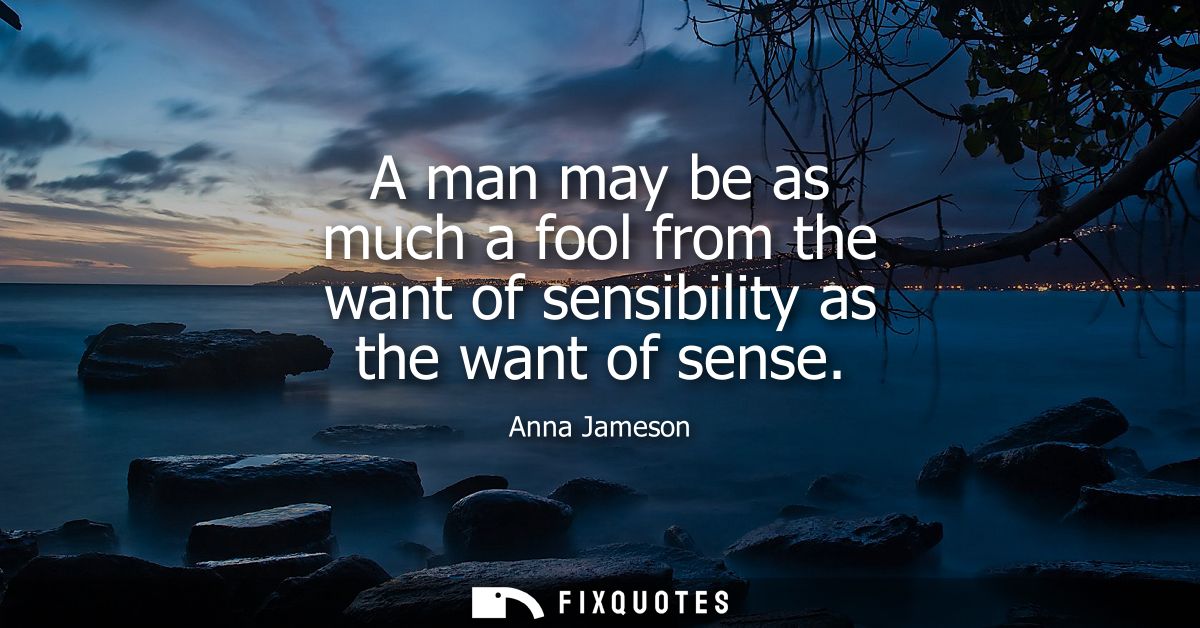
"A man may be as much a fool from the want of sensibility as the want of sense"
About this Quote
The sentence works because it treats emotional perception as a form of intelligence with real stakes. “Want” does double duty: absence, but also a need. The phrase implies that feeling isn’t merely present or absent; it’s something a person can be deprived of by habit, class training, or self-protective detachment. In a culture where decorum could masquerade as virtue, Jameson targets the polished man who can argue, manage, and judge yet remain unmoved by suffering. His failure isn’t that he can’t think; it’s that he can’t be touched, so his thinking becomes sterile, even cruel.
Jameson wrote amid debates about sympathy, reform, and women’s moral influence, when the novel and essay were expanding the public’s emotional imagination. Her subtext: a society that prizes calculation over compassion will mistake cold competence for wisdom. The fool she names is frighteningly modern: fluent, competent, and emotionally illiterate.
Quote Details
| Topic | Wisdom |
|---|---|
| Source | Help us find the source |
| Cite |
Citation Formats
APA Style (7th ed.)
Jameson, Anna. (2026, January 16). A man may be as much a fool from the want of sensibility as the want of sense. FixQuotes. https://fixquotes.com/quotes/a-man-may-be-as-much-a-fool-from-the-want-of-122753/
Chicago Style
Jameson, Anna. "A man may be as much a fool from the want of sensibility as the want of sense." FixQuotes. January 16, 2026. https://fixquotes.com/quotes/a-man-may-be-as-much-a-fool-from-the-want-of-122753/.
MLA Style (9th ed.)
"A man may be as much a fool from the want of sensibility as the want of sense." FixQuotes, 16 Jan. 2026, https://fixquotes.com/quotes/a-man-may-be-as-much-a-fool-from-the-want-of-122753/. Accessed 18 Mar. 2026.