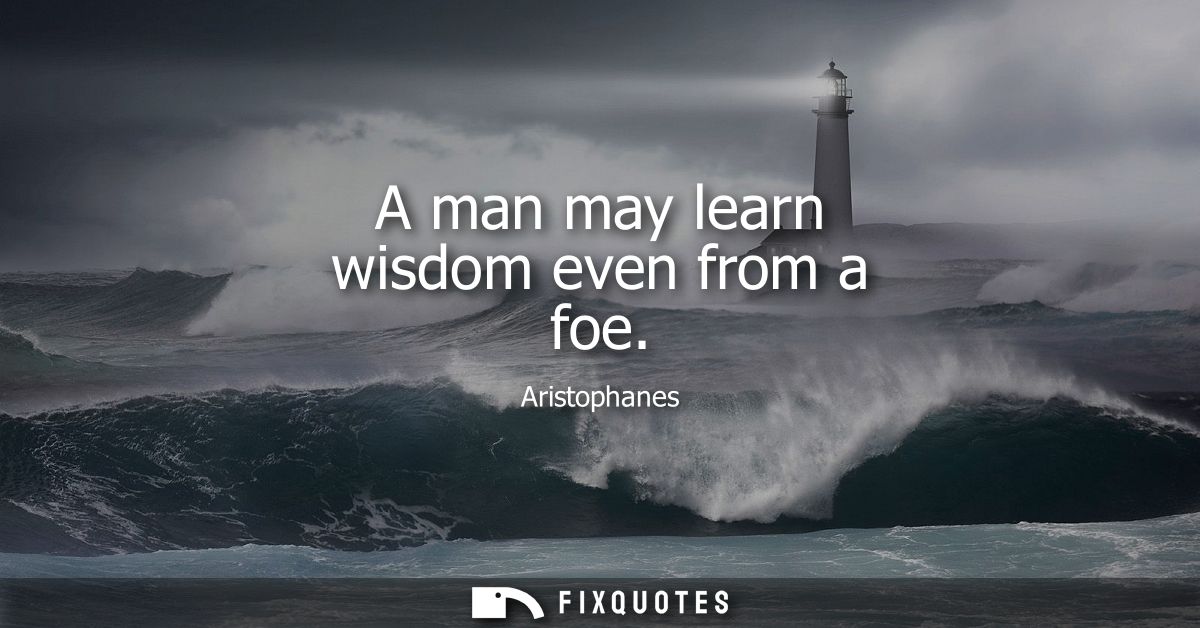
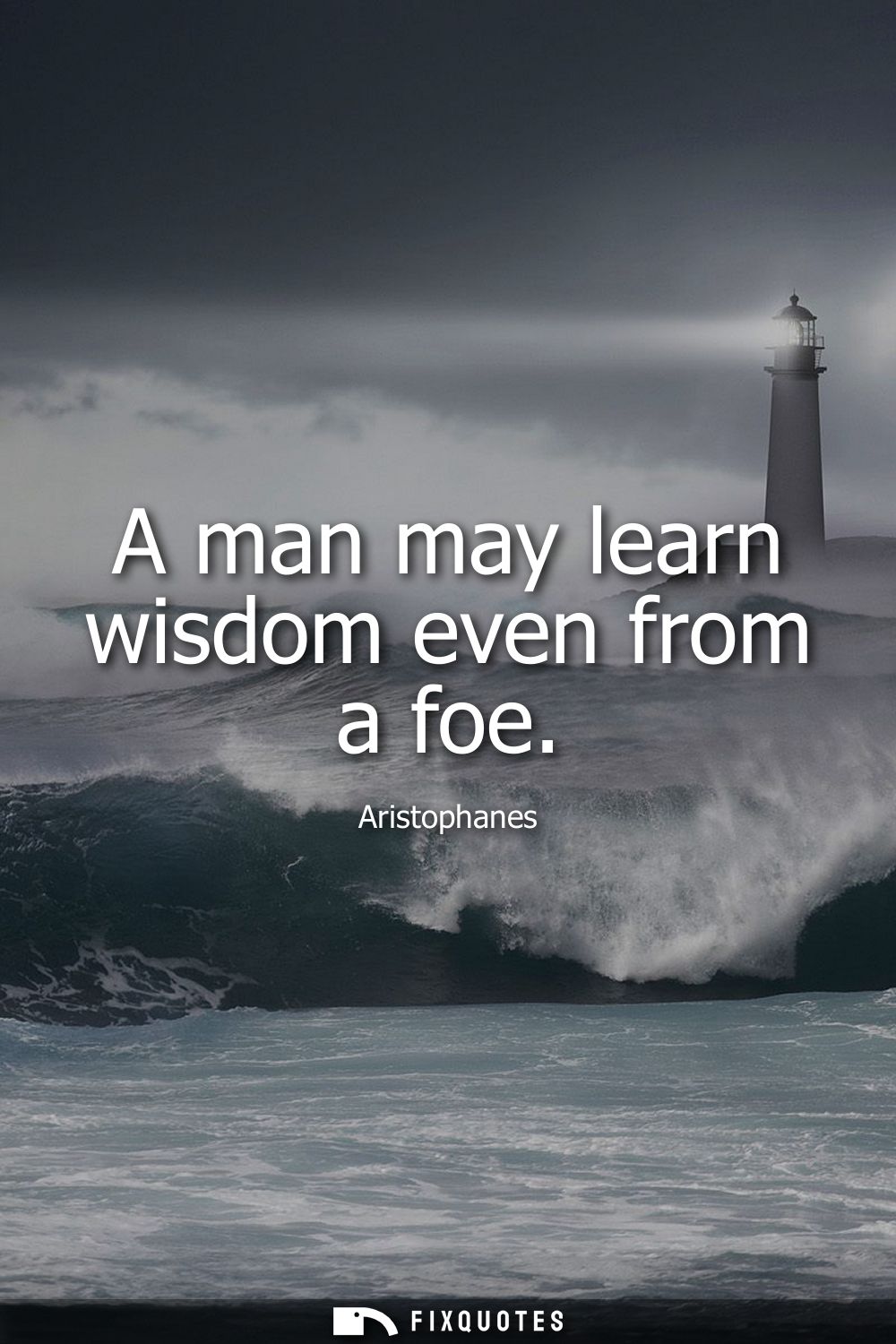
"A man may learn wisdom even from a foe"
About this Quote
Aristophanes lands this line like a sly corrective to Athenian ego: your enemy might be the only person honest enough to teach you something. Coming from a comic poet who made a career out of humiliating public figures onstage, the claim carries a double edge. It reads as moral advice, but it also smuggles in a jab at the complacent citizen who treats disagreement as contamination. If you can only learn from allies, you are not wise; you are merely comforted.
The phrasing is pointedly unsentimental. Not friends, not teachers, not the gods: a foe. In the competitive, litigated, faction-ridden world of classical Athens, foes were abundant and loudly present - in the Assembly, in the courts, across the battlefield. Aristophanes knew that civic life was a contact sport, and comedy itself functioned as a kind of sanctioned hostility, an arena where mockery could force audiences to confront their own bad ideas. The subtext is that antagonism sharpens perception: the foe sees your blind spots because they are invested in exploiting them.
There is also a quiet warning about intellectual hygiene. The city that refuses to hear its opponents slides toward groupthink, then toward disaster. Aristophanes watched Athens overreach, panic, and punish dissent; his plays needle the crowd for being too easily flattered. Wisdom, here, is less a private virtue than a civic skill: the ability to metabolize conflict into insight instead of turning it into tribal loyalty.
The phrasing is pointedly unsentimental. Not friends, not teachers, not the gods: a foe. In the competitive, litigated, faction-ridden world of classical Athens, foes were abundant and loudly present - in the Assembly, in the courts, across the battlefield. Aristophanes knew that civic life was a contact sport, and comedy itself functioned as a kind of sanctioned hostility, an arena where mockery could force audiences to confront their own bad ideas. The subtext is that antagonism sharpens perception: the foe sees your blind spots because they are invested in exploiting them.
There is also a quiet warning about intellectual hygiene. The city that refuses to hear its opponents slides toward groupthink, then toward disaster. Aristophanes watched Athens overreach, panic, and punish dissent; his plays needle the crowd for being too easily flattered. Wisdom, here, is less a private virtue than a civic skill: the ability to metabolize conflict into insight instead of turning it into tribal loyalty.
Quote Details
| Topic | Wisdom |
|---|---|
| Source | Help us find the source |
| Cite |
Citation Formats
APA Style (7th ed.)
Aristophanes. (2026, January 16). A man may learn wisdom even from a foe. FixQuotes. https://fixquotes.com/quotes/a-man-may-learn-wisdom-even-from-a-foe-109233/
Chicago Style
Aristophanes. "A man may learn wisdom even from a foe." FixQuotes. January 16, 2026. https://fixquotes.com/quotes/a-man-may-learn-wisdom-even-from-a-foe-109233/.
MLA Style (9th ed.)
"A man may learn wisdom even from a foe." FixQuotes, 16 Jan. 2026, https://fixquotes.com/quotes/a-man-may-learn-wisdom-even-from-a-foe-109233/. Accessed 12 Feb. 2026.
More Quotes by Aristophanes
Add to List