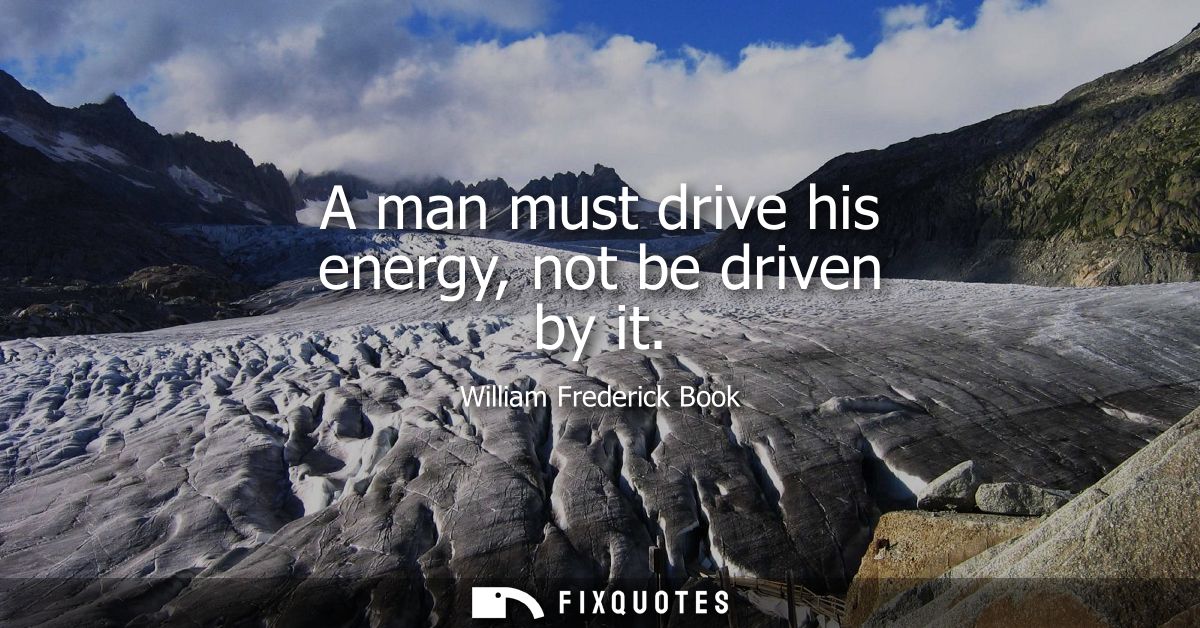
"A man must drive his energy, not be driven by it"
About this Quote
Self-control is the unglamorous superpower hiding in Book's clean, almost mechanical phrasing. "Drive" flips energy from a mystical inner force into something like a vehicle or a team of horses: useful, powerful, and dangerous if it takes the reins. The sentence doesn't romanticize passion; it treats raw vigor as morally neutral, a resource that needs a driver. That's the point of the sharp contrast in the second clause: "not be driven by it". The warning isn't that energy is bad, but that undirected intensity becomes coercive, turning the self into a passenger in its own life.
Book, writing from an era steeped in self-improvement literature, industrial discipline, and the Protestant-tinged belief that character is built through management of impulse, aims at a particular kind of modern anxiety: having plenty of hustle and still feeling out of control. The subtext is anti-excuse. If you blame your temper, ambition, libido, or restlessness for what you do, you're outsourcing responsibility to your nervous system.
The line works because it's austere. No therapy-speak, no inspirational fog. It implies a hierarchy: will above appetite, purpose above mood. It also carries a social critique. In a culture that rewards visible intensity - the always-on worker, the charismatic go-getter - Book reminds you that unsteered energy isn't authenticity; it's volatility. Real agency isn't feeling a lot. It's deciding where the feeling goes.
Book, writing from an era steeped in self-improvement literature, industrial discipline, and the Protestant-tinged belief that character is built through management of impulse, aims at a particular kind of modern anxiety: having plenty of hustle and still feeling out of control. The subtext is anti-excuse. If you blame your temper, ambition, libido, or restlessness for what you do, you're outsourcing responsibility to your nervous system.
The line works because it's austere. No therapy-speak, no inspirational fog. It implies a hierarchy: will above appetite, purpose above mood. It also carries a social critique. In a culture that rewards visible intensity - the always-on worker, the charismatic go-getter - Book reminds you that unsteered energy isn't authenticity; it's volatility. Real agency isn't feeling a lot. It's deciding where the feeling goes.
Quote Details
| Topic | Self-Discipline |
|---|---|
| Source | Help us find the source |
| Cite |
Citation Formats
APA Style (7th ed.)
Book, William Frederick. (2026, January 16). A man must drive his energy, not be driven by it. FixQuotes. https://fixquotes.com/quotes/a-man-must-drive-his-energy-not-be-driven-by-it-122723/
Chicago Style
Book, William Frederick. "A man must drive his energy, not be driven by it." FixQuotes. January 16, 2026. https://fixquotes.com/quotes/a-man-must-drive-his-energy-not-be-driven-by-it-122723/.
MLA Style (9th ed.)
"A man must drive his energy, not be driven by it." FixQuotes, 16 Jan. 2026, https://fixquotes.com/quotes/a-man-must-drive-his-energy-not-be-driven-by-it-122723/. Accessed 7 Apr. 2026.
More Quotes by William
Add to List