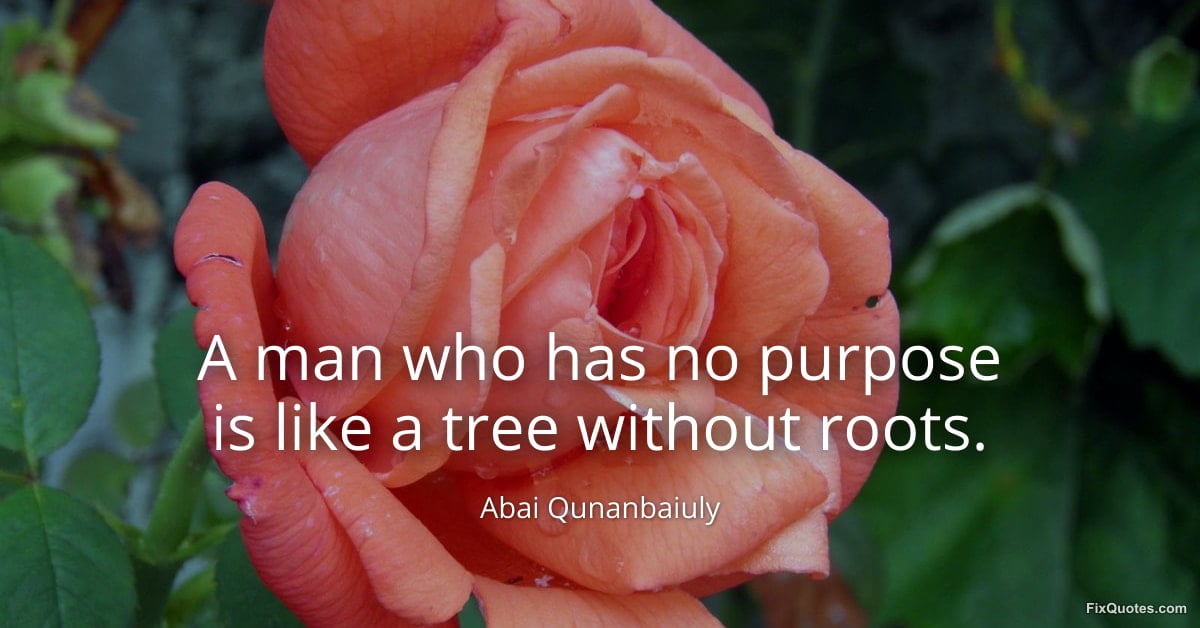
"A man who has no purpose is like a tree without roots"
About this Quote
Purpose, for Abai, is not a motivational poster slogan; it is the unseen infrastructure that keeps a person upright when the weather turns. The image does its work quietly. A tree can look tall and alive for a while even if its roots are compromised, but it is already living on borrowed time. That’s the sting: aimlessness isn’t merely sad, it’s structurally dangerous.
Abai Qunanbaiuly wrote as a poet and moral critic at a moment when Kazakh society was being pulled between nomadic tradition, Russian imperial administration, and the pressures of modernization. In that context, “purpose” reads less like private ambition and more like a demand for inner grounding amid cultural upheaval. Roots aren’t glamorous; they’re buried, patient, often inherited. He’s hinting that a life without a guiding ethic, craft, or responsibility becomes easy to topple by external forces: fashion, authority, resentment, idleness.
The subtext is also a rebuke to performative vitality. A rootless tree still has leaves; a purposeless person can still have status, charm, even education. Abai is skeptical of appearances. What matters is the sustaining connection to something deeper: learning, conscience, service, faith, community, a chosen discipline. This is why the metaphor lands: it frames purpose not as a destination but as anchorage, a relationship to origin and obligation.
In a culture negotiating identity under empire, Abai’s line becomes quietly political: if you don’t decide what you’re for, someone else will decide what you’re for you.
Abai Qunanbaiuly wrote as a poet and moral critic at a moment when Kazakh society was being pulled between nomadic tradition, Russian imperial administration, and the pressures of modernization. In that context, “purpose” reads less like private ambition and more like a demand for inner grounding amid cultural upheaval. Roots aren’t glamorous; they’re buried, patient, often inherited. He’s hinting that a life without a guiding ethic, craft, or responsibility becomes easy to topple by external forces: fashion, authority, resentment, idleness.
The subtext is also a rebuke to performative vitality. A rootless tree still has leaves; a purposeless person can still have status, charm, even education. Abai is skeptical of appearances. What matters is the sustaining connection to something deeper: learning, conscience, service, faith, community, a chosen discipline. This is why the metaphor lands: it frames purpose not as a destination but as anchorage, a relationship to origin and obligation.
In a culture negotiating identity under empire, Abai’s line becomes quietly political: if you don’t decide what you’re for, someone else will decide what you’re for you.
Quote Details
| Topic | Meaning of Life |
|---|---|
| Source | The Book of Words (Kara Sozder), prose maxims, 19th century. [translated] |
| Cite |
Citation Formats
APA Style (7th ed.)
Qunanbaiuly, Abai. (2026, February 14). A man who has no purpose is like a tree without roots. FixQuotes. https://fixquotes.com/quotes/a-man-who-has-no-purpose-is-like-a-tree-without-185302/
Chicago Style
Qunanbaiuly, Abai. "A man who has no purpose is like a tree without roots." FixQuotes. February 14, 2026. https://fixquotes.com/quotes/a-man-who-has-no-purpose-is-like-a-tree-without-185302/.
MLA Style (9th ed.)
"A man who has no purpose is like a tree without roots." FixQuotes, 14 Feb. 2026, https://fixquotes.com/quotes/a-man-who-has-no-purpose-is-like-a-tree-without-185302/. Accessed 29 Mar. 2026.
More Quotes by Abai
Add to List