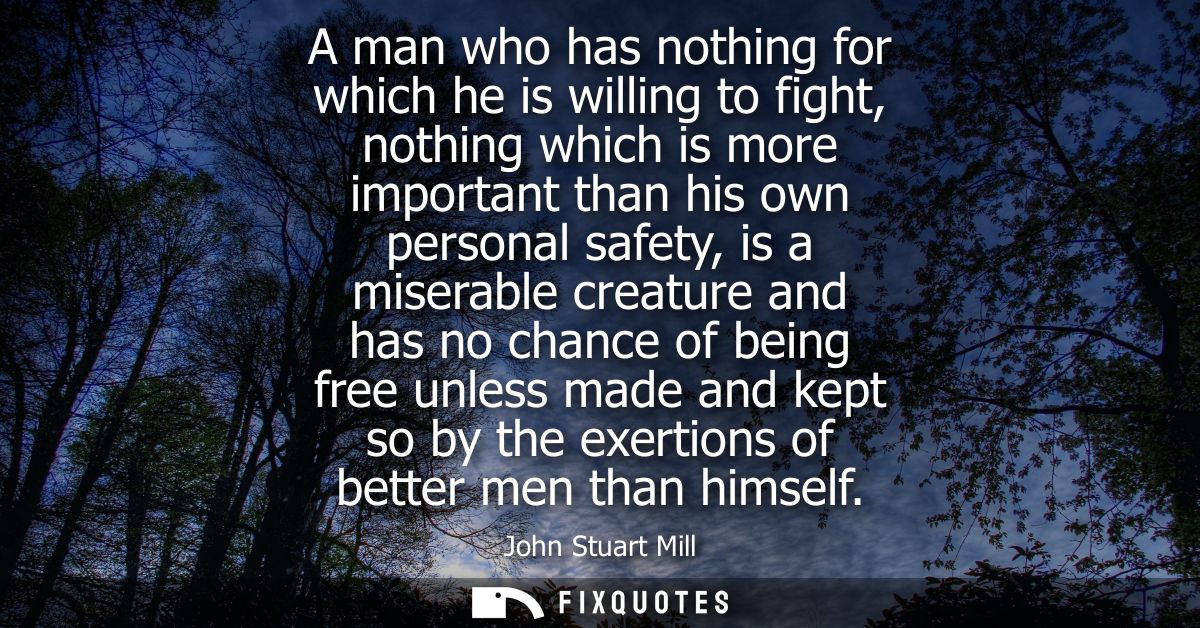
"A man who has nothing for which he is willing to fight, nothing which is more important than his own personal safety, is a miserable creature and has no chance of being free unless made and kept so by the exertions of better men than himself"
About this Quote
The subtext is bluntly anti-paternalist. Mill’s liberalism is often caricatured as polite tolerance, but here he draws a hard line: rights cannot survive as mere paper claims. They require people willing to endure discomfort, stigma, even danger to defend them. Otherwise liberty degrades into a managed condition, “made and kept so” by others - which is Mill’s way of saying that passive people don’t stay free; they get administered.
Context sharpens the edge. Writing in an era of expanding suffrage, mass politics, and industrial conformity, Mill feared not only tyrants but the soft coercion of public opinion and the seductive trade: obedience in exchange for protection. The rhetoric works because it weaponizes a fear deeper than death: humiliation. “Miserable creature” isn’t a philosophical category; it’s social shame. Mill pressures the reader to ask what they would actually sacrifice for autonomy - and whether a freedom maintained by someone else’s bravery is freedom at all, or just a lease that can be revoked.
Quote Details
| Topic | Freedom |
|---|---|
| Source | Unverified source: The Contest in America (John Stuart Mill, 1862)
Evidence: A man who has nothing which he is willing to fight for, nothing which he cares more about than he does about his personal safety, is a miserable creature, who has no chance of being free, unless made and kept so by the exertions of better men than himself. (Page 32 (in the 1862 Boston pamphlet re... Other candidates (1) The Book of Man (William J. Bennett, 2013) compilation97.8% ... A man who has nothing for which he is willing to fight , nothing which is more important than his own personal sa... |
| Cite |
Citation Formats
APA Style (7th ed.)
Mill, John Stuart. (2026, February 26). A man who has nothing for which he is willing to fight, nothing which is more important than his own personal safety, is a miserable creature and has no chance of being free unless made and kept so by the exertions of better men than himself. FixQuotes. https://fixquotes.com/quotes/a-man-who-has-nothing-for-which-he-is-willing-to-32173/
Chicago Style
Mill, John Stuart. "A man who has nothing for which he is willing to fight, nothing which is more important than his own personal safety, is a miserable creature and has no chance of being free unless made and kept so by the exertions of better men than himself." FixQuotes. February 26, 2026. https://fixquotes.com/quotes/a-man-who-has-nothing-for-which-he-is-willing-to-32173/.
MLA Style (9th ed.)
"A man who has nothing for which he is willing to fight, nothing which is more important than his own personal safety, is a miserable creature and has no chance of being free unless made and kept so by the exertions of better men than himself." FixQuotes, 26 Feb. 2026, https://fixquotes.com/quotes/a-man-who-has-nothing-for-which-he-is-willing-to-32173/. Accessed 31 Mar. 2026.