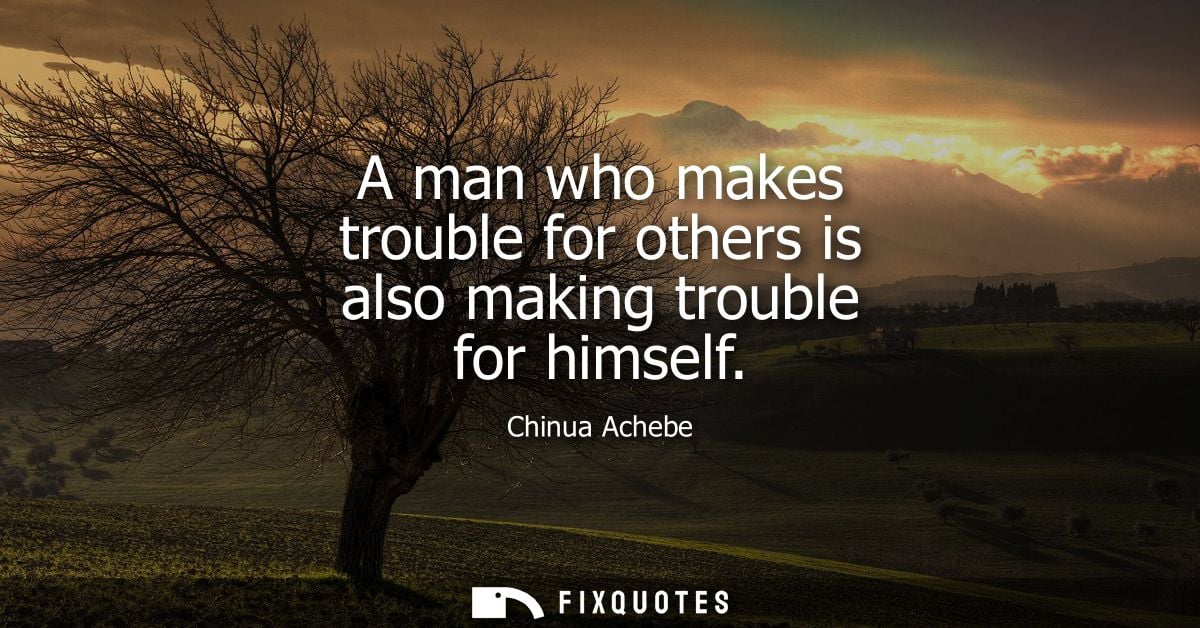
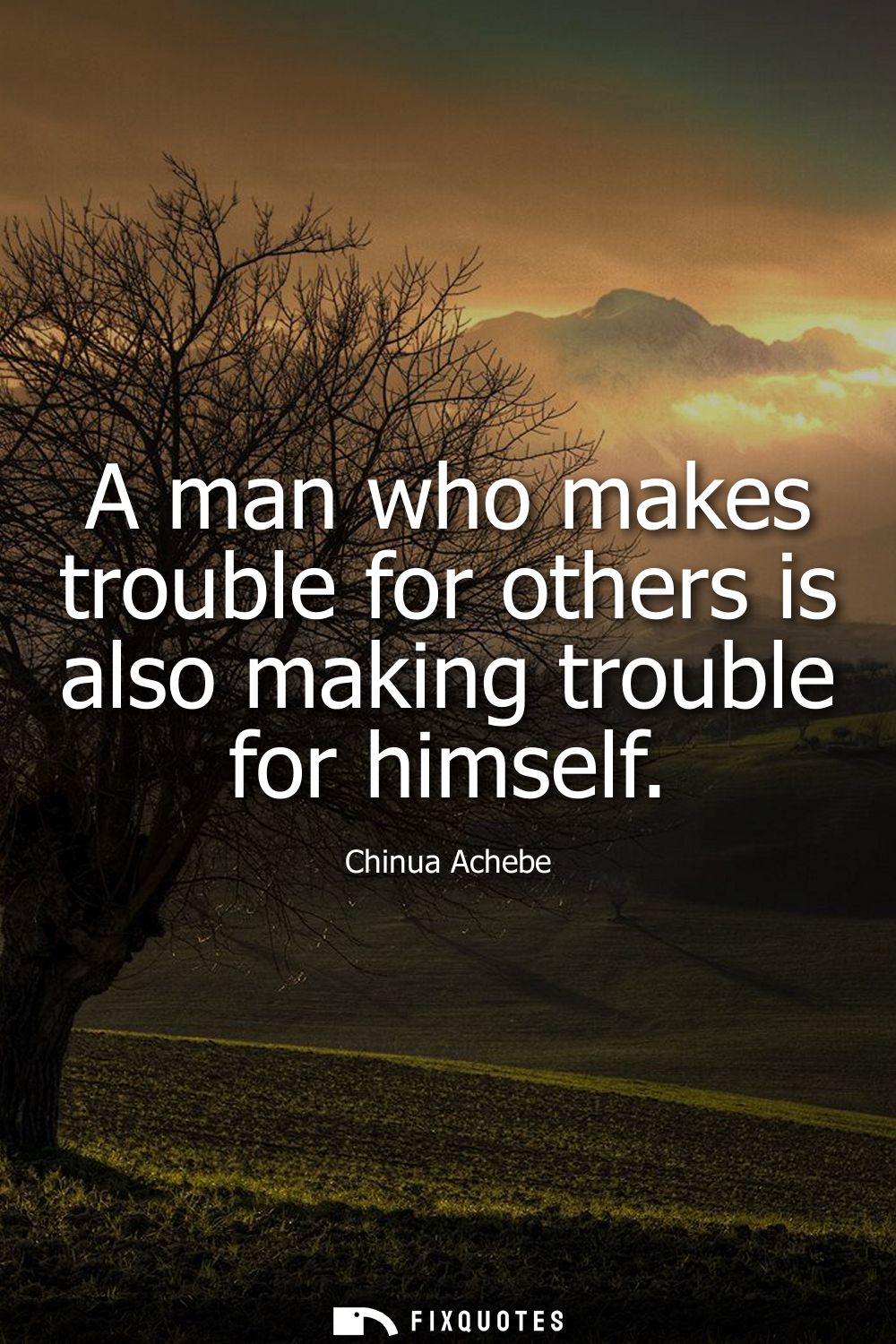
"A man who makes trouble for others is also making trouble for himself"
About this Quote
The intent is corrective, almost parental, but the subtext is political. In a society held together by reciprocal obligation, trouble is not a private hobby; it’s a contagion. You destabilize someone else’s life and you degrade the shared systems that keep your own life livable: trust, reputation, ritual, the thin social contracts that stop grievance from turning into feud. Achebe writes from worlds where the “I” is always in conversation with the “we,” so the phrase “for others” quietly implies “against the village,” “against continuity,” “against yourself.”
Context matters: Achebe is a chronicler of colonial disruption and postcolonial fallout, where power repeatedly disguises self-sabotage as progress. The colonizer who humiliates a people also poisons the moral legitimacy that sustains rule; the local strongman who weaponizes fear inherits a society too broken to govern. The line reads simple because it’s meant to travel orally, like folklore, but it carries Achebe’s larger argument: violence and domination are short-term strategies that rot the ground beneath the victor.
Quote Details
| Topic | African Proverbs |
|---|---|
| Source | Later attribution: THE BEST QUOTES BY GREAT PHILOSOPHER'S (Princewill Okeke, 2016) modern compilationISBN: 9781365555954 · ID: ozm8DQAAQBAJ
Evidence:
... Chinua Achebe A functioning, robust democracy requires a healthy educated, participatory followership, and an educated, morally grounded leadership. Chinua Achebe A man who makes trouble for others is also making trouble for himself. Chinua ... |
| Cite |
Citation Formats
APA Style (7th ed.)
Achebe, Chinua. (2026, March 26). A man who makes trouble for others is also making trouble for himself. FixQuotes. https://fixquotes.com/quotes/a-man-who-makes-trouble-for-others-is-also-making-52015/
Chicago Style
Achebe, Chinua. "A man who makes trouble for others is also making trouble for himself." FixQuotes. March 26, 2026. https://fixquotes.com/quotes/a-man-who-makes-trouble-for-others-is-also-making-52015/.
MLA Style (9th ed.)
"A man who makes trouble for others is also making trouble for himself." FixQuotes, 26 Mar. 2026, https://fixquotes.com/quotes/a-man-who-makes-trouble-for-others-is-also-making-52015/. Accessed 3 Apr. 2026.