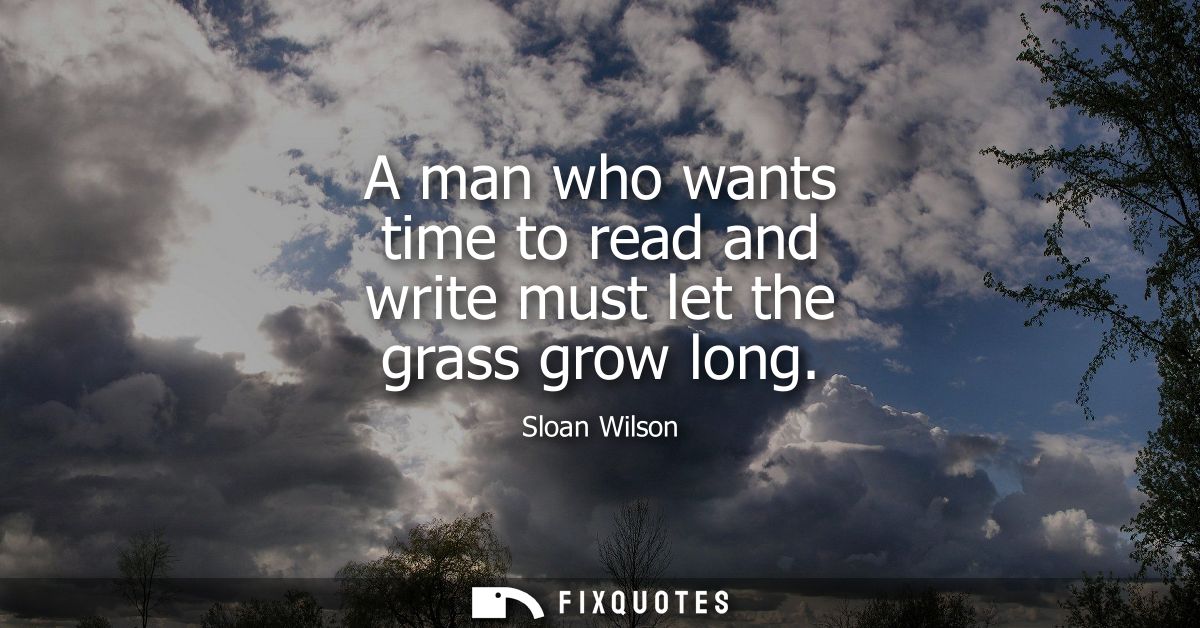
"A man who wants time to read and write must let the grass grow long"
About this Quote
The line lands like a polite provocation: if you want a serious inner life, your yard is going to look a little shabby. Sloan Wilson turns “let the grass grow long” into a domestic heresy, a refusal of the mid-century American religion of upkeep. It’s not really about horticulture; it’s about the invisible hours that get quietly taxed away by appearances.
As a novelist who came of age alongside postwar suburbia and its moral economy of neat lawns, Wilson is pointing at a conflict that still feels painfully modern: time isn’t merely scarce, it’s socially policed. The long grass signals an abandonment of the performative tasks that reassure neighbors you’re responsible, industrious, normal. Reading and writing, by contrast, can look like leisure or indulgence to anyone counting visible outputs. Wilson’s sentence is a small defense of work that doesn’t immediately announce itself.
The intent is strategic, too. He doesn’t romanticize writerly isolation with an attic and a candle. He picks the most banal symbol of respectable life and suggests neglecting it, as if to say: the barrier to art isn’t only talent or inspiration, it’s errands. The subtext is a dare to disappoint people a little, including your own internalized “good citizen” who equates virtue with busyness. Long grass becomes a kind of quiet manifesto: protect your attention by letting something harmless go.
As a novelist who came of age alongside postwar suburbia and its moral economy of neat lawns, Wilson is pointing at a conflict that still feels painfully modern: time isn’t merely scarce, it’s socially policed. The long grass signals an abandonment of the performative tasks that reassure neighbors you’re responsible, industrious, normal. Reading and writing, by contrast, can look like leisure or indulgence to anyone counting visible outputs. Wilson’s sentence is a small defense of work that doesn’t immediately announce itself.
The intent is strategic, too. He doesn’t romanticize writerly isolation with an attic and a candle. He picks the most banal symbol of respectable life and suggests neglecting it, as if to say: the barrier to art isn’t only talent or inspiration, it’s errands. The subtext is a dare to disappoint people a little, including your own internalized “good citizen” who equates virtue with busyness. Long grass becomes a kind of quiet manifesto: protect your attention by letting something harmless go.
Quote Details
| Topic | Time |
|---|---|
| Source | Help us find the source |
| Cite |
Citation Formats
APA Style (7th ed.)
Wilson, Sloan. (2026, January 16). A man who wants time to read and write must let the grass grow long. FixQuotes. https://fixquotes.com/quotes/a-man-who-wants-time-to-read-and-write-must-let-129381/
Chicago Style
Wilson, Sloan. "A man who wants time to read and write must let the grass grow long." FixQuotes. January 16, 2026. https://fixquotes.com/quotes/a-man-who-wants-time-to-read-and-write-must-let-129381/.
MLA Style (9th ed.)
"A man who wants time to read and write must let the grass grow long." FixQuotes, 16 Jan. 2026, https://fixquotes.com/quotes/a-man-who-wants-time-to-read-and-write-must-let-129381/. Accessed 31 Mar. 2026.
More Quotes by Sloan
Add to List