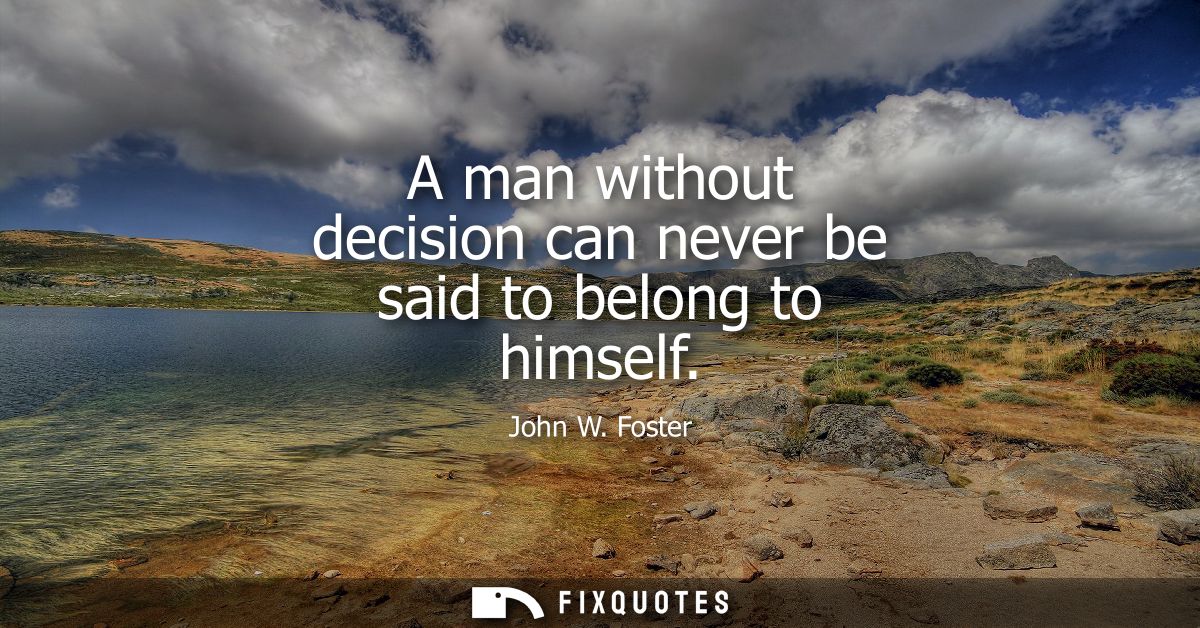
"A man without decision can never be said to belong to himself"
About this Quote
Selfhood, in Foster's view, is less a private possession than a military asset: you earn it by choosing. "A man without decision" isn't merely indecisive; he's tactically compromised. The line works because it flips the usual assumption that identity is something you discover. For Foster, identity is something you command. Without the capacity to decide, a person becomes a territory others can occupy - family pressure, political fashion, institutional orders, even the pull of comfort. "Belong to himself" is the quiet blade here: it implies that inaction isn't neutral, it's a transfer of ownership.
The intent carries the hard pragmatism of a soldier and statesman shaped by 19th-century American expansion, bureaucracy, and war. Foster served in the Union Army, then spent decades in diplomacy at a moment when the United States was learning how power actually functions: not as ideals, but as choices made under constraint. Decision becomes a moral technology, the mechanism by which you keep your agency intact when events, superiors, or enemies would prefer you drift.
There's also an austere masculinity in the phrasing - "a man" as the unit of responsibility, trained to see hesitation as weakness and resolve as virtue. Read now, the sentence feels like a warning about modern life: algorithms, institutions, and endless options don't steal our freedom by force; they do it by inviting us to defer. Foster's subtext is blunt: if you won't decide, someone else will - and you'll call it fate.
The intent carries the hard pragmatism of a soldier and statesman shaped by 19th-century American expansion, bureaucracy, and war. Foster served in the Union Army, then spent decades in diplomacy at a moment when the United States was learning how power actually functions: not as ideals, but as choices made under constraint. Decision becomes a moral technology, the mechanism by which you keep your agency intact when events, superiors, or enemies would prefer you drift.
There's also an austere masculinity in the phrasing - "a man" as the unit of responsibility, trained to see hesitation as weakness and resolve as virtue. Read now, the sentence feels like a warning about modern life: algorithms, institutions, and endless options don't steal our freedom by force; they do it by inviting us to defer. Foster's subtext is blunt: if you won't decide, someone else will - and you'll call it fate.
Quote Details
| Topic | Decision-Making |
|---|---|
| Source | Later attribution: Choice (Raymond Ngaiza, 2022) modern compilationISBN: 9781039145320 · ID: XNZ0EAAAQBAJ
Evidence: ... John W. Foster said , " A man without decision can never be said to belong to himself . " 4 In the same way , a wife who never makes decisions may be said to belong to her husband , and vice versa . Self - assertion may be observed ... Other candidates (1) Essays in a Series of Letters (John W. Foster, 1806)50.0% A man without decision can never be said to belong to himself; (Essay II, "On Decision of Character"; p. 67 in the 18... |
| Cite |
Citation Formats
APA Style (7th ed.)
Foster, John W. (2026, March 12). A man without decision can never be said to belong to himself. FixQuotes. https://fixquotes.com/quotes/a-man-without-decision-can-never-be-said-to-136604/
Chicago Style
Foster, John W. "A man without decision can never be said to belong to himself." FixQuotes. March 12, 2026. https://fixquotes.com/quotes/a-man-without-decision-can-never-be-said-to-136604/.
MLA Style (9th ed.)
"A man without decision can never be said to belong to himself." FixQuotes, 12 Mar. 2026, https://fixquotes.com/quotes/a-man-without-decision-can-never-be-said-to-136604/. Accessed 3 Apr. 2026.
More Quotes by John
Add to List