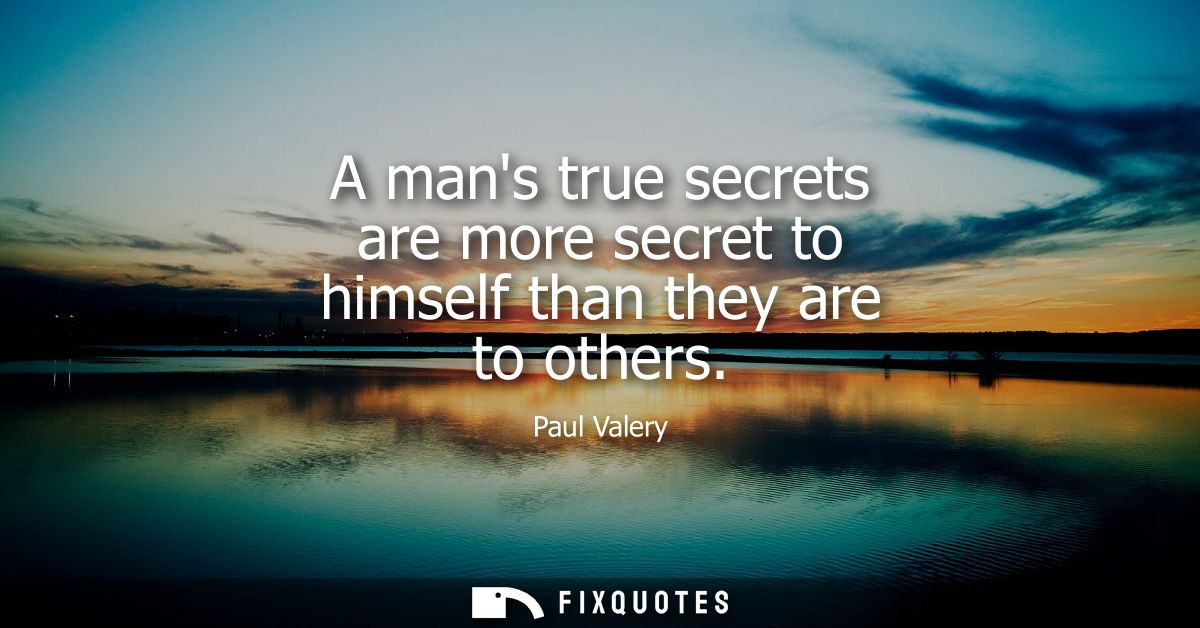
"A man's true secrets are more secret to himself than they are to others"
About this Quote
Valery’s line lands like a polite ambush: the real mystery isn’t what other people don’t know about you, it’s what you can’t quite know about yourself. Coming from a poet who also lived as a rigorous thinker about mind and method, it reads less like a romantic confession than an epistemological jab. We flatter ourselves with the idea of inner transparency - that if we’re hiding something, we at least know what it is. Valery suggests the opposite: the deepest “secrets” aren’t locked in a vault; they’re unformed, pre-verbal, disguised as habits, tastes, and reflexes that feel natural precisely because they evade inspection.
The subtext is a quiet critique of modern self-narration. We build coherent stories about our motives (“I did it for love,” “I’m just not that kind of person”), and those stories function like PR: not only for others, but for the self as audience. Meanwhile, outsiders can sometimes see patterns we can’t - a friend noticing you chase approval, a partner seeing how you pick the same fight with different scripts. Their knowledge isn’t deeper; it’s less invested.
Context matters: Valery wrote in a period obsessed with the hidden life of the psyche, when Freud was turning repression into a cultural keyword. But Valery’s angle is cooler and more skeptical. The “secret” isn’t merely buried; it’s structurally difficult to possess. Consciousness is a spotlight, not a map. The line works because it punctures the comforting myth that self-knowledge is private property. It isn’t withheld; it’s incomplete.
The subtext is a quiet critique of modern self-narration. We build coherent stories about our motives (“I did it for love,” “I’m just not that kind of person”), and those stories function like PR: not only for others, but for the self as audience. Meanwhile, outsiders can sometimes see patterns we can’t - a friend noticing you chase approval, a partner seeing how you pick the same fight with different scripts. Their knowledge isn’t deeper; it’s less invested.
Context matters: Valery wrote in a period obsessed with the hidden life of the psyche, when Freud was turning repression into a cultural keyword. But Valery’s angle is cooler and more skeptical. The “secret” isn’t merely buried; it’s structurally difficult to possess. Consciousness is a spotlight, not a map. The line works because it punctures the comforting myth that self-knowledge is private property. It isn’t withheld; it’s incomplete.
Quote Details
| Topic | Truth |
|---|
More Quotes by Paul
Add to List