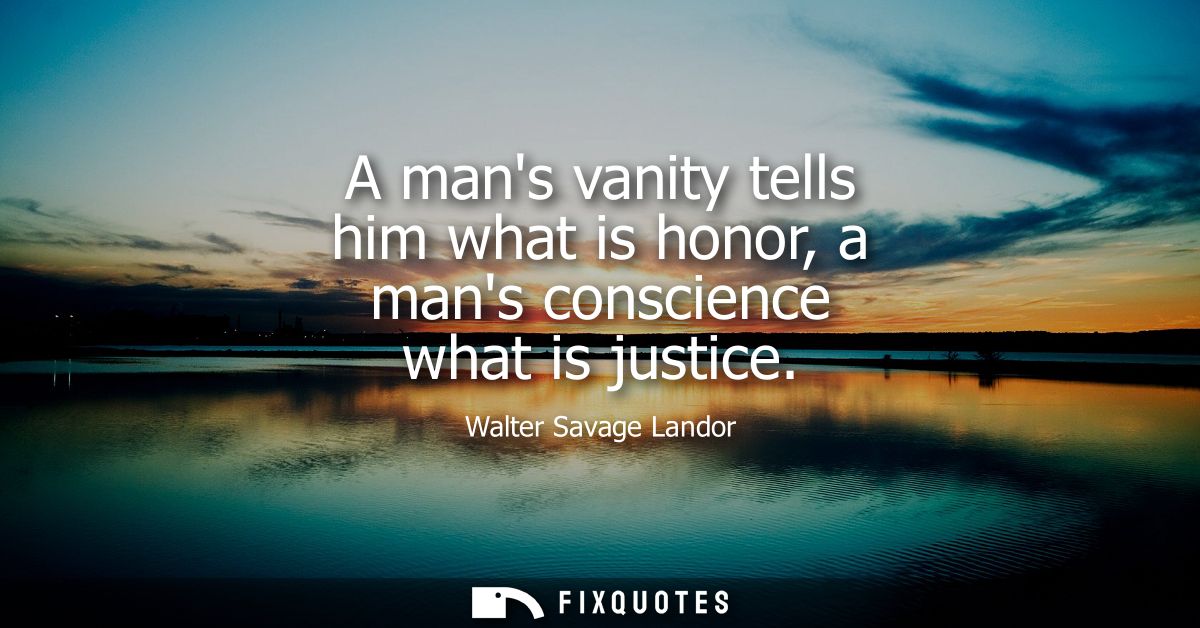
"A man's vanity tells him what is honor, a man's conscience what is justice"
About this Quote
Then he pivots to “conscience” as the source of justice. Justice, in his framing, is harder, quieter, and more dangerous to the self. Conscience doesn’t care how your story plays at the club or in print; it cares whether you can live with your choices when the audience leaves. The subtext is that justice is not primarily a public badge but a private burden - the work of refusing convenient myths about ourselves.
The sentence works because it sounds like a tidy proverb while smuggling in a political critique. Landor wrote in an era of stiff class codes, dueling-era hangovers, and reputational morality: honor could demand violence, silence, or hypocrisy, all to preserve the masculine image. By contrast, conscience-driven justice can require the humiliating act of contradicting your tribe. He’s warning that a culture obsessed with “honor” will confuse optics for ethics - and congratulate itself for it.
Quote Details
| Topic | Ethics & Morality |
|---|---|
| Source | Help us find the source |
| Cite |
Citation Formats
APA Style (7th ed.)
Landor, Walter Savage. (2026, January 16). A man's vanity tells him what is honor, a man's conscience what is justice. FixQuotes. https://fixquotes.com/quotes/a-mans-vanity-tells-him-what-is-honor-a-mans-85030/
Chicago Style
Landor, Walter Savage. "A man's vanity tells him what is honor, a man's conscience what is justice." FixQuotes. January 16, 2026. https://fixquotes.com/quotes/a-mans-vanity-tells-him-what-is-honor-a-mans-85030/.
MLA Style (9th ed.)
"A man's vanity tells him what is honor, a man's conscience what is justice." FixQuotes, 16 Jan. 2026, https://fixquotes.com/quotes/a-mans-vanity-tells-him-what-is-honor-a-mans-85030/. Accessed 4 Feb. 2026.