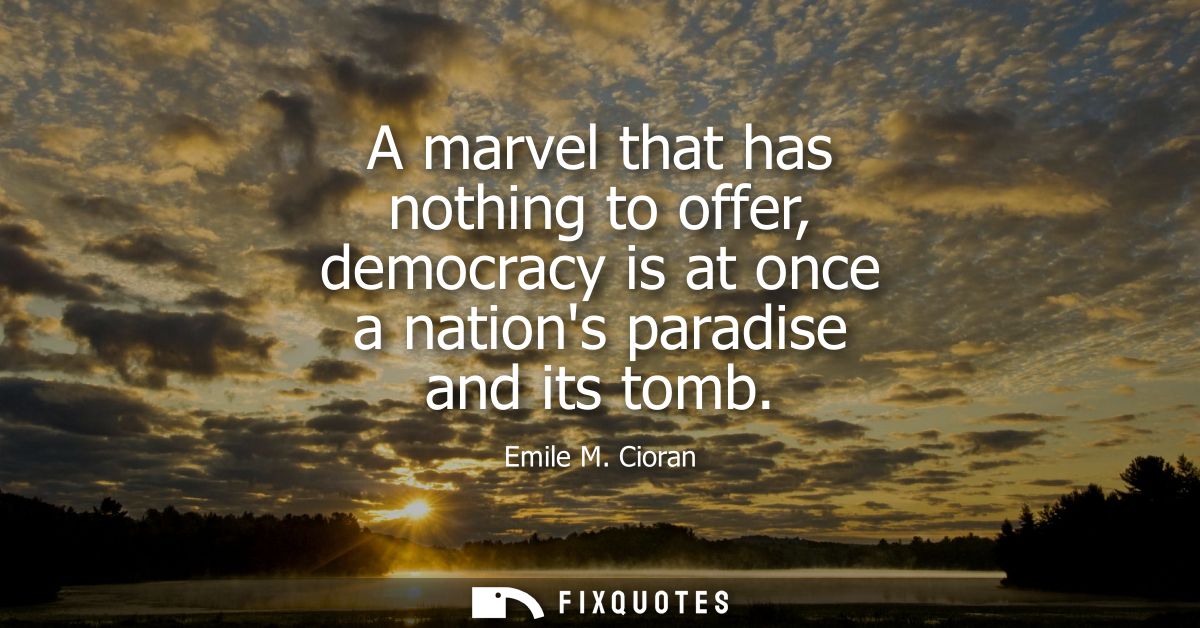
"A marvel that has nothing to offer, Democracy is at once a nation's paradise and its tomb"
About this Quote
“Paradise and tomb” is Cioran at peak negative theology: a political system becomes both the best we can do and the way we decay. Paradise, because democracy lowers the temperature of history. It makes catastrophe less glamorous, tyranny less inevitable, power more reversible. Tomb, because that same cooling can feel like a civilizational anesthesia. When politics turns into administration and compromise becomes virtue, the heroic (and the monstrous) energies that once drove revolutions get domesticated. What dies isn’t just the despot; it’s the appetite for grand narratives.
The context is a 20th century intellectual watching ideologies promise salvation and deliver mass death. Cioran, shaped by interwar Europe and allergic to utopias, distrusts any system that pretends to “offer” destiny. Democracy survives his skepticism because it doesn’t pretend very well. Its strength, in his view, is also its existential insult: it keeps us alive, but it won’t tell us why.
Quote Details
| Topic | Deep |
|---|---|
| Source | Help us find the source |
| Cite |
Citation Formats
APA Style (7th ed.)
Cioran, Emile M. (2026, February 16). A marvel that has nothing to offer, Democracy is at once a nation's paradise and its tomb. FixQuotes. https://fixquotes.com/quotes/a-marvel-that-has-nothing-to-offer-democracy-is-141494/
Chicago Style
Cioran, Emile M. "A marvel that has nothing to offer, Democracy is at once a nation's paradise and its tomb." FixQuotes. February 16, 2026. https://fixquotes.com/quotes/a-marvel-that-has-nothing-to-offer-democracy-is-141494/.
MLA Style (9th ed.)
"A marvel that has nothing to offer, Democracy is at once a nation's paradise and its tomb." FixQuotes, 16 Feb. 2026, https://fixquotes.com/quotes/a-marvel-that-has-nothing-to-offer-democracy-is-141494/. Accessed 14 Mar. 2026.