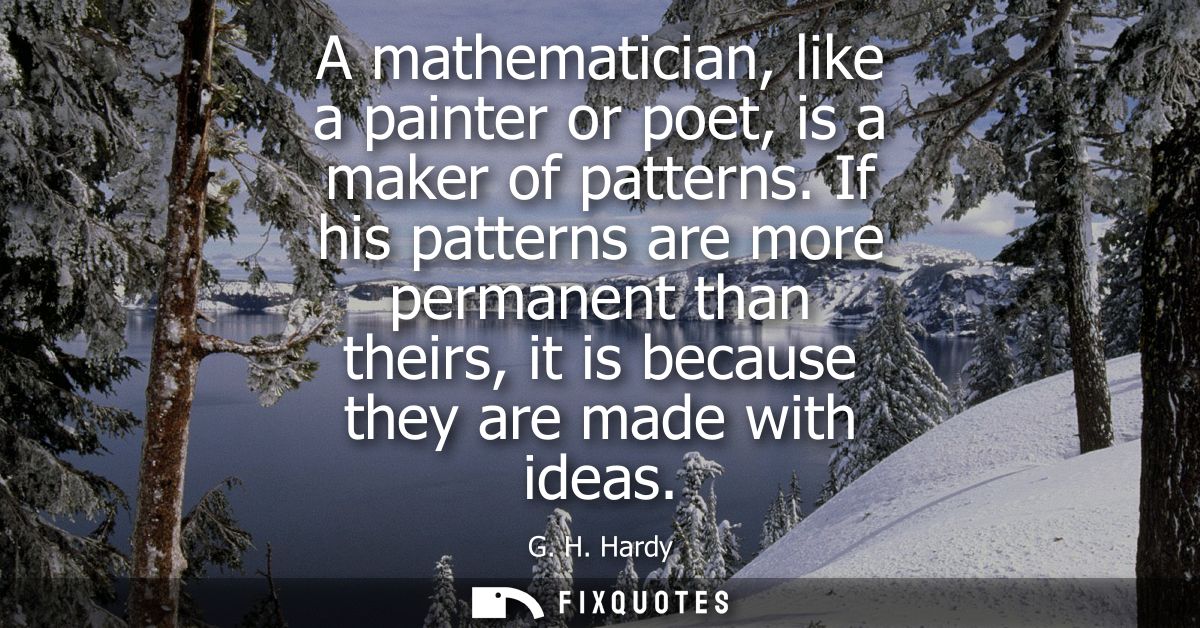
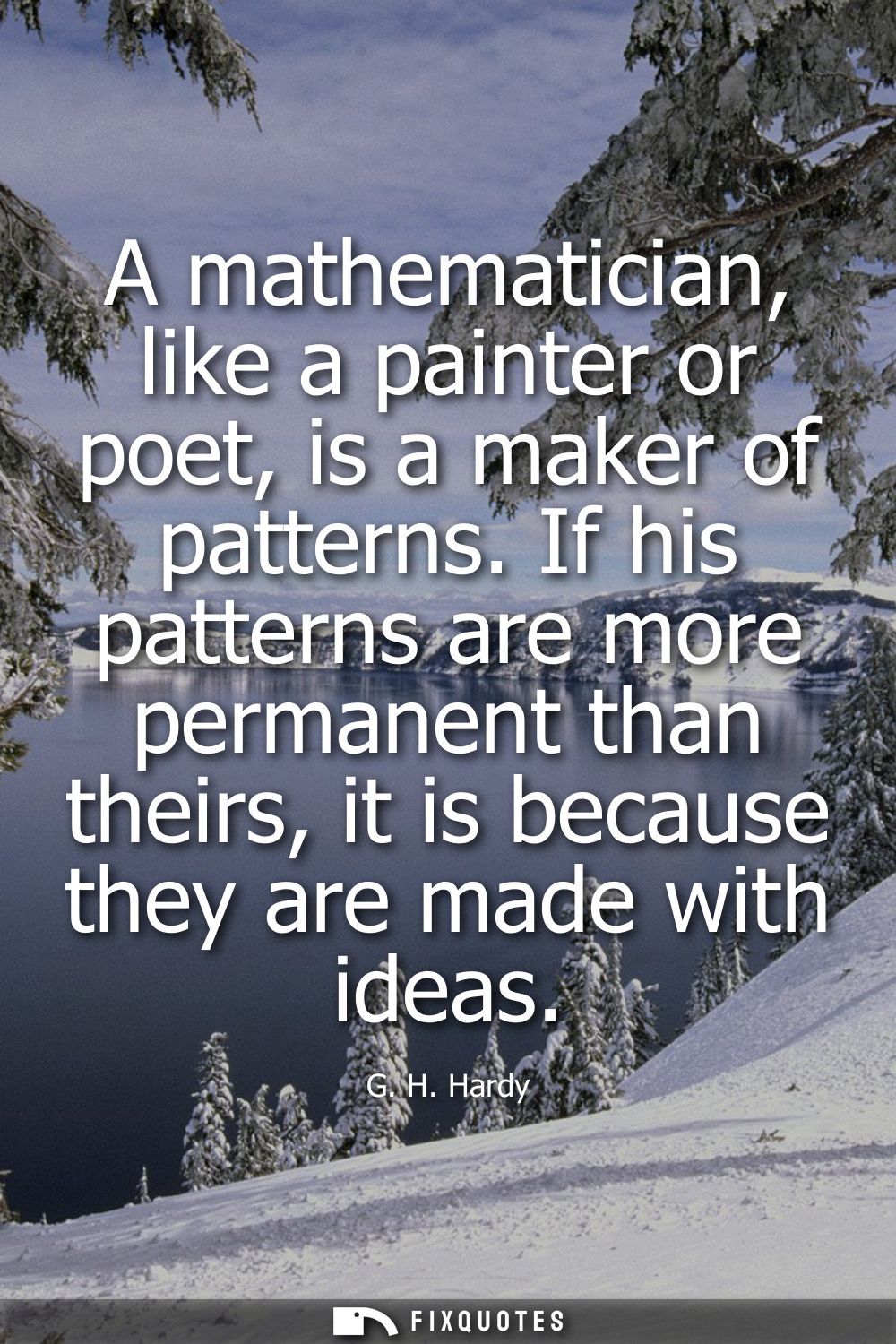
"A mathematician, like a painter or poet, is a maker of patterns. If his patterns are more permanent than theirs, it is because they are made with ideas"
About this Quote
The subtext is also an anxious piece of boundary-drawing. Hardy lived through an era when pure mathematics was increasingly shadowed by modern warfare and industrial application. In A Mathematician’s Apology (where this sentiment belongs), he’s trying to protect a certain kind of intellectual life from being reduced to mere instrumentality. By claiming mathematical patterns are “more permanent,” he’s not just praising abstraction; he’s proposing an ethical escape hatch: ideas can outlast regimes, markets, and the violent uses other people might find for technique.
It’s also a quietly elitist sentence, in Hardy’s characteristic register. Permanence is a value judgment, not a neutral fact. A poem can change meaning across centuries; a theorem, once proved, stays proved. Hardy leverages that stability to suggest a purer kind of immortality - not fame, but inevitability. The seduction is that math becomes art without mess: creation that looks like discovery, personal style that masquerades as timeless truth.
Quote Details
| Topic | Wisdom |
|---|---|
| Source | G. H. Hardy, A Mathematician's Apology (1940) — source of the quoted passage commonly cited from this essay/book. |
| Cite |
Citation Formats
APA Style (7th ed.)
Hardy, G. H. (2026, January 16). A mathematician, like a painter or poet, is a maker of patterns. If his patterns are more permanent than theirs, it is because they are made with ideas. FixQuotes. https://fixquotes.com/quotes/a-mathematician-like-a-painter-or-poet-is-a-maker-111242/
Chicago Style
Hardy, G. H. "A mathematician, like a painter or poet, is a maker of patterns. If his patterns are more permanent than theirs, it is because they are made with ideas." FixQuotes. January 16, 2026. https://fixquotes.com/quotes/a-mathematician-like-a-painter-or-poet-is-a-maker-111242/.
MLA Style (9th ed.)
"A mathematician, like a painter or poet, is a maker of patterns. If his patterns are more permanent than theirs, it is because they are made with ideas." FixQuotes, 16 Jan. 2026, https://fixquotes.com/quotes/a-mathematician-like-a-painter-or-poet-is-a-maker-111242/. Accessed 12 Feb. 2026.