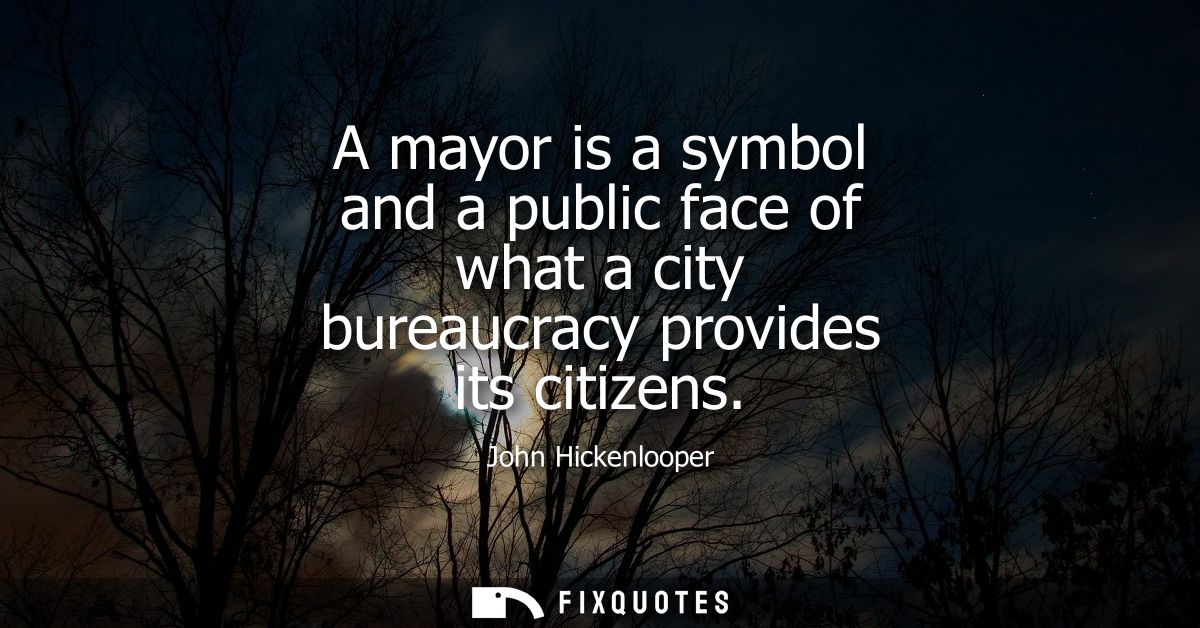
"A mayor is a symbol and a public face of what a city bureaucracy provides its citizens"
About this Quote
The intent is quietly corrective. It pushes back against the heroic-mayor myth - the idea that one charismatic leader can personally will a city into competence. Instead, it sells a managerial theory of democracy: legitimacy flows from service delivery. If the bureaucracy performs, the mayor looks like a leader. If it fails, the mayor wears the failure even when the root cause is a decades-old procurement system or underfunded department.
There's also a subtle warning embedded in the word "symbol". Symbols can be used. Mayors are expected to absorb public anger, soothe anxiety after crises, and translate institutional complexity into a story simple enough to fit a headline. Hickenlooper, a technocratic, problem-solving type, is signaling that modern urban politics is customer service with consequences. Governance becomes less about grand ideology and more about whether the city can keep its basic promises - and whether the mayor can convincingly stand in for that promise.
Quote Details
| Topic | Leadership |
|---|---|
| Source | Help us find the source |
| Cite |
Citation Formats
APA Style (7th ed.)
Hickenlooper, John. (2026, January 15). A mayor is a symbol and a public face of what a city bureaucracy provides its citizens. FixQuotes. https://fixquotes.com/quotes/a-mayor-is-a-symbol-and-a-public-face-of-what-a-151792/
Chicago Style
Hickenlooper, John. "A mayor is a symbol and a public face of what a city bureaucracy provides its citizens." FixQuotes. January 15, 2026. https://fixquotes.com/quotes/a-mayor-is-a-symbol-and-a-public-face-of-what-a-151792/.
MLA Style (9th ed.)
"A mayor is a symbol and a public face of what a city bureaucracy provides its citizens." FixQuotes, 15 Jan. 2026, https://fixquotes.com/quotes/a-mayor-is-a-symbol-and-a-public-face-of-what-a-151792/. Accessed 27 Mar. 2026.