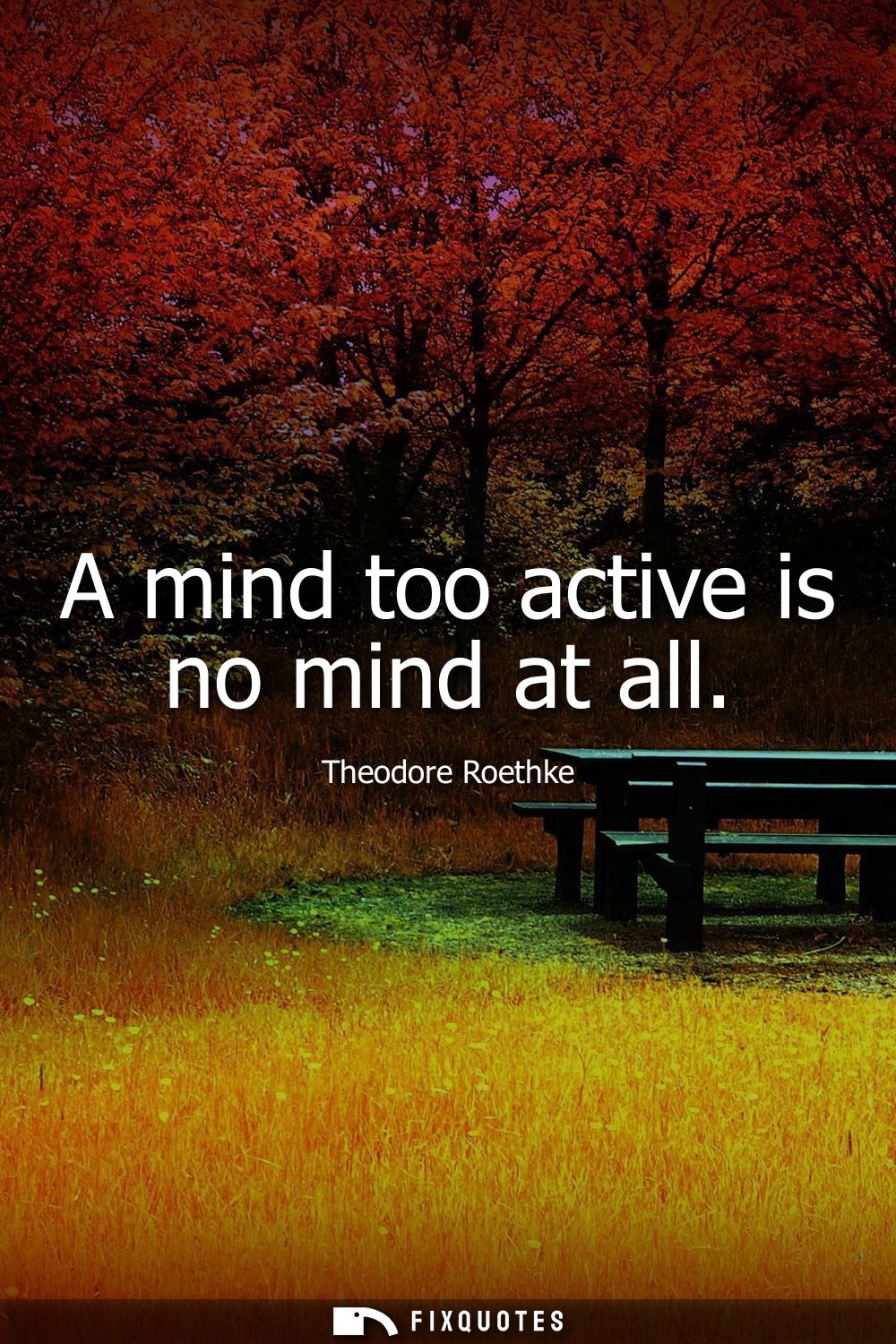
"A mind too active is no mind at all"
About this Quote
Roethke’s line lands like a Zen slap delivered in Midwestern English: the problem isn’t ignorance, it’s mental overproduction. “A mind too active is no mind at all” sounds paradoxical because it is one. It turns the prized American virtue of busyness inward, suggesting that constant cognition can collapse into noise, compulsions, and self-canceling chatter. Activity becomes a kind of vacancy.
The phrasing matters. “Too active” isn’t curiosity or vigor; it’s excess, a mind that can’t stop manufacturing interpretations, worries, plans. Roethke doesn’t say the mind is “distracted” or “unfocused” (terms that let you blame external stimuli). He implies something more intimate: the mind itself can become an engine of its own erasure. When thought is continuous motion, it stops being a tool for perceiving and starts being an obstacle to perception.
Context sharpens the edge. Roethke’s work often circles growth, nature, and interior weather, and his biography includes severe bouts of mental illness. Read through that lens, the line carries lived urgency: the “active” mind as mania, rumination, or the spiraling self that can’t find a quiet surface to reflect anything real. As a poet, he’s also defending a craft premise: art doesn’t come from constant thinking-about, but from attention, stillness, and the courage to let meaning arrive unforced.
The subtext is almost accusatory toward modern life, even before our era of screens: if your inner monologue never shuts up, you don’t have consciousness so much as a crowded room. Roethke offers a bleak comfort: silence isn’t emptiness; it’s the condition for a mind to exist at all.
The phrasing matters. “Too active” isn’t curiosity or vigor; it’s excess, a mind that can’t stop manufacturing interpretations, worries, plans. Roethke doesn’t say the mind is “distracted” or “unfocused” (terms that let you blame external stimuli). He implies something more intimate: the mind itself can become an engine of its own erasure. When thought is continuous motion, it stops being a tool for perceiving and starts being an obstacle to perception.
Context sharpens the edge. Roethke’s work often circles growth, nature, and interior weather, and his biography includes severe bouts of mental illness. Read through that lens, the line carries lived urgency: the “active” mind as mania, rumination, or the spiraling self that can’t find a quiet surface to reflect anything real. As a poet, he’s also defending a craft premise: art doesn’t come from constant thinking-about, but from attention, stillness, and the courage to let meaning arrive unforced.
The subtext is almost accusatory toward modern life, even before our era of screens: if your inner monologue never shuts up, you don’t have consciousness so much as a crowded room. Roethke offers a bleak comfort: silence isn’t emptiness; it’s the condition for a mind to exist at all.
Quote Details
| Topic | Wisdom |
|---|---|
| Source | Help us find the source |
| Cite |
Citation Formats
APA Style (7th ed.)
Roethke, Theodore. (2026, January 15). A mind too active is no mind at all. FixQuotes. https://fixquotes.com/quotes/a-mind-too-active-is-no-mind-at-all-135906/
Chicago Style
Roethke, Theodore. "A mind too active is no mind at all." FixQuotes. January 15, 2026. https://fixquotes.com/quotes/a-mind-too-active-is-no-mind-at-all-135906/.
MLA Style (9th ed.)
"A mind too active is no mind at all." FixQuotes, 15 Jan. 2026, https://fixquotes.com/quotes/a-mind-too-active-is-no-mind-at-all-135906/. Accessed 12 Feb. 2026.
More Quotes by Theodore
Add to List