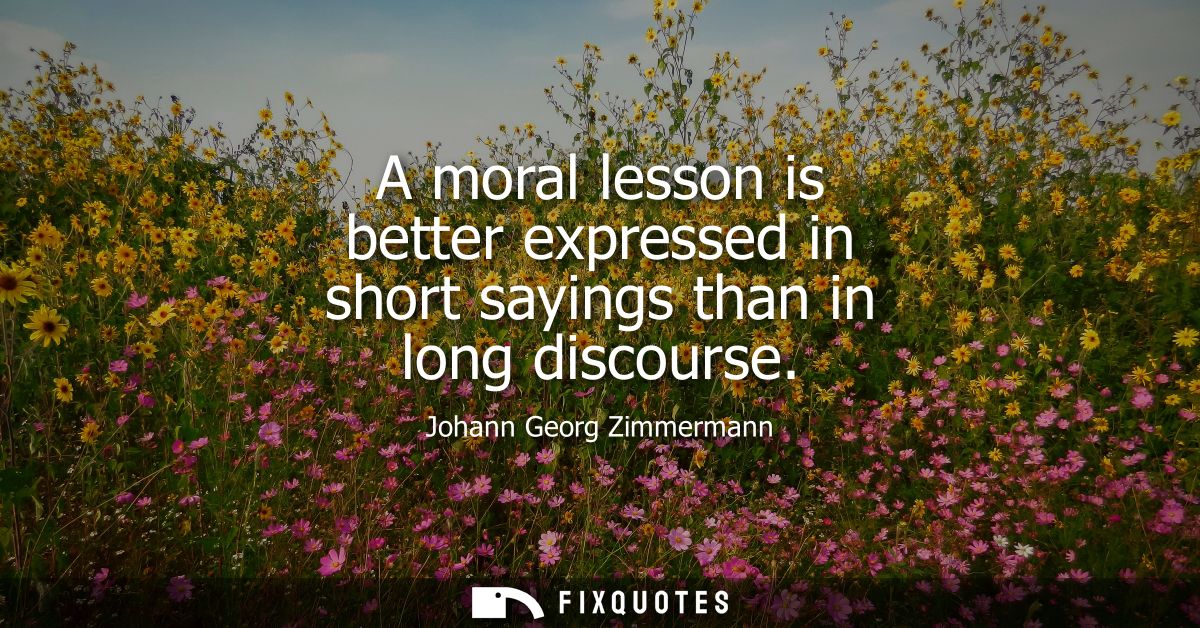
"A moral lesson is better expressed in short sayings than in long discourse"
About this Quote
The intent is practical, almost diagnostic. Short moral sayings work because they respect the listener’s attention and, more importantly, their agency. A maxim doesn’t drag you through an author’s ego; it invites you to complete the thought yourself. That’s the subtext: morality isn’t improved by verbosity. Length can be a way of laundering weak arguments, or of converting instruction into dominance. The longer the discourse, the more room for rationalization, exceptions, and status-signaling. The short saying denies all that. It’s portable, repeatable, and socially enforceable.
There’s also a quiet awareness of how people actually change. Ethical insight rarely arrives via a lecture. It arrives as a phrase you can’t unhear, a line that shows up later in the heat of decision-making. Zimmermann is arguing for moral language that behaves like a tool, not a monument.
Quote Details
| Topic | Wisdom |
|---|---|
| Source | Help us find the source |
| Cite |
Citation Formats
APA Style (7th ed.)
Zimmermann, Johann Georg. (2026, January 15). A moral lesson is better expressed in short sayings than in long discourse. FixQuotes. https://fixquotes.com/quotes/a-moral-lesson-is-better-expressed-in-short-167784/
Chicago Style
Zimmermann, Johann Georg. "A moral lesson is better expressed in short sayings than in long discourse." FixQuotes. January 15, 2026. https://fixquotes.com/quotes/a-moral-lesson-is-better-expressed-in-short-167784/.
MLA Style (9th ed.)
"A moral lesson is better expressed in short sayings than in long discourse." FixQuotes, 15 Jan. 2026, https://fixquotes.com/quotes/a-moral-lesson-is-better-expressed-in-short-167784/. Accessed 3 Apr. 2026.