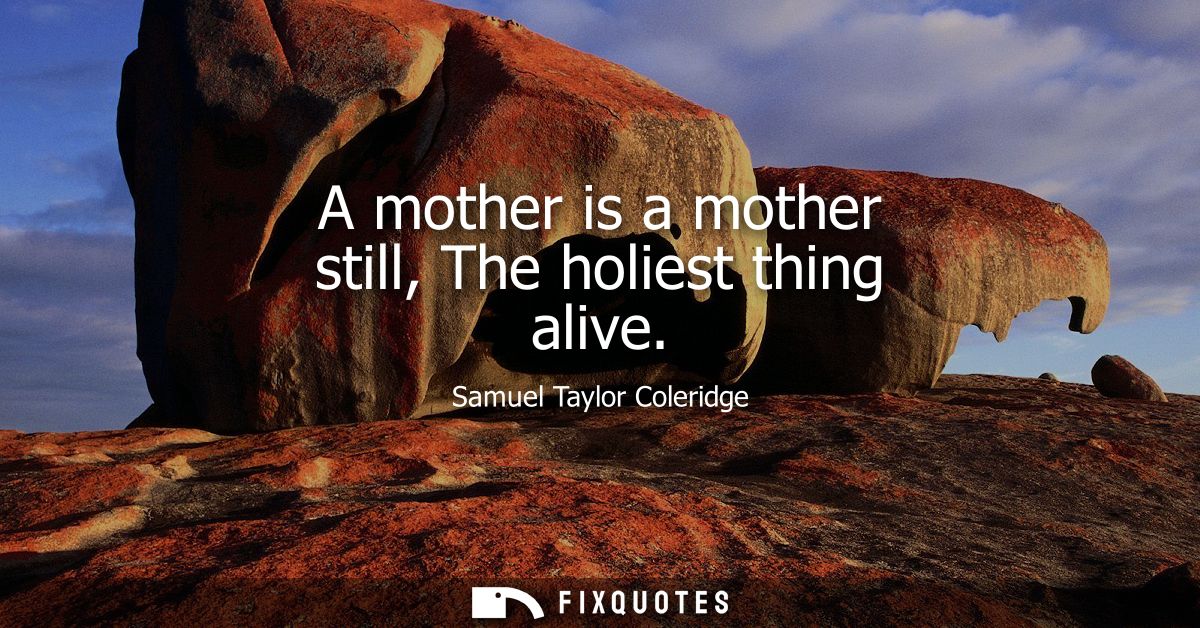
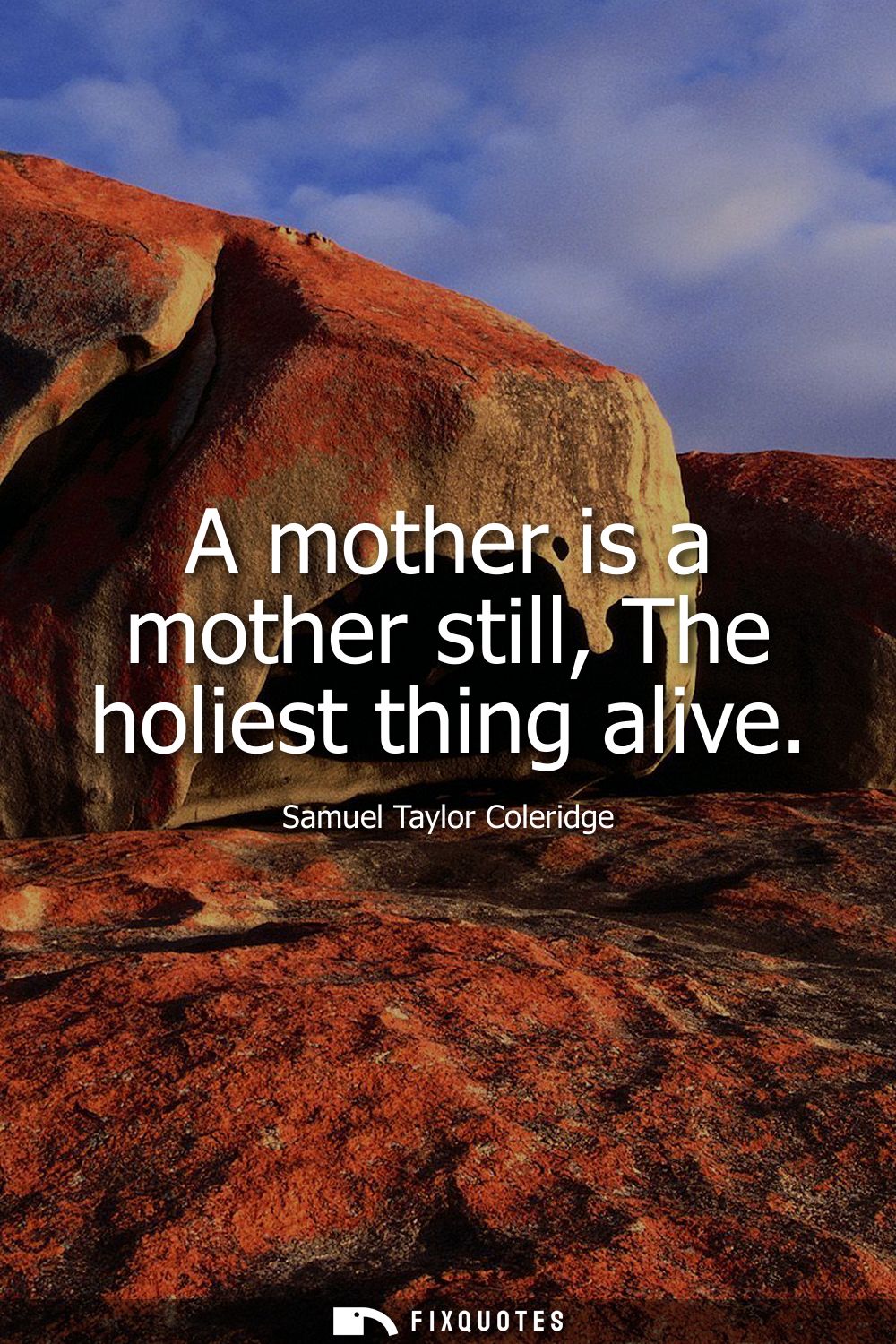
"A mother is a mother still, the holiest thing alive"
About this Quote
Coleridge isn’t praising motherhood as a warm abstraction; he’s consecrating it, turning a domestic role into a moral absolute. “A mother is a mother still” has the bluntness of a proverb: identity here isn’t a mood, a phase, or a social title that can be revoked. It’s durable, almost fated. The insistence matters because it pushes back against the period’s anxieties about “fallen” women, fractured families, and the uneven moral bookkeeping that so often excused men while branding women for life. In that economy, Coleridge draws a line: whatever else happens, the mother remains.
Then comes the dare: “The holiest thing alive.” Not “one of” the holiest, not “among the” most sacred - the holiest. It’s a superlative that elevates motherhood above institutions, above clerical authority, above the officially holy. Coleridge, a poet steeped in Christian language and Romantic reverence, is effectively relocating sanctity from church doctrine to embodied care. Holiness isn’t only in scripture or ceremony; it’s in the labor of keeping someone alive, in intimacy that precedes consent and outlasts approval.
The subtext is political as much as emotional. Romanticism loved to crown the “natural” as a rival to the mechanized, hierarchical modern world. Making the mother the pinnacle of living holiness is a quiet critique of the era’s public values: empire, industry, prestige. Coleridge’s line works because it sounds simple while smuggling in a reordering of what society should worship - not power, but the person who gives and sustains life.
Then comes the dare: “The holiest thing alive.” Not “one of” the holiest, not “among the” most sacred - the holiest. It’s a superlative that elevates motherhood above institutions, above clerical authority, above the officially holy. Coleridge, a poet steeped in Christian language and Romantic reverence, is effectively relocating sanctity from church doctrine to embodied care. Holiness isn’t only in scripture or ceremony; it’s in the labor of keeping someone alive, in intimacy that precedes consent and outlasts approval.
The subtext is political as much as emotional. Romanticism loved to crown the “natural” as a rival to the mechanized, hierarchical modern world. Making the mother the pinnacle of living holiness is a quiet critique of the era’s public values: empire, industry, prestige. Coleridge’s line works because it sounds simple while smuggling in a reordering of what society should worship - not power, but the person who gives and sustains life.
Quote Details
| Topic | Mother |
|---|---|
| Source | Verified source: The Friend (periodical, 1809–1810) (Samuel Taylor Coleridge, 1809)
Evidence: A mother is a mother still, The holiest thing alive.. This line occurs in Coleridge’s poem “The Three Graves” (specifically in the portion often referred to as a “Continuation of The Three Graves”), where it appears as: “Beneath the foulest mother's curse No child could ever thrive: A mother is a mother still, The holiest thing alive.” ([gutenberg.org](https://www.gutenberg.org/ebooks/29091.html.images)) For FIRST publication: editorial/bibliographical notes in Coleridge’s collected poetical works state that “The Three Graves” was included in Coleridge’s periodical The Friend in the autumn of 1809 (Sept.–Nov. 1809). ([gutenberg.org](https://www.gutenberg.org/ebooks/29091.html.images)) A separate critical-heritage source explicitly identifies September 21, 1809 as the publication date in The Friend for the (then-published) portion of “The Three Graves.” ([vdoc.pub](https://vdoc.pub/documents/the-collected-critical-heritage-i-samuel-taylor-coleridge-the-critical-heritage-volume-1-1794-1834-tu17j42ccs00?utm_source=openai)) However: I have not, in the sources retrieved here, a scanned image of the original 1809 issue of The Friend showing this exact line on the page (i.e., I can verify the line in Coleridge’s poetry text, but I cannot provide an exact page number in the 1809 periodical issue itself from the primary artifact). So: primary-work attribution is solid, but the exact ‘issue/page’ in the 1809 printing is not fully verified from a facsimile in this search. Other candidates (1) The poems of Samuel Taylor Coleridge, with a prefatory no... (Samuel Taylor [poetical works] Coleridge, 1884) compilation95.0% Samuel Taylor [poetical works] Coleridge Joseph Skipsey. But when they to the churchyard came , I've heard poor ... A... |
| Cite |
Citation Formats
APA Style (7th ed.)
Coleridge, Samuel Taylor. (2026, February 20). A mother is a mother still, the holiest thing alive. FixQuotes. https://fixquotes.com/quotes/a-mother-is-a-mother-still-the-holiest-thing-alive-97231/
Chicago Style
Coleridge, Samuel Taylor. "A mother is a mother still, the holiest thing alive." FixQuotes. February 20, 2026. https://fixquotes.com/quotes/a-mother-is-a-mother-still-the-holiest-thing-alive-97231/.
MLA Style (9th ed.)
"A mother is a mother still, the holiest thing alive." FixQuotes, 20 Feb. 2026, https://fixquotes.com/quotes/a-mother-is-a-mother-still-the-holiest-thing-alive-97231/. Accessed 14 Mar. 2026.
More Quotes by Samuel
Add to List