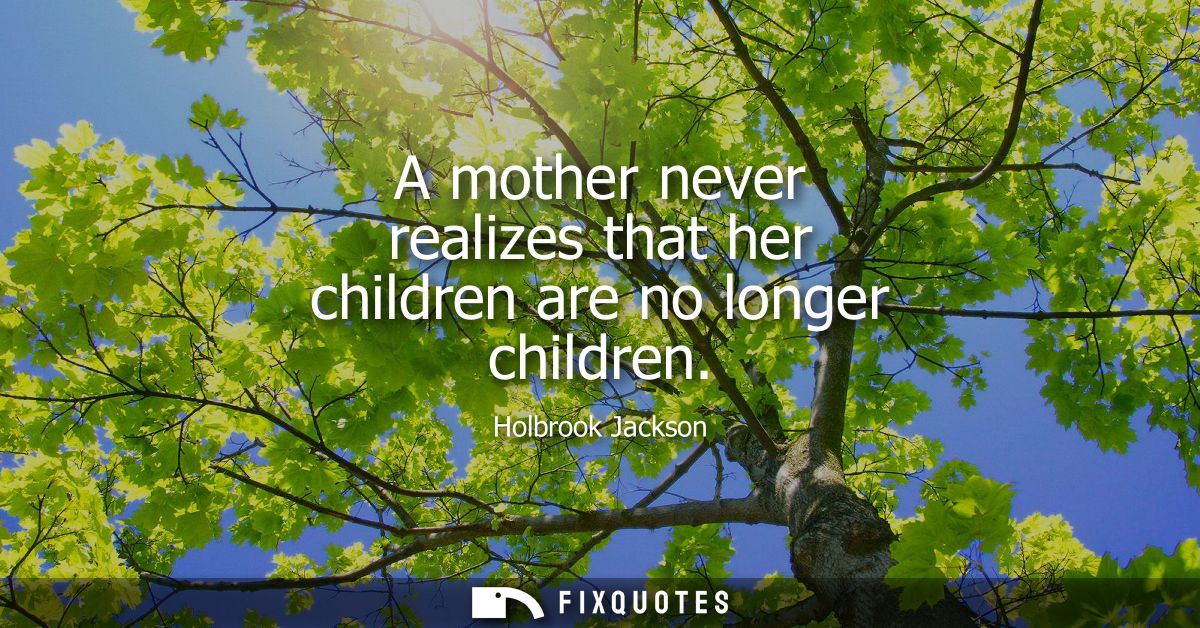
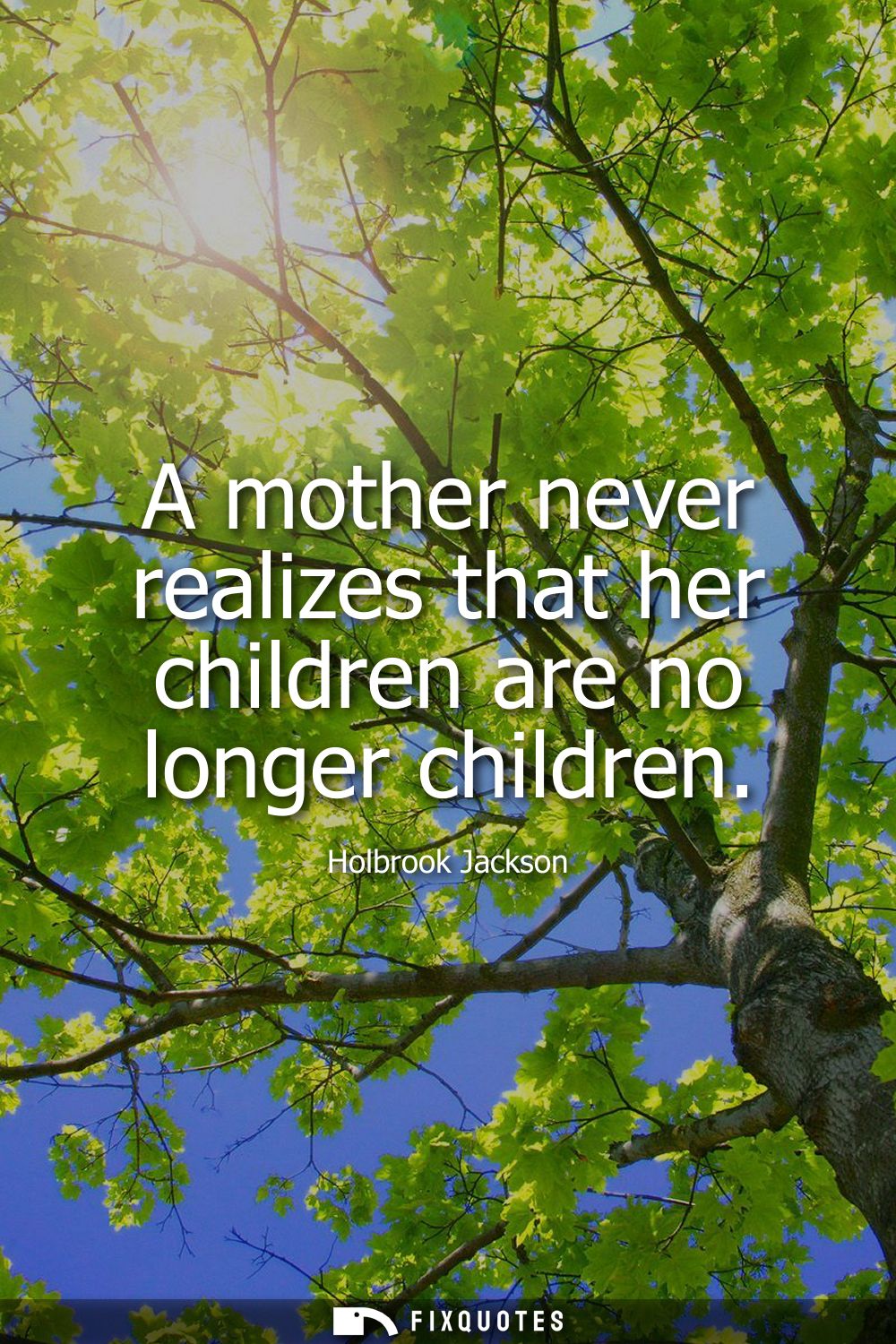
"A mother never realizes that her children are no longer children"
About this Quote
The sting in Holbrook Jackson's line is its quiet accusation: the mother isn’t merely slow to notice change; she’s structurally unable to. Framed as “never,” the claim has the absolutist snap of an aphorism, the kind that pretends to be a fact about human nature while really describing a social role. Motherhood, in Jackson’s formulation, is not an emotion but a lens that locks in place. Once you’ve authored someone’s helplessness, you keep reading them in that original draft.
The subtext is less sentimental than it looks. “Realizes” implies cognition, not affection, and the failure is mental as much as emotional. The child’s adulthood threatens a mother’s lived authority: if they’re no longer “children,” then the rituals of protection, worry, and permission-making start to look like control. Calling the grown person “my child” can be tenderness; it can also be a way of shrinking their autonomy to something manageable.
Jackson wrote in a period when the modern household was being reimagined by mass literacy, psychoanalysis, and changing gender expectations. Domesticity was marketed as a vocation, motherhood as an identity with moral status. This line reads like a cool, almost clinical snapshot of that identity’s side effect: time passes, but the maternal gaze resists narrative closure.
It works because it compresses a whole family argument into a single sentence. Every adult who has been talked down to at 30 hears it; every parent who can’t stop scanning for danger recognizes the compulsion. The tragedy is mutual: the mother loses the child she remembers, and the child keeps fighting to be seen.
The subtext is less sentimental than it looks. “Realizes” implies cognition, not affection, and the failure is mental as much as emotional. The child’s adulthood threatens a mother’s lived authority: if they’re no longer “children,” then the rituals of protection, worry, and permission-making start to look like control. Calling the grown person “my child” can be tenderness; it can also be a way of shrinking their autonomy to something manageable.
Jackson wrote in a period when the modern household was being reimagined by mass literacy, psychoanalysis, and changing gender expectations. Domesticity was marketed as a vocation, motherhood as an identity with moral status. This line reads like a cool, almost clinical snapshot of that identity’s side effect: time passes, but the maternal gaze resists narrative closure.
It works because it compresses a whole family argument into a single sentence. Every adult who has been talked down to at 30 hears it; every parent who can’t stop scanning for danger recognizes the compulsion. The tragedy is mutual: the mother loses the child she remembers, and the child keeps fighting to be seen.
Quote Details
| Topic | Mother |
|---|---|
| Source | Help us find the source |
| Cite |
Citation Formats
APA Style (7th ed.)
Jackson, Holbrook. (2026, January 17). A mother never realizes that her children are no longer children. FixQuotes. https://fixquotes.com/quotes/a-mother-never-realizes-that-her-children-are-no-53378/
Chicago Style
Jackson, Holbrook. "A mother never realizes that her children are no longer children." FixQuotes. January 17, 2026. https://fixquotes.com/quotes/a-mother-never-realizes-that-her-children-are-no-53378/.
MLA Style (9th ed.)
"A mother never realizes that her children are no longer children." FixQuotes, 17 Jan. 2026, https://fixquotes.com/quotes/a-mother-never-realizes-that-her-children-are-no-53378/. Accessed 6 Apr. 2026.
More Quotes by Holbrook
Add to List