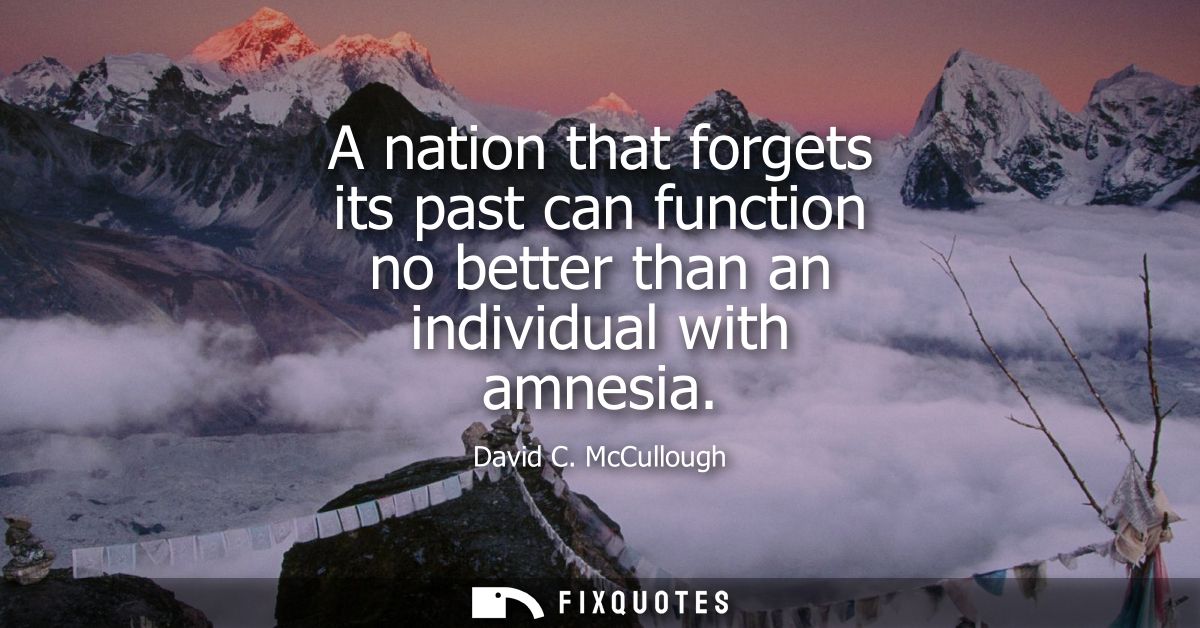
"A nation that forgets its past can function no better than an individual with amnesia"
About this Quote
The intent is corrective, aimed at a civic culture that treats history as optional enrichment rather than operational knowledge. McCullough spent a career writing popular narrative history that made institutions and turning points legible to general readers; the subtext is a rebuke to the idea that democracy runs on vibes. Forgetting, in his framing, isn’t neutral. It invites repetition: the same demagogic tricks, the same scapegoating cycles, the same short-term fixes sold as bold new visions.
The line also carries a quiet accusation against a consumerist approach to citizenship. An amnesiac is easy to manipulate because they lack context; a nation with weak historical literacy becomes susceptible to myth, nostalgia, and strategically edited “heritage.” McCullough’s rhetorical move is to make historical knowledge feel less like trivia and more like self-preservation. It’s not that the past deserves reverence; it’s that the future requires recall.
Quote Details
| Topic | Legacy & Remembrance |
|---|---|
| Source | Help us find the source |
| Cite |
Citation Formats
APA Style (7th ed.)
McCullough, David C. (2026, January 15). A nation that forgets its past can function no better than an individual with amnesia. FixQuotes. https://fixquotes.com/quotes/a-nation-that-forgets-its-past-can-function-no-130064/
Chicago Style
McCullough, David C. "A nation that forgets its past can function no better than an individual with amnesia." FixQuotes. January 15, 2026. https://fixquotes.com/quotes/a-nation-that-forgets-its-past-can-function-no-130064/.
MLA Style (9th ed.)
"A nation that forgets its past can function no better than an individual with amnesia." FixQuotes, 15 Jan. 2026, https://fixquotes.com/quotes/a-nation-that-forgets-its-past-can-function-no-130064/. Accessed 7 Mar. 2026.