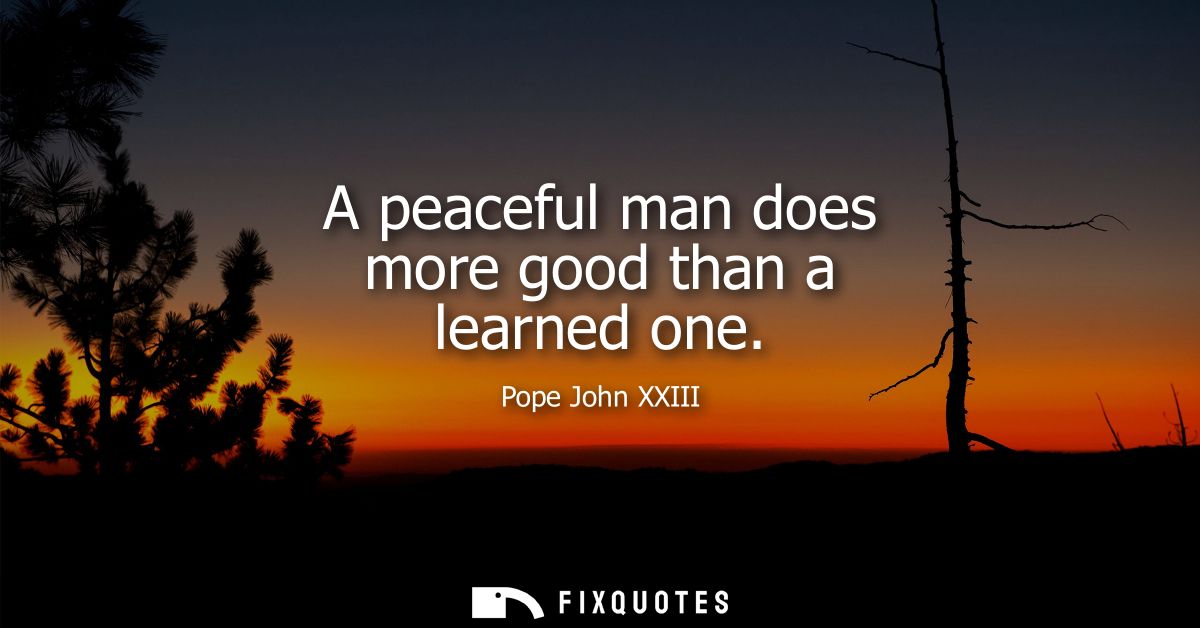
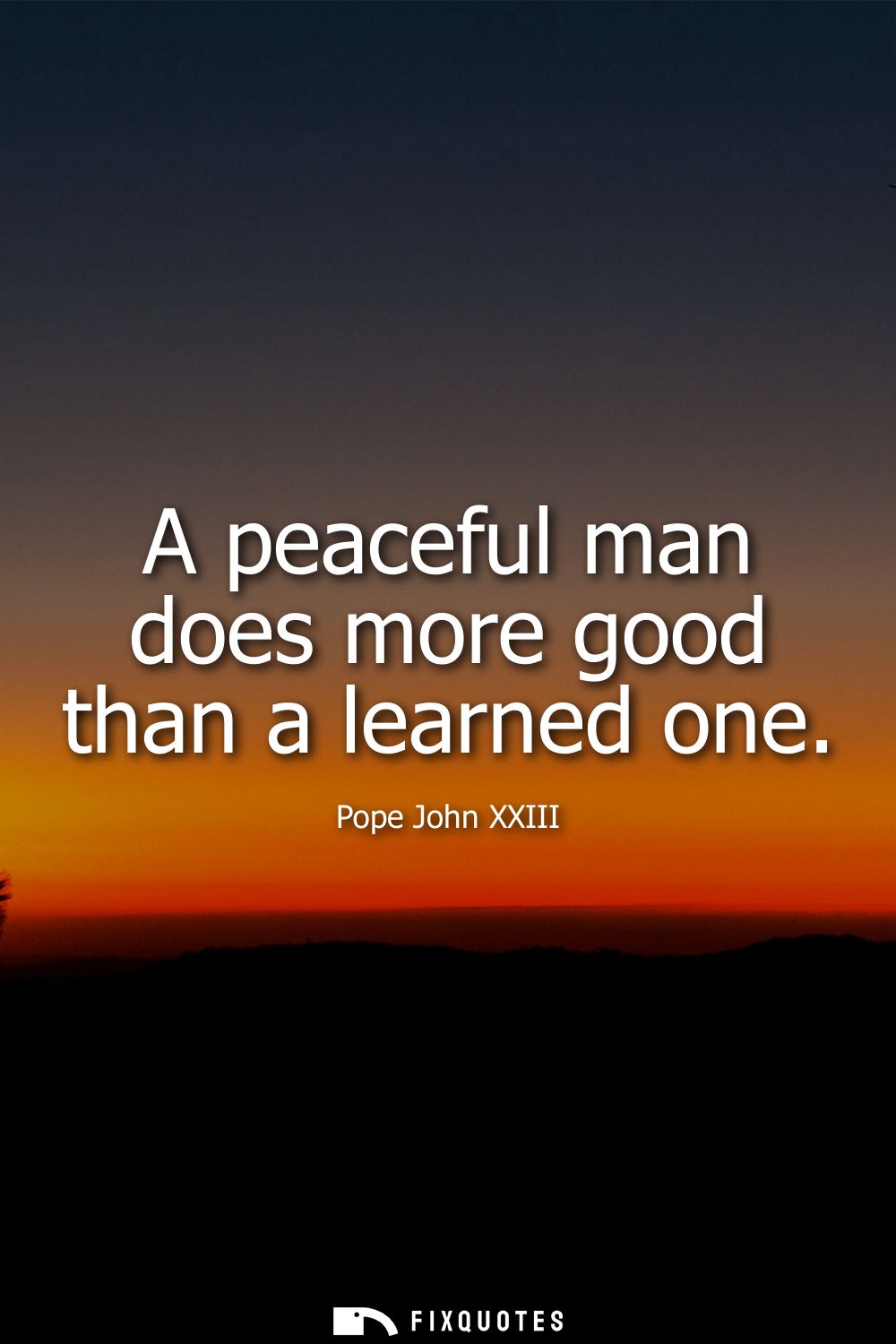
"A peaceful man does more good than a learned one"
About this Quote
Pope John XXIII is quietly demoting the intellect, not to insult learning, but to strip it of its moral alibi. “A peaceful man does more good than a learned one” lands like a pastoral rebuke to the kind of brilliance that can argue any side, win any room, and still leave human beings scorched. The line’s power is its reversal of prestige: in a culture (and a Church) that often crowns the educated, John XXIII elevates temperament and practice over credentials. Peace, here, isn’t a soft personality trait; it’s a disciplined stance that prevents harm before it needs to be repaired.
The subtext is distinctly mid-20th century Catholic: after two world wars, ideologies dressed up as “systems,” and the looming Cold War, expertise had proved capable of building both cathedrals and weapons. John XXIII, best known for convening Vatican II and for the peace-oriented encyclical Pacem in Terris, speaks from an era when “learned” could mean technocratic confidence, doctrinal rigidity, or intellectual vanity. All can become forms of violence when they justify contempt.
The phrasing is simple on purpose. It doesn’t ask you to parse a theory of virtue; it asks you to notice outcomes. The “peaceful man” does good because he’s harder to recruit into ego battles, factional feuds, and righteous crusades. Learning can illuminate, but peace builds the conditions where illumination actually helps rather than humiliates. In that sense, the quote is less anti-intellectual than anti-self-importance: sanctity measured not by what you know, but by what you refuse to escalate.
The subtext is distinctly mid-20th century Catholic: after two world wars, ideologies dressed up as “systems,” and the looming Cold War, expertise had proved capable of building both cathedrals and weapons. John XXIII, best known for convening Vatican II and for the peace-oriented encyclical Pacem in Terris, speaks from an era when “learned” could mean technocratic confidence, doctrinal rigidity, or intellectual vanity. All can become forms of violence when they justify contempt.
The phrasing is simple on purpose. It doesn’t ask you to parse a theory of virtue; it asks you to notice outcomes. The “peaceful man” does good because he’s harder to recruit into ego battles, factional feuds, and righteous crusades. Learning can illuminate, but peace builds the conditions where illumination actually helps rather than humiliates. In that sense, the quote is less anti-intellectual than anti-self-importance: sanctity measured not by what you know, but by what you refuse to escalate.
Quote Details
| Topic | Peace |
|---|---|
| Source | Help us find the source |
| Cite |
Citation Formats
APA Style (7th ed.)
XXIII, Pope John. (2026, January 17). A peaceful man does more good than a learned one. FixQuotes. https://fixquotes.com/quotes/a-peaceful-man-does-more-good-than-a-learned-one-70853/
Chicago Style
XXIII, Pope John. "A peaceful man does more good than a learned one." FixQuotes. January 17, 2026. https://fixquotes.com/quotes/a-peaceful-man-does-more-good-than-a-learned-one-70853/.
MLA Style (9th ed.)
"A peaceful man does more good than a learned one." FixQuotes, 17 Jan. 2026, https://fixquotes.com/quotes/a-peaceful-man-does-more-good-than-a-learned-one-70853/. Accessed 11 Mar. 2026.
More Quotes by Pope
Add to List