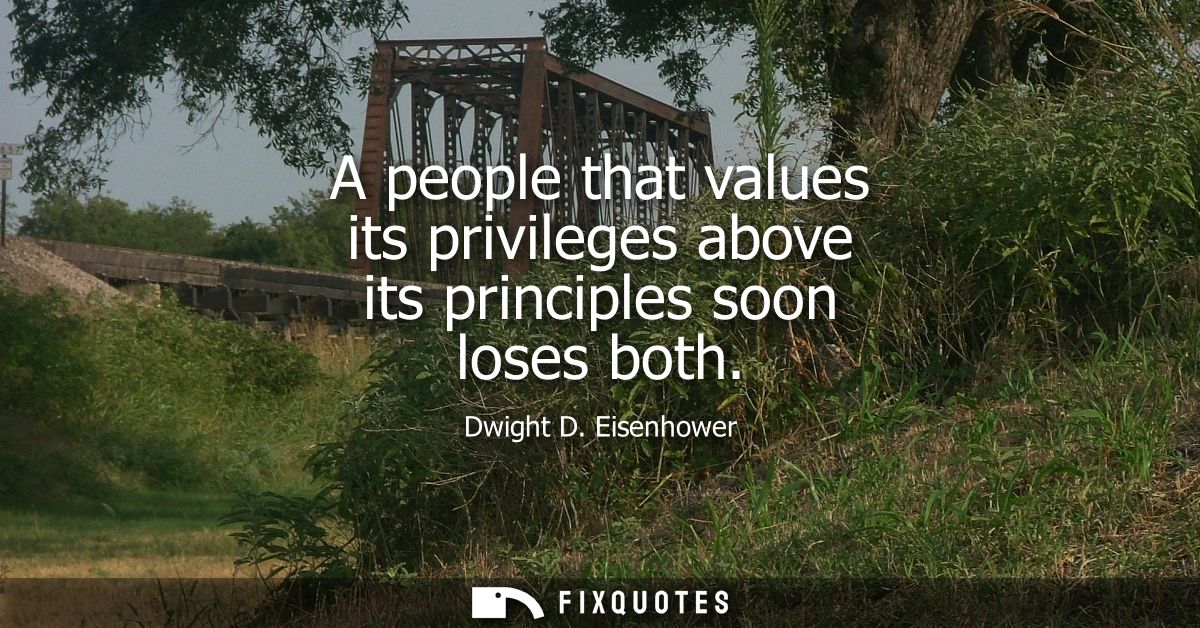
"A people that values its privileges above its principles soon loses both"
About this Quote
The subtext carries the voice of a career coalition-builder who watched democracies wobble under stress. Coming out of World War II and into the Cold War, the United States was flush with power and tempted by shortcuts: loyalty tests, fear politics, secrecy, and the rationalization that civil liberties are luxuries best postponed. Eisenhower doesn’t need to name a villain; he points to a habit. People don’t usually renounce principles with a grand speech. They do it piecemeal, choosing immediate advantage over inconvenient consistency.
Rhetorically, the sentence is engineered to stick. The mirrored nouns (“privileges” / “principles”) and the tight little trapdoor of “soon loses both” create a moral physics: prioritize comfort over conscience and you don’t just become hypocritical - you become vulnerable. It’s patriotism without incense, a president insisting that the real national security asset is integrity, not entitlement.
Quote Details
| Topic | Ethics & Morality |
|---|---|
| Source | Verified source: First Inaugural Address (Dwight D. Eisenhower, 1953)
Evidence:
We must be willing, individually and as a Nation, to accept whatever sacrifices may be required of us. A people that values its privileges above its principles soon loses both.. This line appears in Dwight D. Eisenhower’s First Inaugural Address, delivered in Washington, D.C. on January 20, 1953. The page linked is a primary-text transcription hosted by Yale Law School’s Avalon Project. The Eisenhower Presidential Library also attributes the quote to the Inaugural Address dated 1/20/53, and the National Park Service reproduces the same passage as part of its Eisenhower Memorial inscriptions/context. ([avalon.law.yale.edu](https://avalon.law.yale.edu/20th_century/eisen1.asp?utm_source=openai)) |
| Cite |
Citation Formats
APA Style (7th ed.)
Eisenhower, Dwight D. (2026, February 9). A people that values its privileges above its principles soon loses both. FixQuotes. https://fixquotes.com/quotes/a-people-that-values-its-privileges-above-its-30912/
Chicago Style
Eisenhower, Dwight D. "A people that values its privileges above its principles soon loses both." FixQuotes. February 9, 2026. https://fixquotes.com/quotes/a-people-that-values-its-privileges-above-its-30912/.
MLA Style (9th ed.)
"A people that values its privileges above its principles soon loses both." FixQuotes, 9 Feb. 2026, https://fixquotes.com/quotes/a-people-that-values-its-privileges-above-its-30912/. Accessed 20 Mar. 2026.