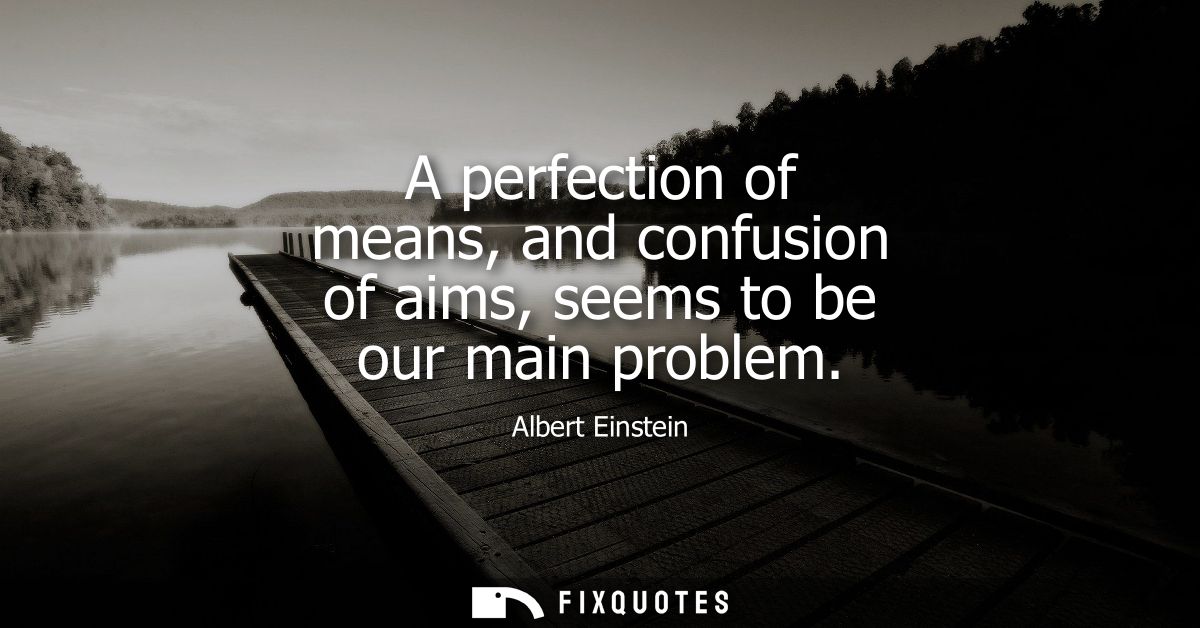
"A perfection of means, and confusion of aims, seems to be our main problem"
About this Quote
The sentence works because it frames a cultural pathology as an engineering mismatch. Means and ends are supposed to lock together cleanly; here they’re decoupled. That’s a quietly devastating way to talk about the 20th century, an era that gave Einstein both the triumphs of theoretical clarity and the spectacle of applied science conscripted into total war. He doesn’t need to mention bombs, bureaucracies, or propaganda. The syntax does that work: “seems” feigns modesty while smuggling in an indictment, and “our main problem” universalizes responsibility without flattening it into a generic scold.
Subtext: modernity isn’t failing because it can’t build; it’s failing because it can’t choose. When tools become the measure of value, “can we?” replaces “should we?” Einstein’s warning reads less like nostalgia than like a demand for ethical calibration: upgrade the aims with the same rigor we lavish on the means.
Quote Details
| Topic | Vision & Strategy |
|---|---|
| Source | Help us find the source |
| Cite |
Citation Formats
APA Style (7th ed.)
Einstein, Albert. (2026, January 15). A perfection of means, and confusion of aims, seems to be our main problem. FixQuotes. https://fixquotes.com/quotes/a-perfection-of-means-and-confusion-of-aims-seems-13624/
Chicago Style
Einstein, Albert. "A perfection of means, and confusion of aims, seems to be our main problem." FixQuotes. January 15, 2026. https://fixquotes.com/quotes/a-perfection-of-means-and-confusion-of-aims-seems-13624/.
MLA Style (9th ed.)
"A perfection of means, and confusion of aims, seems to be our main problem." FixQuotes, 15 Jan. 2026, https://fixquotes.com/quotes/a-perfection-of-means-and-confusion-of-aims-seems-13624/. Accessed 24 Mar. 2026.