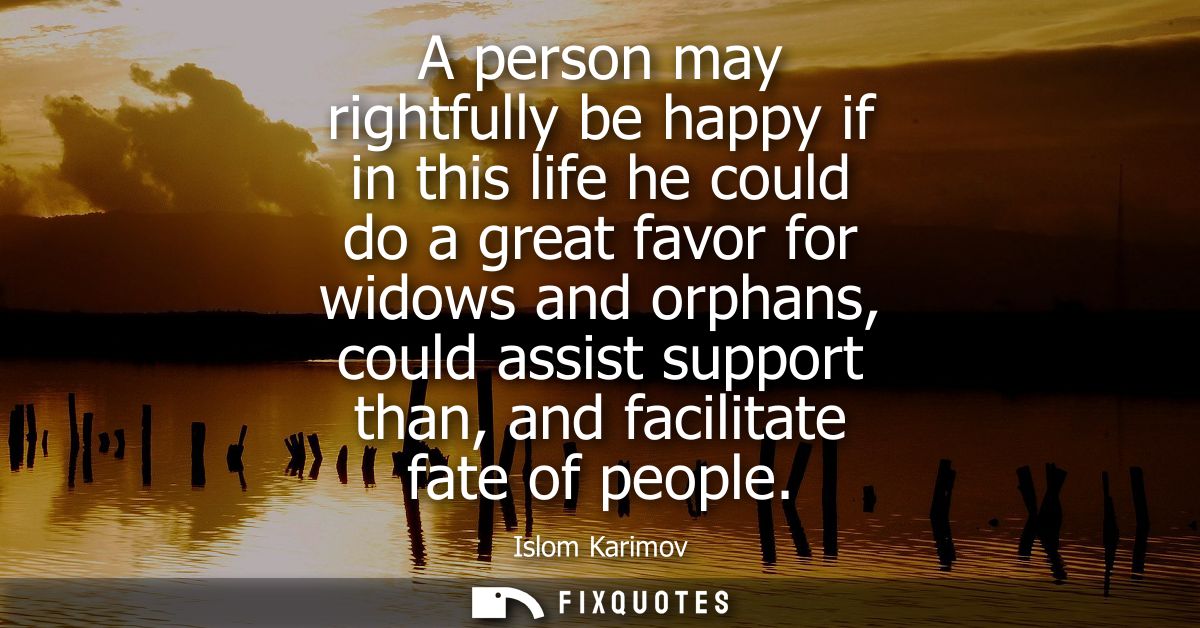
"A person may rightfully be happy if, in this life, he could do a great favor for widows and orphans, could assist support than, and facilitate fate of people"
About this Quote
The phrasing carries a quiet moral audit. You can be happy if you have “done” a “great favor,” if you have “assisted” and “supported,” if you have “facilitated” people’s fate. The ladder of verbs turns compassion into measurable output, almost bureaucratic: help as a ledger item. That’s not accidental from a statesman. It implies a political ethic in which legitimacy comes from delivering security and welfare, and where personal fulfillment is folded into national duty.
The subtext is also self-justifying. Leaders often invoke widows and orphans to sanctify power: who could oppose a system that claims to protect the defenseless? The quote suggests a worldview where the state (and those who run it) are the indispensable intermediaries between citizens and “fate.” Even happiness is permissioned, contingent on aligning your life with the regime’s preferred moral narrative: stability, caretaking, social order.
Quote Details
| Topic | Kindness |
|---|---|
| Source | Help us find the source |
| Cite |
Citation Formats
APA Style (7th ed.)
Karimov, Islom. (2026, February 19). A person may rightfully be happy if, in this life, he could do a great favor for widows and orphans, could assist support than, and facilitate fate of people. FixQuotes. https://fixquotes.com/quotes/a-person-may-rightfully-be-happy-if-in-this-life-56291/
Chicago Style
Karimov, Islom. "A person may rightfully be happy if, in this life, he could do a great favor for widows and orphans, could assist support than, and facilitate fate of people." FixQuotes. February 19, 2026. https://fixquotes.com/quotes/a-person-may-rightfully-be-happy-if-in-this-life-56291/.
MLA Style (9th ed.)
"A person may rightfully be happy if, in this life, he could do a great favor for widows and orphans, could assist support than, and facilitate fate of people." FixQuotes, 19 Feb. 2026, https://fixquotes.com/quotes/a-person-may-rightfully-be-happy-if-in-this-life-56291/. Accessed 30 Mar. 2026.