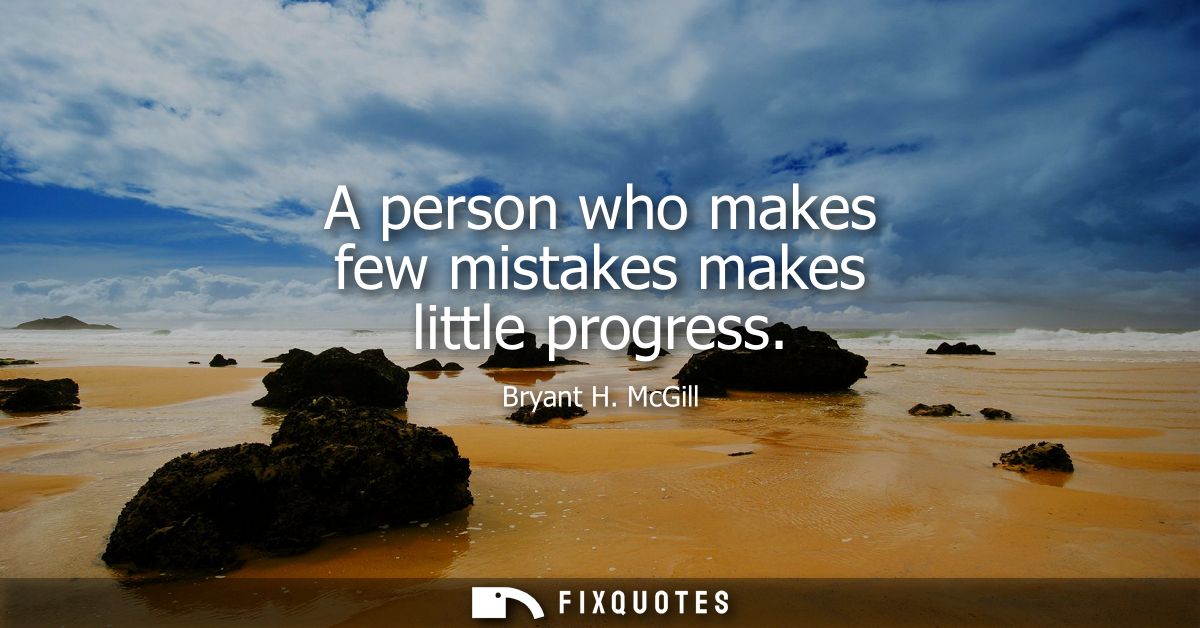
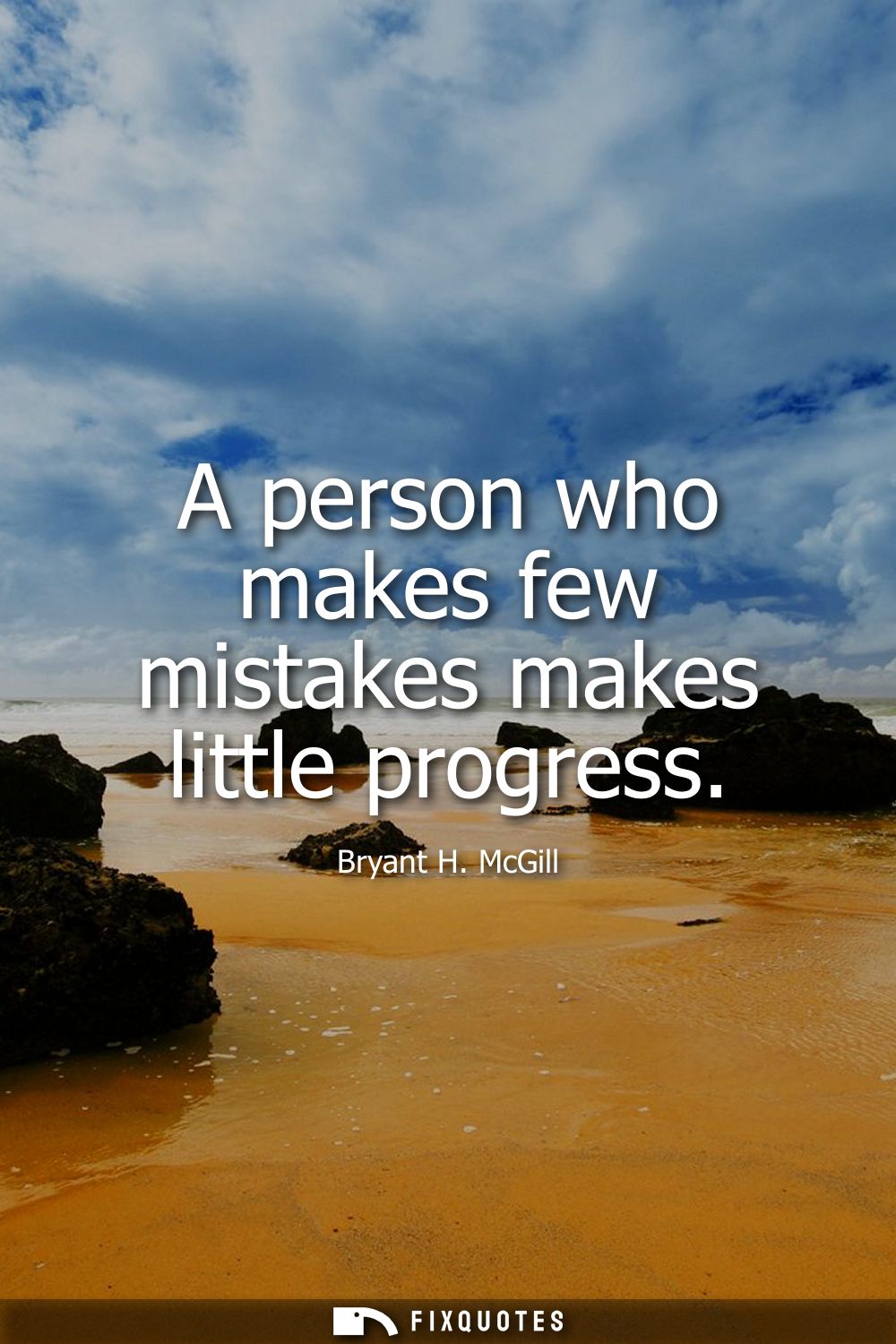
"A person who makes few mistakes makes little progress"
About this Quote
Perfection is being dragged here not as a virtue but as a cover story. McGill's line flips the usual moral math: mistakes aren’t proof of incompetence, they’re proof of participation. The blunt parallel structure makes it feel like a law of physics rather than a pep talk - fewer errors, less forward motion. It’s a clean rhetorical trap: if you pride yourself on being mistake-free, you’re also admitting you haven’t been testing yourself where it counts.
The intent is motivational, but the subtext is a quiet critique of risk-avoidant identity. In modern professional culture, “high performer” often translates to “low variance”: don’t miss, don’t fail publicly, don’t create chaos. McGill suggests that’s not mastery; it’s maintenance. Progress requires contact with the unknown, and the unknown produces scuffs. The quote dignifies those scuffs as evidence of learning velocity.
Context matters because McGill writes in the self-development tradition, where aphorisms are designed to be portable - something you can tape to a monitor or repeat before a hard conversation. Portability forces simplification, so the line compresses a whole learning theory argument into two clauses: experimentation increases error rate; experimentation also increases growth rate. It’s an implicit permission slip for iteration in a culture that often demands polished outcomes on the first try.
It also subtly recalibrates shame. “Mistake” stops being a moral failing and becomes a data point, a receipt for trying.
The intent is motivational, but the subtext is a quiet critique of risk-avoidant identity. In modern professional culture, “high performer” often translates to “low variance”: don’t miss, don’t fail publicly, don’t create chaos. McGill suggests that’s not mastery; it’s maintenance. Progress requires contact with the unknown, and the unknown produces scuffs. The quote dignifies those scuffs as evidence of learning velocity.
Context matters because McGill writes in the self-development tradition, where aphorisms are designed to be portable - something you can tape to a monitor or repeat before a hard conversation. Portability forces simplification, so the line compresses a whole learning theory argument into two clauses: experimentation increases error rate; experimentation also increases growth rate. It’s an implicit permission slip for iteration in a culture that often demands polished outcomes on the first try.
It also subtly recalibrates shame. “Mistake” stops being a moral failing and becomes a data point, a receipt for trying.
Quote Details
| Topic | Learning from Mistakes |
|---|---|
| Source | Help us find the source |
| Cite |
Citation Formats
APA Style (7th ed.)
McGill, Bryant H. (2026, January 17). A person who makes few mistakes makes little progress. FixQuotes. https://fixquotes.com/quotes/a-person-who-makes-few-mistakes-makes-little-38880/
Chicago Style
McGill, Bryant H. "A person who makes few mistakes makes little progress." FixQuotes. January 17, 2026. https://fixquotes.com/quotes/a-person-who-makes-few-mistakes-makes-little-38880/.
MLA Style (9th ed.)
"A person who makes few mistakes makes little progress." FixQuotes, 17 Jan. 2026, https://fixquotes.com/quotes/a-person-who-makes-few-mistakes-makes-little-38880/. Accessed 3 Apr. 2026.
More Quotes by Bryant
Add to List