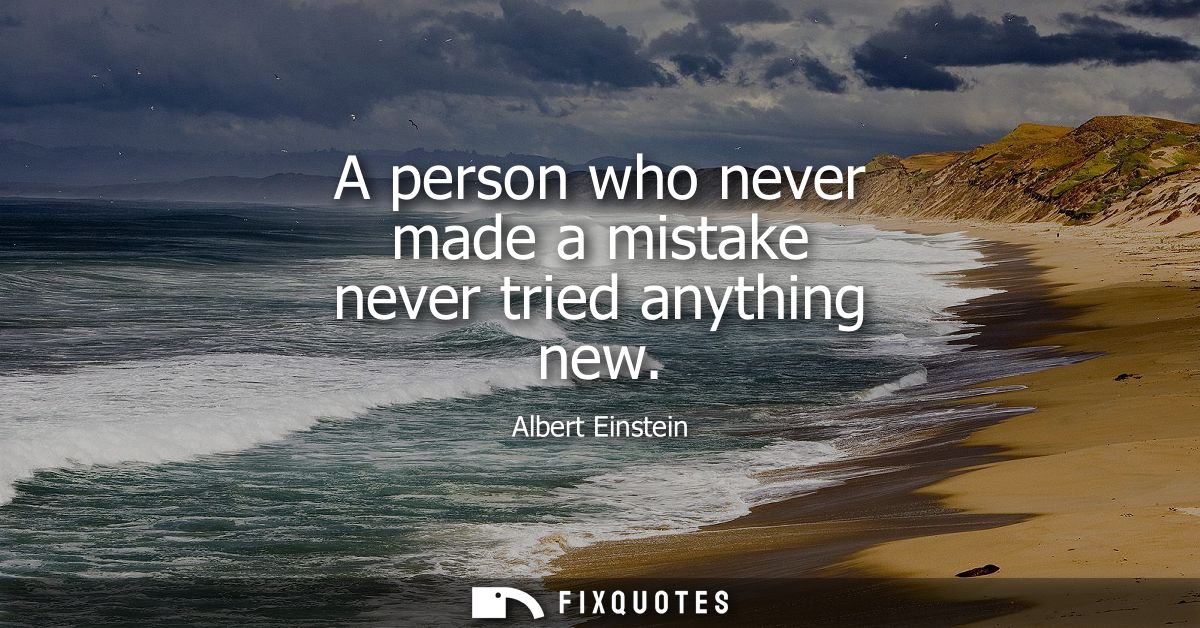
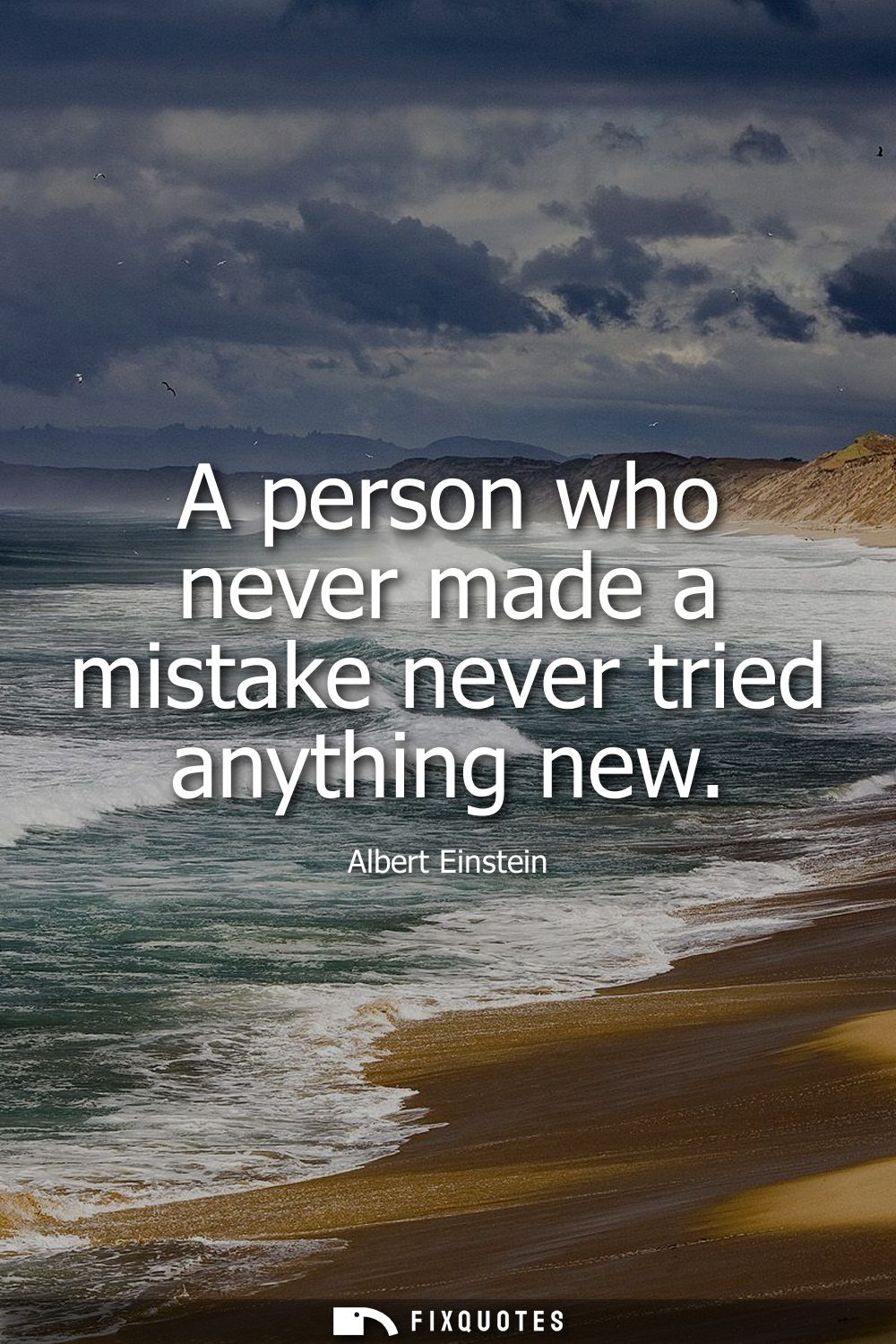
"A person who never made a mistake never tried anything new"
About this Quote
Einstein’s line flatters risk, but its real bite is how neatly it reframes failure as evidence of ambition rather than incompetence. It’s a rhetorical judo move: the shame we attach to mistakes gets redirected into suspicion of perfection. If you’ve never been wrong, the implication goes, you’ve likely been timid, sheltered, or invested in preserving your reputation over expanding your world.
The subtext is especially pointed coming from a physicist whose public mythos is “genius.” Einstein makes genius sound less like a mystical trait and more like a practice: trial, error, revision. That matters culturally because it punctures the fetish for effortless brilliance - in classrooms, in labs, in startups, in every arena where people pretend to be naturally gifted rather than visibly learning. The quote offers a moral permission slip to look messy while you grow.
There’s also a quiet critique of institutions built on punishment: grading systems, bureaucracies, workplaces where being wrong is treated as a character flaw. Einstein isn’t just comforting the anxious striver; he’s calling out environments that incentivize safe bets, incrementalism, and performative certainty. In science, the cost of never being mistaken is often never discovering anything worth the trouble.
The intent isn’t to romanticize error for its own sake. It’s to normalize the only kind of progress that counts: the kind that leaves a paper trail of wrong turns behind it.
The subtext is especially pointed coming from a physicist whose public mythos is “genius.” Einstein makes genius sound less like a mystical trait and more like a practice: trial, error, revision. That matters culturally because it punctures the fetish for effortless brilliance - in classrooms, in labs, in startups, in every arena where people pretend to be naturally gifted rather than visibly learning. The quote offers a moral permission slip to look messy while you grow.
There’s also a quiet critique of institutions built on punishment: grading systems, bureaucracies, workplaces where being wrong is treated as a character flaw. Einstein isn’t just comforting the anxious striver; he’s calling out environments that incentivize safe bets, incrementalism, and performative certainty. In science, the cost of never being mistaken is often never discovering anything worth the trouble.
The intent isn’t to romanticize error for its own sake. It’s to normalize the only kind of progress that counts: the kind that leaves a paper trail of wrong turns behind it.
Quote Details
| Topic | Learning from Mistakes |
|---|---|
| Source | Later attribution: The Mammoth in the Room (Nicolas Pokorny, 2024) modern compilationISBN: 9781647048419 · ID: eW4lEQAAQBAJ
Evidence:
... Albert Einstein once famously said , " A person who never made a mistake never tried anything new . ” As we've already discussed , your team must have the opportunity to take risks , make mistakes , and learn from them . It's your ... |
| Cite |
Citation Formats
APA Style (7th ed.)
Einstein, Albert. (2026, March 1). A person who never made a mistake never tried anything new. FixQuotes. https://fixquotes.com/quotes/a-person-who-never-made-a-mistake-never-tried-13625/
Chicago Style
Einstein, Albert. "A person who never made a mistake never tried anything new." FixQuotes. March 1, 2026. https://fixquotes.com/quotes/a-person-who-never-made-a-mistake-never-tried-13625/.
MLA Style (9th ed.)
"A person who never made a mistake never tried anything new." FixQuotes, 1 Mar. 2026, https://fixquotes.com/quotes/a-person-who-never-made-a-mistake-never-tried-13625/. Accessed 4 Apr. 2026.
More Quotes by Albert
Add to List