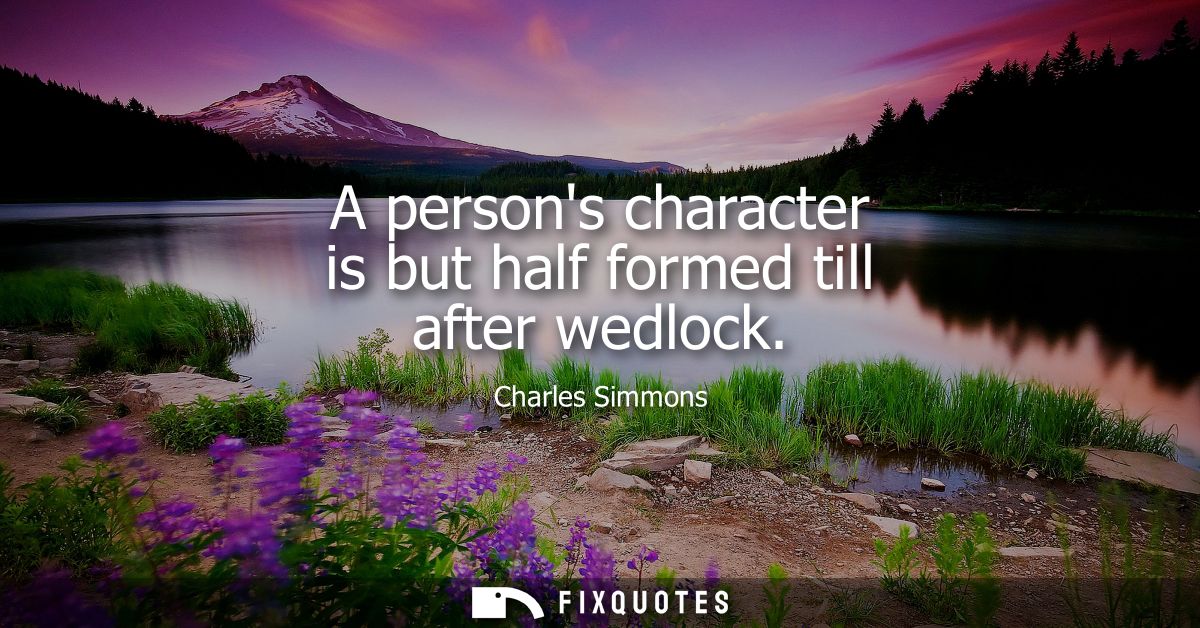
"A person's character is but half formed till after wedlock"
About this Quote
Simmons lands a genteel provocation in the lap of respectable society: marriage doesn’t just reveal who you are, it finishes making you. The line has the tidy certainty of mid-century political common sense, the kind that turns a social arrangement into a moral proving ground. “But half formed” carries a paternalistic chill: adulthood is provisional until the state-sanctioned household locks it in. That’s not romance; it’s governance.
The intent reads as both reassurance and pressure. Reassurance, because it promises that unruly youth, drifting desire, and ambiguous commitment can be stabilized by wedlock’s routines. Pressure, because it implies the unmarried are incomplete citizens, lacking the final polish of responsibility. It’s a political sentence wearing a social mask: a nudge toward conformity framed as character-building.
The subtext is about institutional discipline. Marriage, in this view, is less a private bond than a civic machine that produces steadiness: regular labor, sexual containment, childrearing, reputational stakes. It’s also an argument for patience with men (often men) before they “settle,” while quietly demanding women accept the role of co-authoring that maturation through domestic work.
Context matters: Simmons comes out of a world where politicians treated the family as the smallest unit of the nation-state, a bulwark against disorder and a proxy for virtue. The quote works because it compresses that whole ideology into a single, confident measuring stick: if wedlock completes character, then society can justify rewarding the married and policing everyone else.
The intent reads as both reassurance and pressure. Reassurance, because it promises that unruly youth, drifting desire, and ambiguous commitment can be stabilized by wedlock’s routines. Pressure, because it implies the unmarried are incomplete citizens, lacking the final polish of responsibility. It’s a political sentence wearing a social mask: a nudge toward conformity framed as character-building.
The subtext is about institutional discipline. Marriage, in this view, is less a private bond than a civic machine that produces steadiness: regular labor, sexual containment, childrearing, reputational stakes. It’s also an argument for patience with men (often men) before they “settle,” while quietly demanding women accept the role of co-authoring that maturation through domestic work.
Context matters: Simmons comes out of a world where politicians treated the family as the smallest unit of the nation-state, a bulwark against disorder and a proxy for virtue. The quote works because it compresses that whole ideology into a single, confident measuring stick: if wedlock completes character, then society can justify rewarding the married and policing everyone else.
Quote Details
| Topic | Marriage |
|---|---|
| Source | Help us find the source |
| Cite |
Citation Formats
APA Style (7th ed.)
Simmons, Charles. (2026, January 16). A person's character is but half formed till after wedlock. FixQuotes. https://fixquotes.com/quotes/a-persons-character-is-but-half-formed-till-after-134449/
Chicago Style
Simmons, Charles. "A person's character is but half formed till after wedlock." FixQuotes. January 16, 2026. https://fixquotes.com/quotes/a-persons-character-is-but-half-formed-till-after-134449/.
MLA Style (9th ed.)
"A person's character is but half formed till after wedlock." FixQuotes, 16 Jan. 2026, https://fixquotes.com/quotes/a-persons-character-is-but-half-formed-till-after-134449/. Accessed 12 Feb. 2026.
More Quotes by Charles
Add to List