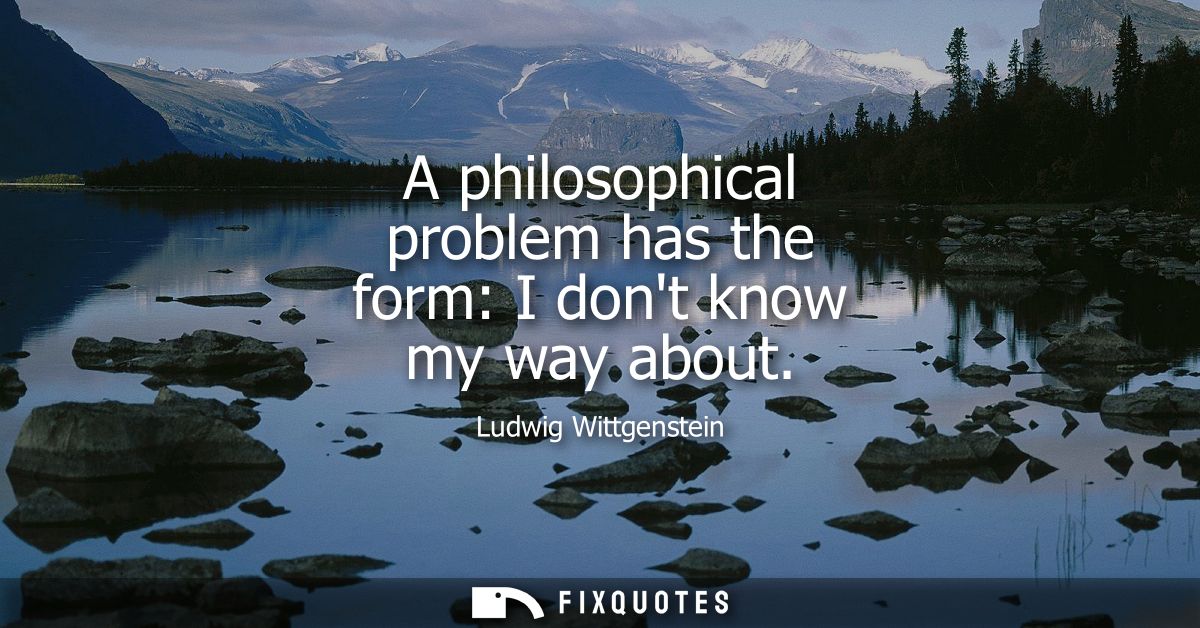
"A philosophical problem has the form: I don't know my way about"
About this Quote
Philosophy, Wittgenstein suggests, isn’t a grand tour of cosmic truths so much as a moment of intellectual vertigo: the realization that the usual signposts have stopped working. “I don’t know my way about” turns the philosopher from oracle into lost pedestrian, and that demotion is the point. The line has the dry precision of someone who thinks metaphysical swagger is a category error. A “philosophical problem” isn’t defined by its subject matter (mind, time, reality) but by a particular kind of stuckness in language - the sense that our words promise a route and then deliver only fog.
The subtext is anti-heroic and quietly therapeutic. Wittgenstein is pushing back against the tradition that treats philosophy as a factory for theories. The “form” of the problem matters because the illness is formal: we have slipped into a picture of how language must work, then we start asking questions that look urgent only inside that picture. His intent is to redescribe philosophy as reorientation - not new information, but regained competence. You don’t solve “Where is the meaning?” the way you solve a math proof; you notice you’ve been wandering in a grammatical maze.
Context sharpens the edge. In the later Wittgenstein of Philosophical Investigations, after the austerity of the Tractatus, he is suspicious of systems and attracted to ordinary usage, to “forms of life.” The image of being lost fits a postwar sensibility, too: less faith in totalizing schemes, more attention to how easily human reason talks itself into dead ends. Philosophy becomes less a ladder to the heavens than a map back to the street.
The subtext is anti-heroic and quietly therapeutic. Wittgenstein is pushing back against the tradition that treats philosophy as a factory for theories. The “form” of the problem matters because the illness is formal: we have slipped into a picture of how language must work, then we start asking questions that look urgent only inside that picture. His intent is to redescribe philosophy as reorientation - not new information, but regained competence. You don’t solve “Where is the meaning?” the way you solve a math proof; you notice you’ve been wandering in a grammatical maze.
Context sharpens the edge. In the later Wittgenstein of Philosophical Investigations, after the austerity of the Tractatus, he is suspicious of systems and attracted to ordinary usage, to “forms of life.” The image of being lost fits a postwar sensibility, too: less faith in totalizing schemes, more attention to how easily human reason talks itself into dead ends. Philosophy becomes less a ladder to the heavens than a map back to the street.
Quote Details
| Topic | Deep |
|---|---|
| Source | Help us find the source |
| Cite |
Citation Formats
APA Style (7th ed.)
Wittgenstein, Ludwig. (2026, January 15). A philosophical problem has the form: I don't know my way about. FixQuotes. https://fixquotes.com/quotes/a-philosophical-problem-has-the-form-i-dont-know-581/
Chicago Style
Wittgenstein, Ludwig. "A philosophical problem has the form: I don't know my way about." FixQuotes. January 15, 2026. https://fixquotes.com/quotes/a-philosophical-problem-has-the-form-i-dont-know-581/.
MLA Style (9th ed.)
"A philosophical problem has the form: I don't know my way about." FixQuotes, 15 Jan. 2026, https://fixquotes.com/quotes/a-philosophical-problem-has-the-form-i-dont-know-581/. Accessed 5 Mar. 2026.
More Quotes by Ludwig
Add to List