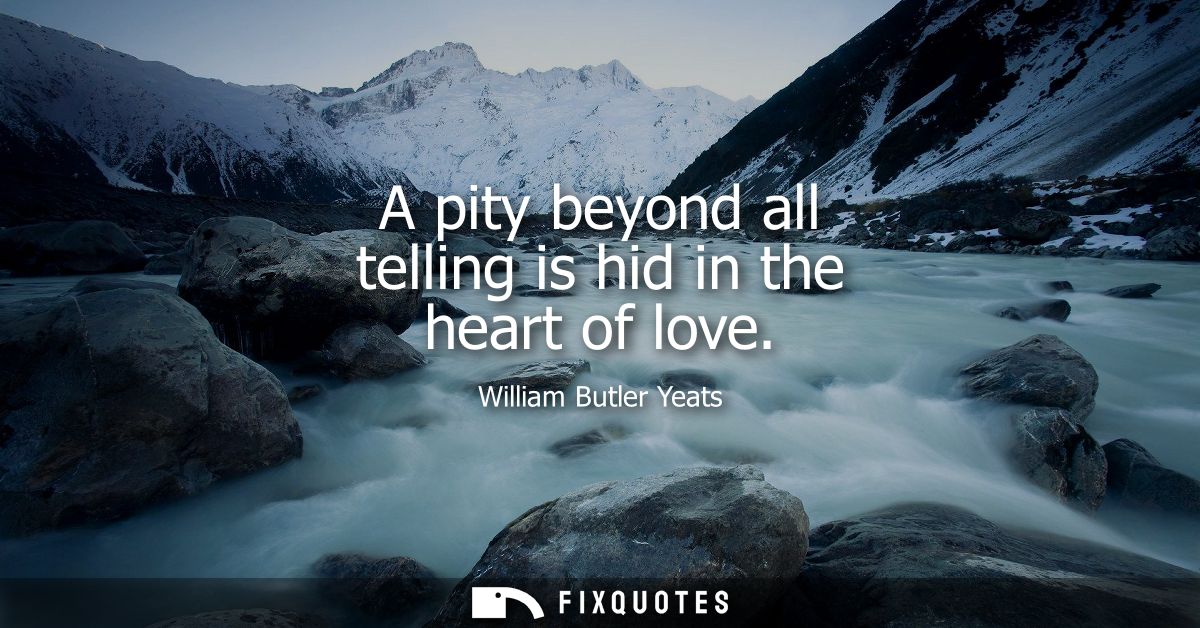
"A pity beyond all telling is hid in the heart of love"
About this Quote
Yeats drops a small bomb here: love isn’t just sweet or tragic, it’s built around a concealed core of sorrow. The key move is “hid.” He’s not talking about heartbreak as an outcome, the bad luck that sometimes follows romance. He’s arguing that pity is structurally embedded in love itself, tucked inside it like a seam you only notice once it tears.
“Pity beyond all telling” has Yeats’s favorite kind of pressure: emotion so large language can’t contain it. That’s not decorative excess; it’s a claim about the limits of expression. Love, for Yeats, is an experience that exceeds the lyric tools we use to domesticate it. You can write poems about devotion, jealousy, fidelity, betrayal - but the deepest component is mute, or at least resistant to being fully said. The line quietly flatters and indicts poetry at the same time.
The subtext is almost metaphysical. To love is to recognize another person’s fragility and your own powerlessness in the face of time, change, and death. Pity isn’t condescension here; it’s the ache of perceiving what can be lost, including the beloved’s suffering and your inability to protect them from life’s eventual damages. Love heightens attention, and attention reveals the wounds.
Context matters: Yeats wrote out of a world anxious with political upheaval and personal disillusionment, where idealism repeatedly ran into reality’s blunt edge. This line feels like an anti-romantic correction delivered in romantic language: love’s deepest truth isn’t ecstasy, it’s grief in disguise.
“Pity beyond all telling” has Yeats’s favorite kind of pressure: emotion so large language can’t contain it. That’s not decorative excess; it’s a claim about the limits of expression. Love, for Yeats, is an experience that exceeds the lyric tools we use to domesticate it. You can write poems about devotion, jealousy, fidelity, betrayal - but the deepest component is mute, or at least resistant to being fully said. The line quietly flatters and indicts poetry at the same time.
The subtext is almost metaphysical. To love is to recognize another person’s fragility and your own powerlessness in the face of time, change, and death. Pity isn’t condescension here; it’s the ache of perceiving what can be lost, including the beloved’s suffering and your inability to protect them from life’s eventual damages. Love heightens attention, and attention reveals the wounds.
Context matters: Yeats wrote out of a world anxious with political upheaval and personal disillusionment, where idealism repeatedly ran into reality’s blunt edge. This line feels like an anti-romantic correction delivered in romantic language: love’s deepest truth isn’t ecstasy, it’s grief in disguise.
Quote Details
| Topic | Heartbreak |
|---|---|
| Source | Help us find the source |
| Cite |
Citation Formats
APA Style (7th ed.)
Yeats, William Butler. (2026, January 18). A pity beyond all telling is hid in the heart of love. FixQuotes. https://fixquotes.com/quotes/a-pity-beyond-all-telling-is-hid-in-the-heart-of-2371/
Chicago Style
Yeats, William Butler. "A pity beyond all telling is hid in the heart of love." FixQuotes. January 18, 2026. https://fixquotes.com/quotes/a-pity-beyond-all-telling-is-hid-in-the-heart-of-2371/.
MLA Style (9th ed.)
"A pity beyond all telling is hid in the heart of love." FixQuotes, 18 Jan. 2026, https://fixquotes.com/quotes/a-pity-beyond-all-telling-is-hid-in-the-heart-of-2371/. Accessed 14 Mar. 2026.
More Quotes by William
Add to List