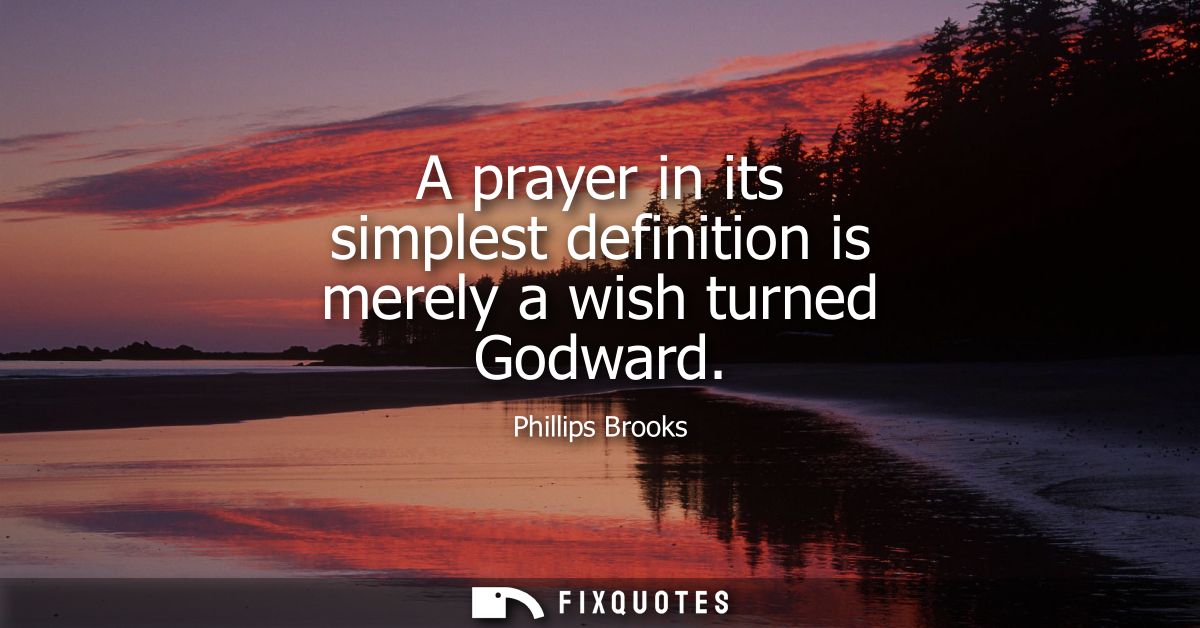
"A prayer in its simplest definition is merely a wish turned Godward"
About this Quote
Brooks strips prayer of its stained-glass mystique and hands it back as something almost embarrassingly human: a wish with direction. The rhetorical move is sly. By calling prayer "merely a wish", he deflates religious performance, the pious vocabulary, the implied spiritual hierarchy. Prayer isn’t a specialized technique reserved for the devout; it’s desire. Then he pivots with "turned Godward", restoring seriousness without reclaiming theatrics. The line suggests that what changes a wish into a prayer is not eloquence or certainty, but orientation - an inward swivel of attention toward the divine.
The subtext is pastoral and democratic. Brooks, a major American Episcopal preacher in a century of industrial churn and doctrinal sparring, seems less interested in policing correct belief than in keeping the channel open between ordinary longing and God. This is a Protestant-inflected sensibility: suspicion of mediation, emphasis on the directness of the relationship, impatience with ritual as a substitute for sincerity. It also reads as a quiet rebuke to the era's moralizing religiosity - prayer as proof of righteousness - and to the opposite temptation, a modern cynicism that treats prayer as superstition. He reframes it as psychology with a horizon: the same engine that produces wishing can produce communion.
That word "simplest" matters. Brooks isn’t exhausting prayer; he’s clearing the throat. Complex theology can come later. First, admit what you want. Then dare to aim it at God.
The subtext is pastoral and democratic. Brooks, a major American Episcopal preacher in a century of industrial churn and doctrinal sparring, seems less interested in policing correct belief than in keeping the channel open between ordinary longing and God. This is a Protestant-inflected sensibility: suspicion of mediation, emphasis on the directness of the relationship, impatience with ritual as a substitute for sincerity. It also reads as a quiet rebuke to the era's moralizing religiosity - prayer as proof of righteousness - and to the opposite temptation, a modern cynicism that treats prayer as superstition. He reframes it as psychology with a horizon: the same engine that produces wishing can produce communion.
That word "simplest" matters. Brooks isn’t exhausting prayer; he’s clearing the throat. Complex theology can come later. First, admit what you want. Then dare to aim it at God.
Quote Details
| Topic | Prayer |
|---|---|
| Source | Help us find the source |
| Cite |
Citation Formats
APA Style (7th ed.)
Brooks, Phillips. (2026, January 14). A prayer in its simplest definition is merely a wish turned Godward. FixQuotes. https://fixquotes.com/quotes/a-prayer-in-its-simplest-definition-is-merely-a-79376/
Chicago Style
Brooks, Phillips. "A prayer in its simplest definition is merely a wish turned Godward." FixQuotes. January 14, 2026. https://fixquotes.com/quotes/a-prayer-in-its-simplest-definition-is-merely-a-79376/.
MLA Style (9th ed.)
"A prayer in its simplest definition is merely a wish turned Godward." FixQuotes, 14 Jan. 2026, https://fixquotes.com/quotes/a-prayer-in-its-simplest-definition-is-merely-a-79376/. Accessed 12 Feb. 2026.
More Quotes by Phillips
Add to List