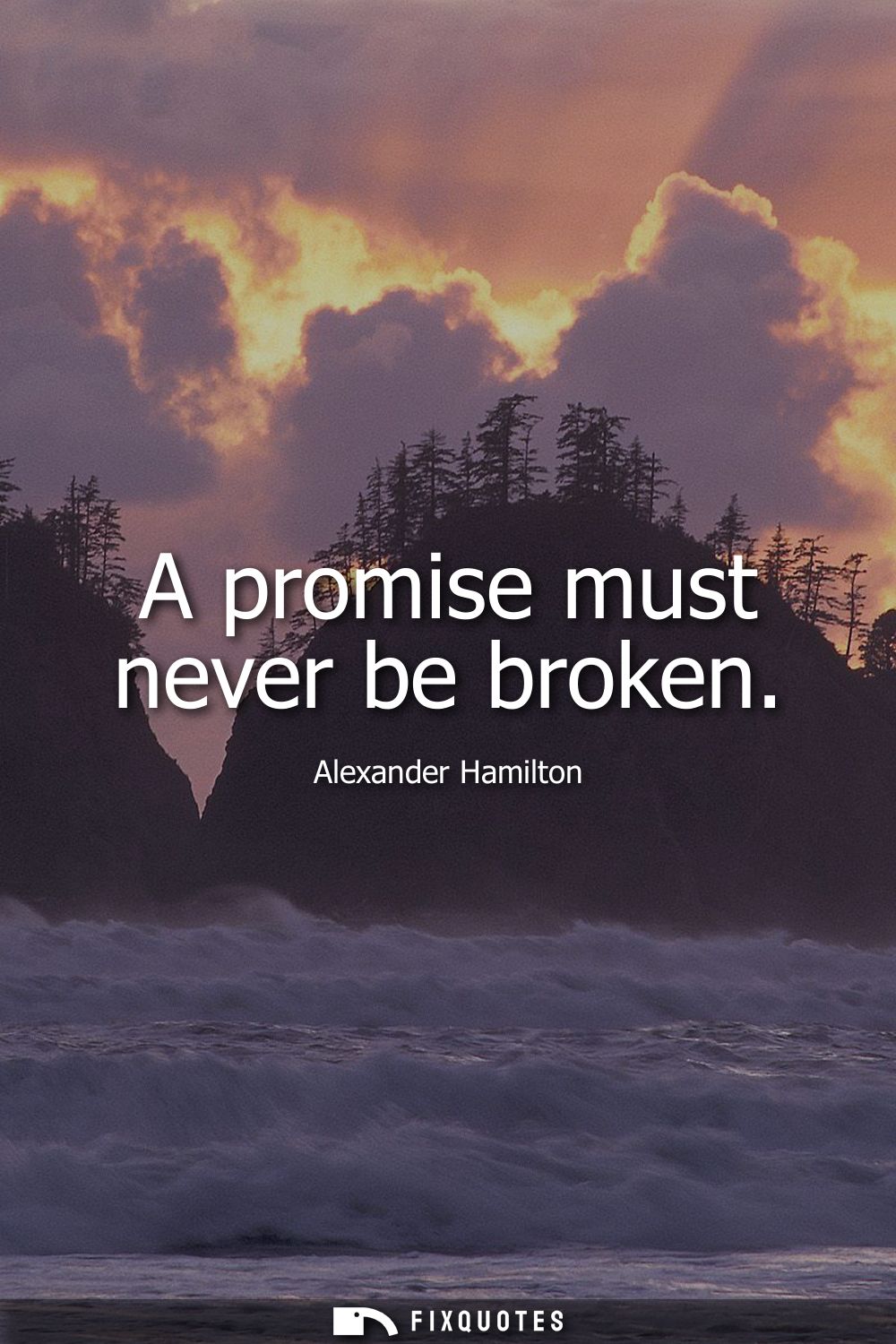
"A promise must never be broken"
About this Quote
In Hamilton's political universe, a promise isn't sentimental etiquette; it's credit. "A promise must never be broken" reads like an ethical absolute, but the real target is practical legitimacy: a young republic trying to convince citizens, creditors, and rival powers that its word is bankable. Coming out of revolution, America had already defaulted on informal commitments, struggled with debt, and watched public trust evaporate under the Articles of Confederation. Hamilton understood that statecraft runs on confidence the way finance runs on liquidity.
The line works because it collapses private morality and public policy into one hard rule. "Must never" is deliberately inflexible, a rhetorical move that turns fidelity into infrastructure. If promises are breakable, then contracts are just vibes, alliances are temporary theater, and taxation becomes coercion without consent. By making promise-keeping nonnegotiable, Hamilton is really arguing for centralized authority capable of honoring commitments: paying debts, enforcing laws, sustaining treaties. This is Federalism as character.
The subtext is also a rebuke. Hamilton spent his career battling political improvisers who treated pledges as campaign tools and obligations as partisan options. He frames reneging not as strategy but as rot, because broken promises don't merely disappoint; they teach the public to expect betrayal, which invites cynicism, faction, and eventually instability.
There's a personal irony, too. Hamilton's own life mixed brilliant institutional seriousness with famously messy judgment. That tension sharpens the line: the man most committed to systems is warning that without the discipline of keeping one's word, the system itself stops working.
The line works because it collapses private morality and public policy into one hard rule. "Must never" is deliberately inflexible, a rhetorical move that turns fidelity into infrastructure. If promises are breakable, then contracts are just vibes, alliances are temporary theater, and taxation becomes coercion without consent. By making promise-keeping nonnegotiable, Hamilton is really arguing for centralized authority capable of honoring commitments: paying debts, enforcing laws, sustaining treaties. This is Federalism as character.
The subtext is also a rebuke. Hamilton spent his career battling political improvisers who treated pledges as campaign tools and obligations as partisan options. He frames reneging not as strategy but as rot, because broken promises don't merely disappoint; they teach the public to expect betrayal, which invites cynicism, faction, and eventually instability.
There's a personal irony, too. Hamilton's own life mixed brilliant institutional seriousness with famously messy judgment. That tension sharpens the line: the man most committed to systems is warning that without the discipline of keeping one's word, the system itself stops working.
Quote Details
| Topic | Honesty & Integrity |
|---|---|
| Source | Help us find the source |
| Cite |
Citation Formats
APA Style (7th ed.)
Hamilton, Alexander. (2026, January 15). A promise must never be broken. FixQuotes. https://fixquotes.com/quotes/a-promise-must-never-be-broken-25665/
Chicago Style
Hamilton, Alexander. "A promise must never be broken." FixQuotes. January 15, 2026. https://fixquotes.com/quotes/a-promise-must-never-be-broken-25665/.
MLA Style (9th ed.)
"A promise must never be broken." FixQuotes, 15 Jan. 2026, https://fixquotes.com/quotes/a-promise-must-never-be-broken-25665/. Accessed 22 Mar. 2026.
More Quotes by Alexander
Add to List