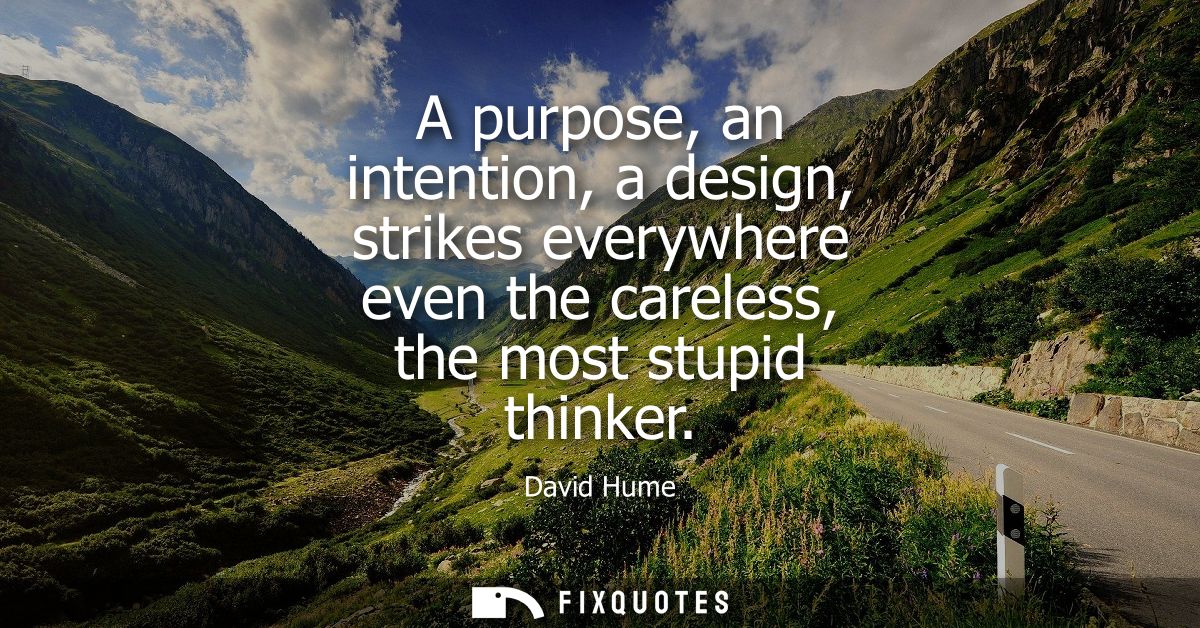
"A purpose, an intention, a design, strikes everywhere, even the careless, the most stupid thinker"
About this Quote
The insult (“careless,” “most stupid thinker”) isn’t just spice. It’s a rhetorical squeeze. If even the least reflective person feels the pull of intention, then the pull can’t be proof; it’s too cheap, too widely available. Hume is pointing to the psychological origin of the design intuition, which is exactly what makes it philosophically suspect. A belief that comes easily is a belief that demands extra scrutiny.
Context sharpens the edge. In the 18th century, natural theology and its watchmaker-style arguments were cultural common sense, a respectable bridge between new science and old faith. Hume, writing against that comfort, stages the debate in his Dialogues Concerning Natural Religion: the world looks like an artifact, but “looks like” is doing all the work. The quote captures his signature move - turning confidence into a case study. Design is not an observation sitting out there in nature; it’s an interpretation stamped onto nature by a mind hungry for intention.
Quote Details
| Topic | Reason & Logic |
|---|---|
| Source | Help us find the source |
| Cite |
Citation Formats
APA Style (7th ed.)
Hume, David. (2026, February 18). A purpose, an intention, a design, strikes everywhere, even the careless, the most stupid thinker. FixQuotes. https://fixquotes.com/quotes/a-purpose-an-intention-a-design-strikes-76384/
Chicago Style
Hume, David. "A purpose, an intention, a design, strikes everywhere, even the careless, the most stupid thinker." FixQuotes. February 18, 2026. https://fixquotes.com/quotes/a-purpose-an-intention-a-design-strikes-76384/.
MLA Style (9th ed.)
"A purpose, an intention, a design, strikes everywhere, even the careless, the most stupid thinker." FixQuotes, 18 Feb. 2026, https://fixquotes.com/quotes/a-purpose-an-intention-a-design-strikes-76384/. Accessed 28 Mar. 2026.