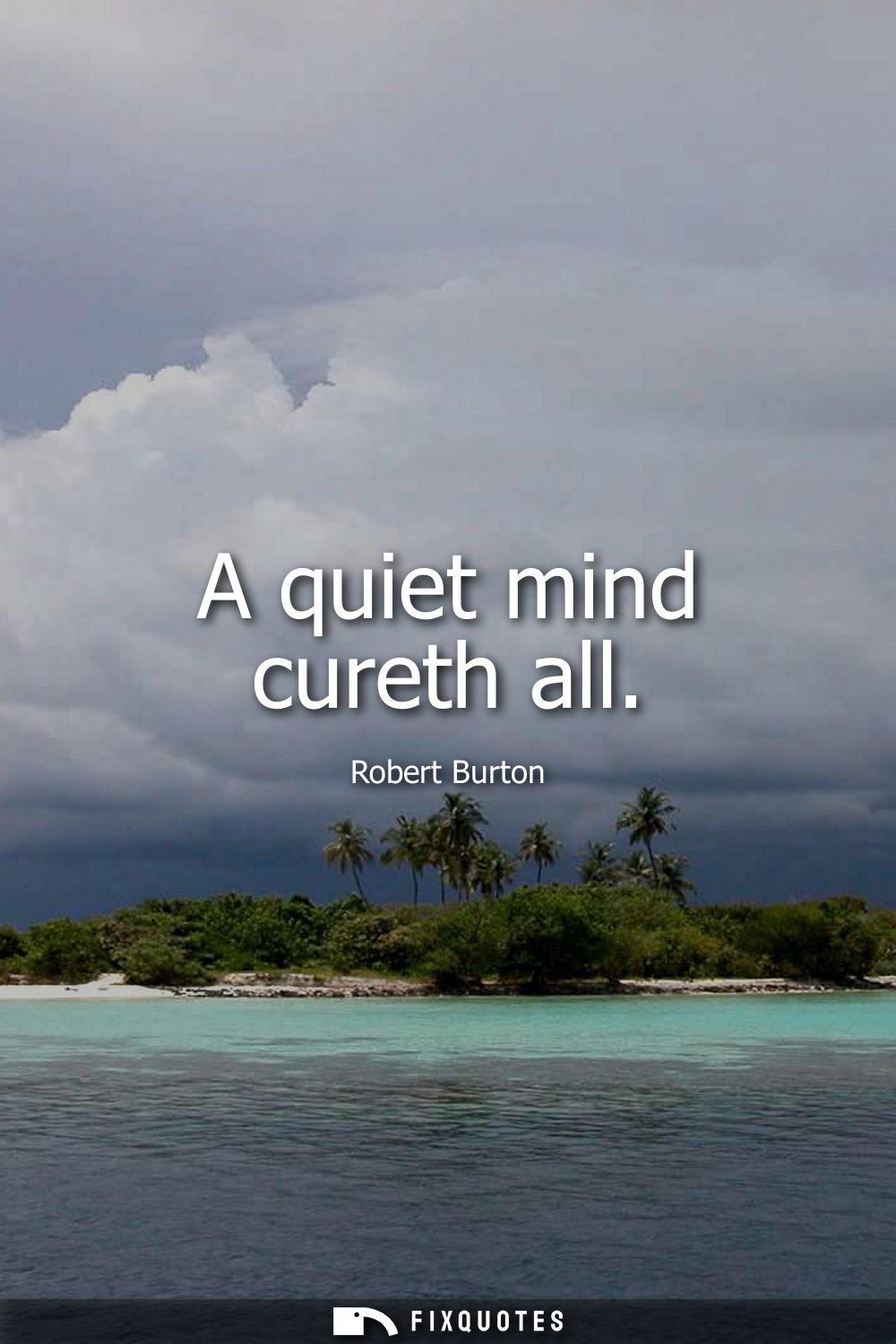
"A quiet mind cureth all"
About this Quote
"A quiet mind cureth all" is the kind of confident compression Robert Burton loved: a physician of moods speaking in the language of medicine while quietly admitting how little medicine can touch. Burton wrote in an era when "cures" meant bloodletting and herbal tonics, but his real subject in The Anatomy of Melancholy was the inner weather that refuses to obey external treatments. The line pivots on an old verb - "cureth" - with its churchy certainty, as if calm were not a practice but a sacrament.
The intent is prescriptive, almost stern. Burton is telling you that the battleground is cognitive before it's chemical: stop feeding the mind noise, obsession, rumination, and the body follows. The subtext is more anxious. Only someone steeped in melancholy would argue so forcefully for quiet as a panacea; it reads like a note pinned to his own psyche. Burton isn't praising silence as aesthetic purity. He's recommending it as survival.
Context sharpens the edge. Early modern England was loud with sermons, plagues, political volatility, and a growing print culture that poured stimuli into homes that had previously been insulated. Burton, a scholar and cleric, watched people become expert at inflaming themselves - with pamphlets, gossip, theology, ambition. Against that churn, "quiet" becomes not passivity but refusal: a disciplined withdrawal from the machinery that manufactures worry.
The line works because it overstates. "All" is provocation, not proof - an intentional exaggeration designed to make the reader test the claim against their own agitation. Burton's cure is less a potion than a posture: stillness as an act of control in a world that profits from your unrest.
The intent is prescriptive, almost stern. Burton is telling you that the battleground is cognitive before it's chemical: stop feeding the mind noise, obsession, rumination, and the body follows. The subtext is more anxious. Only someone steeped in melancholy would argue so forcefully for quiet as a panacea; it reads like a note pinned to his own psyche. Burton isn't praising silence as aesthetic purity. He's recommending it as survival.
Context sharpens the edge. Early modern England was loud with sermons, plagues, political volatility, and a growing print culture that poured stimuli into homes that had previously been insulated. Burton, a scholar and cleric, watched people become expert at inflaming themselves - with pamphlets, gossip, theology, ambition. Against that churn, "quiet" becomes not passivity but refusal: a disciplined withdrawal from the machinery that manufactures worry.
The line works because it overstates. "All" is provocation, not proof - an intentional exaggeration designed to make the reader test the claim against their own agitation. Burton's cure is less a potion than a posture: stillness as an act of control in a world that profits from your unrest.
Quote Details
| Topic | Wisdom |
|---|---|
| Source | Help us find the source |
| Cite |
Citation Formats
APA Style (7th ed.)
Burton, Robert. (2026, January 17). A quiet mind cureth all. FixQuotes. https://fixquotes.com/quotes/a-quiet-mind-cureth-all-33844/
Chicago Style
Burton, Robert. "A quiet mind cureth all." FixQuotes. January 17, 2026. https://fixquotes.com/quotes/a-quiet-mind-cureth-all-33844/.
MLA Style (9th ed.)
"A quiet mind cureth all." FixQuotes, 17 Jan. 2026, https://fixquotes.com/quotes/a-quiet-mind-cureth-all-33844/. Accessed 6 Mar. 2026.
More Quotes by Robert
Add to List