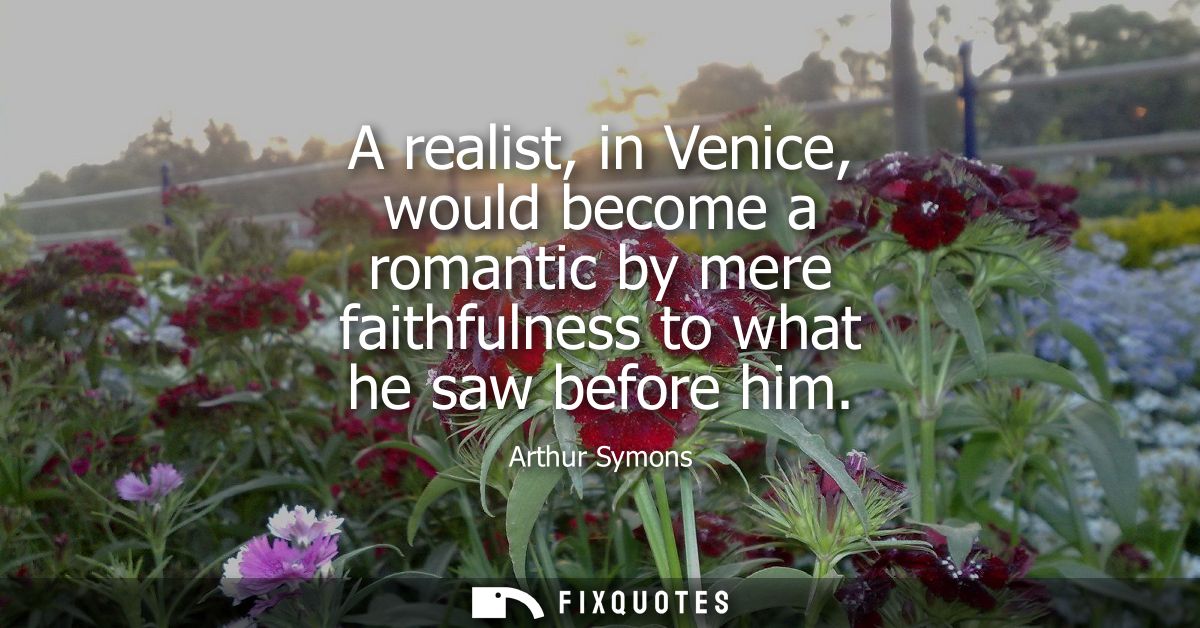
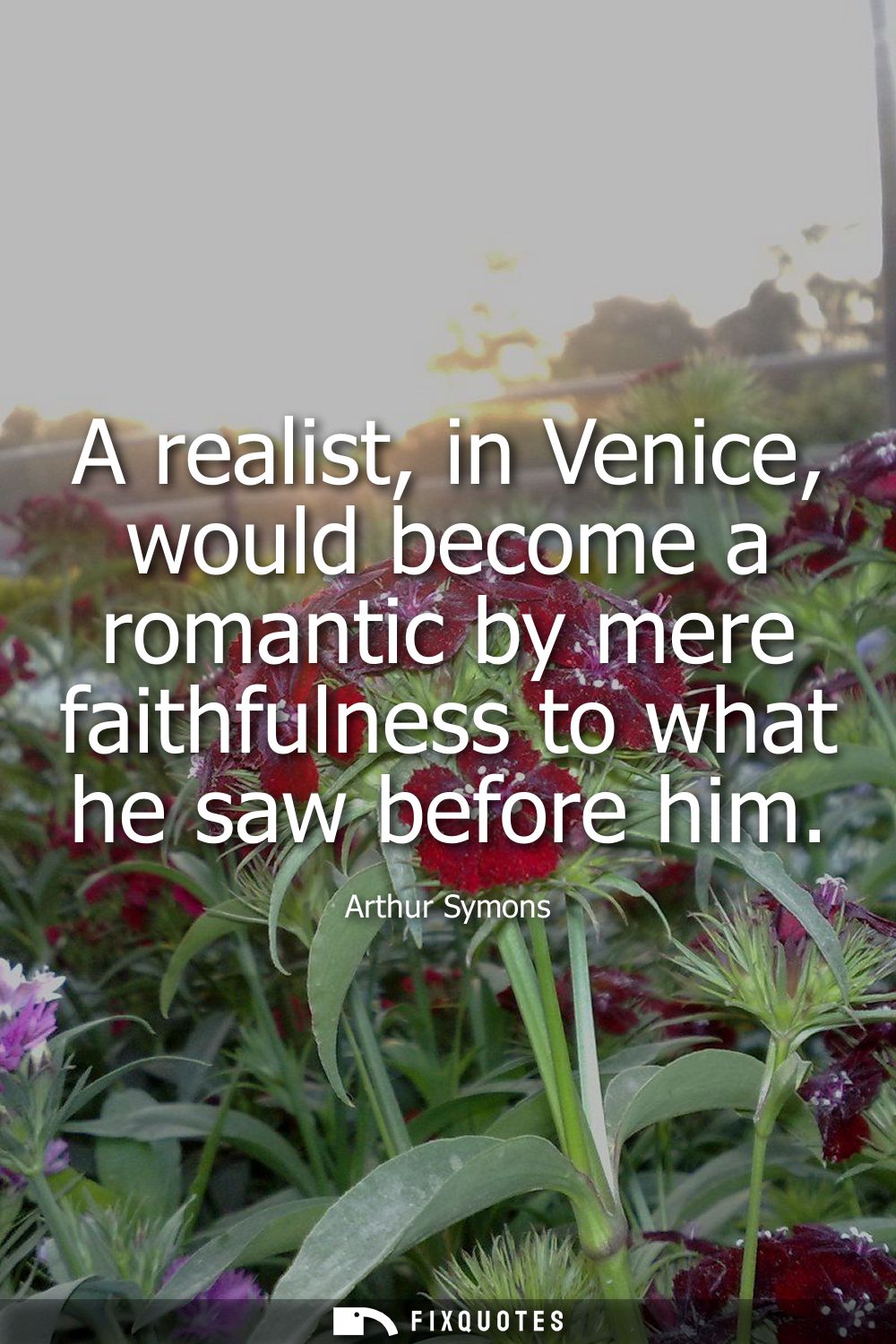
"A realist, in Venice, would become a romantic by mere faithfulness to what he saw before him"
About this Quote
The subtext is about the instability of “the real.” Venice doesn’t just offer sights; it edits the viewer. Water turns architecture into double images; time feels layered; decay reads as ornament. In that environment, describing accurately means admitting atmosphere, sensuality, and the soft-focus effects of light. The realist can’t stay morally stern, because the subject matter refuses to behave like neutral data. Symons is also poking at the modern writer’s anxiety: if you’re moved, are you being sentimental? His answer is that the sentiment is built into the scene, not smuggled in by the author.
Context matters: Symons wrote at a moment when modernism was incubating, when “impression” was starting to outrank plot and certainty. Venice becomes his perfect alibi for style - proof that heightened language can be a form of honesty, not escape.
Quote Details
| Topic | Romantic |
|---|---|
| Source | Help us find the source |
| Cite |
Citation Formats
APA Style (7th ed.)
Symons, Arthur. (2026, January 16). A realist, in Venice, would become a romantic by mere faithfulness to what he saw before him. FixQuotes. https://fixquotes.com/quotes/a-realist-in-venice-would-become-a-romantic-by-111333/
Chicago Style
Symons, Arthur. "A realist, in Venice, would become a romantic by mere faithfulness to what he saw before him." FixQuotes. January 16, 2026. https://fixquotes.com/quotes/a-realist-in-venice-would-become-a-romantic-by-111333/.
MLA Style (9th ed.)
"A realist, in Venice, would become a romantic by mere faithfulness to what he saw before him." FixQuotes, 16 Jan. 2026, https://fixquotes.com/quotes/a-realist-in-venice-would-become-a-romantic-by-111333/. Accessed 28 Mar. 2026.