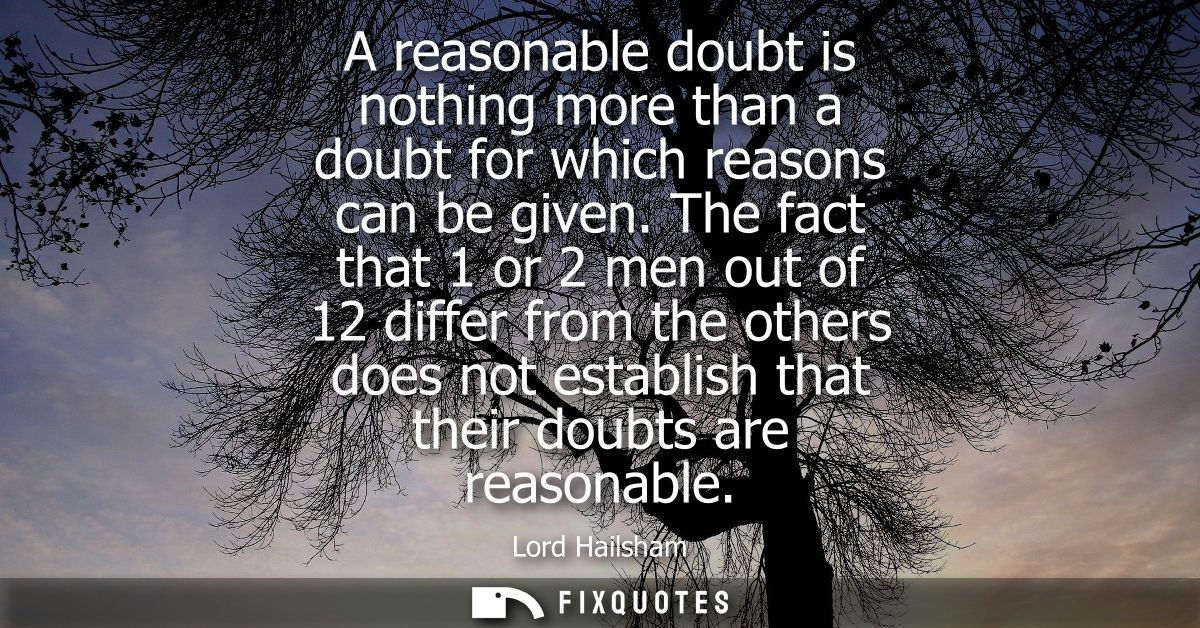
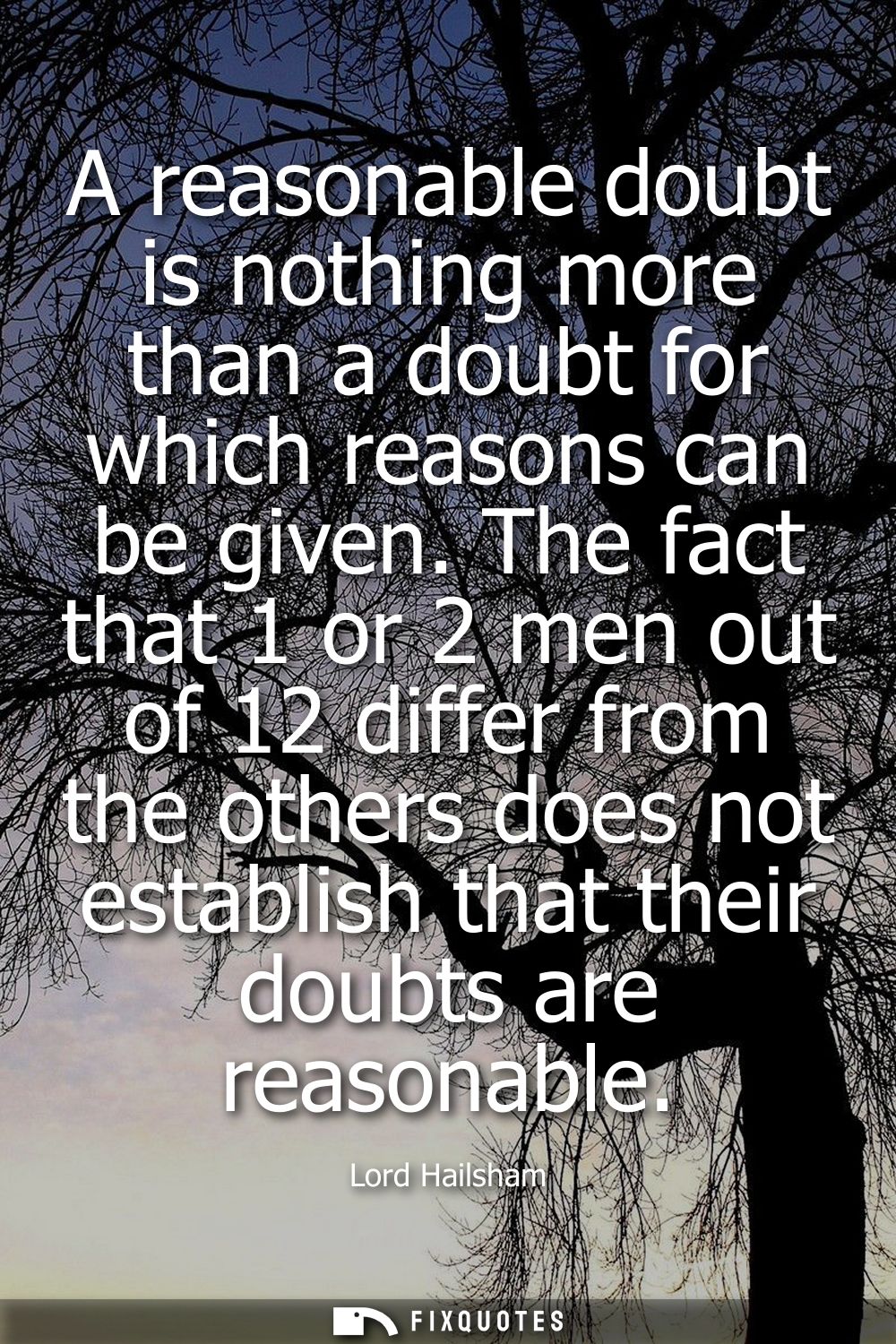
"A reasonable doubt is nothing more than a doubt for which reasons can be given. The fact that 1 or 2 men out of 12 differ from the others does not establish that their doubts are reasonable"
About this Quote
The second sentence is where the politics shows. Hailsham punctures a comforting civic myth: that disagreement, by itself, carries moral authority. Two holdouts don’t automatically become brave truth-tellers; they might be confused, stubborn, biased, or merely contrarian. He’s warning against treating minority status as evidence of rationality, a warning that lands awkwardly in cultures that romanticize the lone dissenter. The subtext is institutional: courts depend on decision-making that can be explained, not just felt. Reason is a social currency; you have to be able to “pay” with it in front of others.
Context matters because Hailsham wasn’t a philosopher in a seminar room; he was a British politician and Lord Chancellor steeped in the legitimacy problems of the justice system. “Reasonable doubt” is a rhetorical tool as much as a legal standard, and he’s trying to police its misuse: not to make convictions easier, exactly, but to keep acquittals from riding on vibes, sympathy, or performative skepticism. The line is bracing because it reminds us how democratic institutions actually justify power: by demanding reasons, not just doubts.
Quote Details
| Topic | Justice |
|---|---|
| Source | Help us find the source |
| Cite |
Citation Formats
APA Style (7th ed.)
Hailsham, Lord. (2026, January 16). A reasonable doubt is nothing more than a doubt for which reasons can be given. The fact that 1 or 2 men out of 12 differ from the others does not establish that their doubts are reasonable. FixQuotes. https://fixquotes.com/quotes/a-reasonable-doubt-is-nothing-more-than-a-doubt-134089/
Chicago Style
Hailsham, Lord. "A reasonable doubt is nothing more than a doubt for which reasons can be given. The fact that 1 or 2 men out of 12 differ from the others does not establish that their doubts are reasonable." FixQuotes. January 16, 2026. https://fixquotes.com/quotes/a-reasonable-doubt-is-nothing-more-than-a-doubt-134089/.
MLA Style (9th ed.)
"A reasonable doubt is nothing more than a doubt for which reasons can be given. The fact that 1 or 2 men out of 12 differ from the others does not establish that their doubts are reasonable." FixQuotes, 16 Jan. 2026, https://fixquotes.com/quotes/a-reasonable-doubt-is-nothing-more-than-a-doubt-134089/. Accessed 13 Feb. 2026.