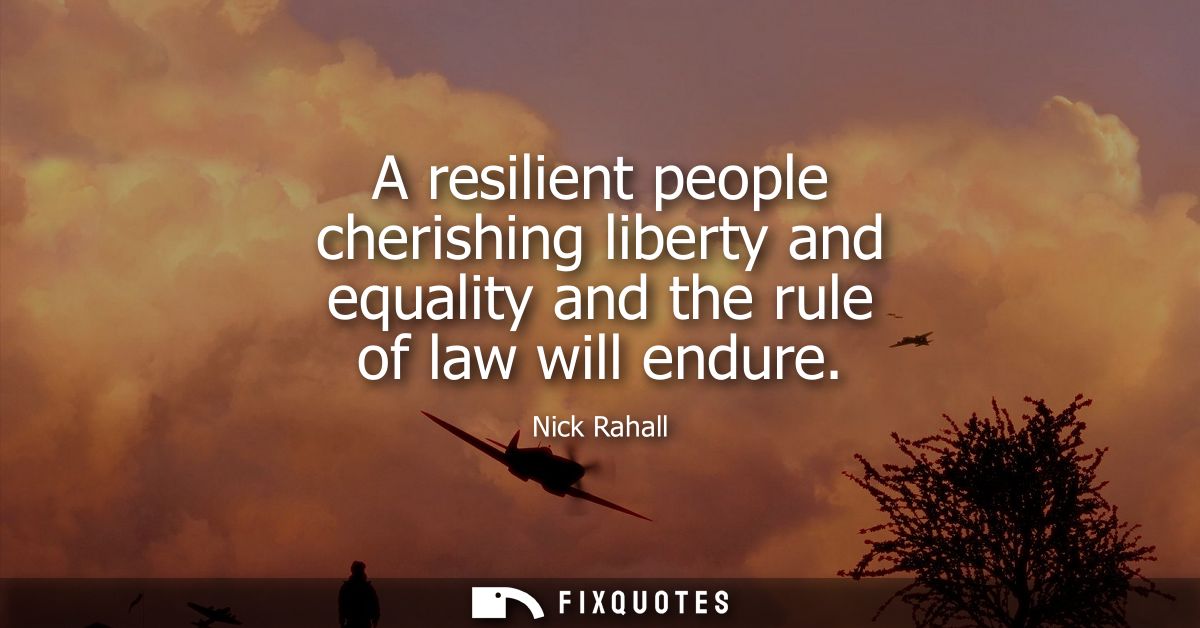
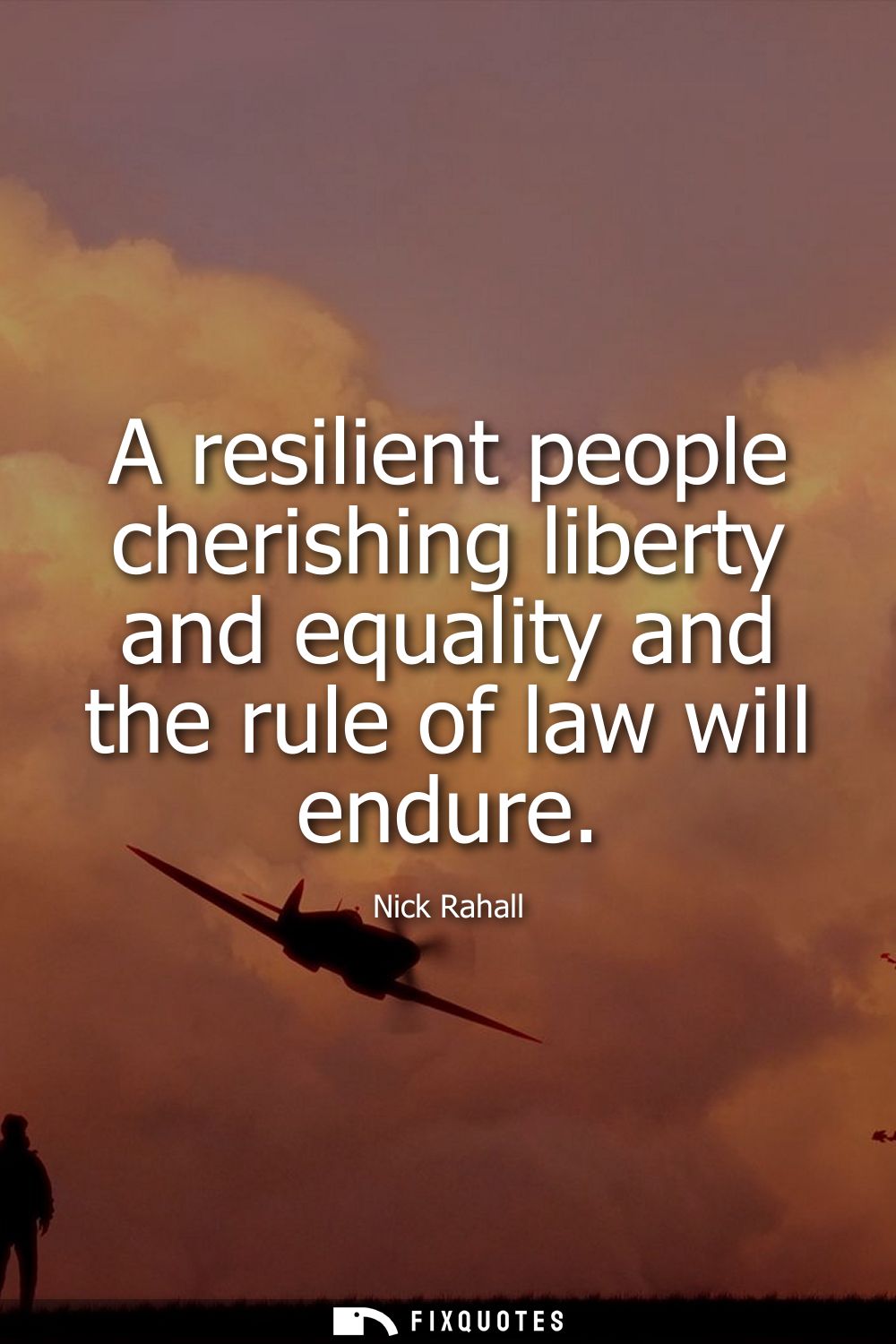
"A resilient people cherishing liberty and equality and the rule of law will endure"
About this Quote
The three-part credo - “liberty and equality and the rule of law” - is classic American civil religion: abstract enough to unite, moral enough to sound non-negotiable, and flexible enough to mean different things to different audiences. Notice the sequencing. Pairing liberty with equality signals a balancing act between competing political impulses, but tacking on “rule of law” anchors the sentiment in institutional legitimacy. That’s a subtle argument against both cynicism and extremism: your grievances may be real, but the remedy must stay inside the system.
The verb choice matters, too. “Cherishing” isn’t “defending” or “enforcing.” It shifts the burden from government action to public character, implying that endurance is less about the state’s competence than the citizenry’s values. “Will endure” lands as prophecy rather than promise - an almost constitutional confidence that the republic is self-healing if the culture stays loyal to its founding ideals.
Contextually, this reads like post-shock rhetoric: the kind of sentence deployed after scandal, violence, or democratic stress, when leaders need a unifying frame that blesses existing institutions while calling for civic steadiness. It’s comfort with a quiet warning: endurance is conditional.
Quote Details
| Topic | Freedom |
|---|---|
| Source | Help us find the source |
| Cite |
Citation Formats
APA Style (7th ed.)
Rahall, Nick. (2026, January 15). A resilient people cherishing liberty and equality and the rule of law will endure. FixQuotes. https://fixquotes.com/quotes/a-resilient-people-cherishing-liberty-and-151098/
Chicago Style
Rahall, Nick. "A resilient people cherishing liberty and equality and the rule of law will endure." FixQuotes. January 15, 2026. https://fixquotes.com/quotes/a-resilient-people-cherishing-liberty-and-151098/.
MLA Style (9th ed.)
"A resilient people cherishing liberty and equality and the rule of law will endure." FixQuotes, 15 Jan. 2026, https://fixquotes.com/quotes/a-resilient-people-cherishing-liberty-and-151098/. Accessed 18 Feb. 2026.