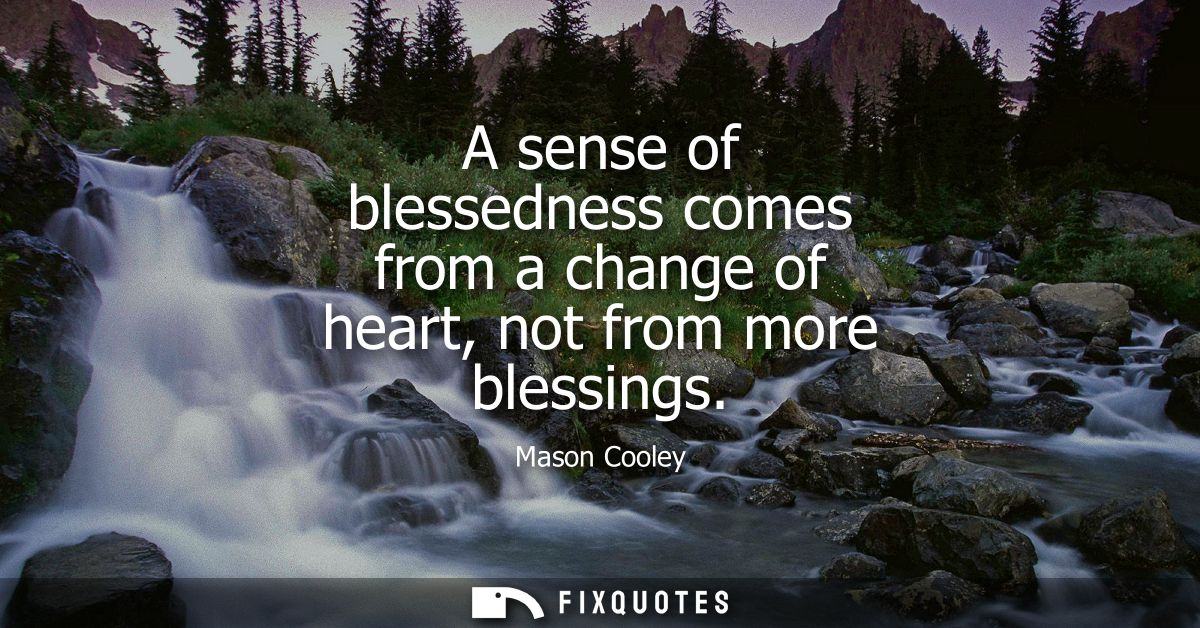
"A sense of blessedness comes from a change of heart, not from more blessings"
About this Quote
The intent feels corrective, almost diagnostic. If you’re chasing the sensation of being blessed by stacking favorable events, you’ll never stop negotiating with reality. Cooley implies the shortage isn’t in your circumstances but in your receptivity. “Change of heart” suggests something deeper than a mood upgrade: a reorientation of desire, gratitude, and maybe even forgiveness. It’s spiritual language without a sermon, and that restraint is the point. He’s not promising transcendence; he’s pointing to a lever you can actually pull.
Subtextually, the quote is skeptical of the transactional view of happiness that turns life into a scoreboard. More blessings can easily become more entitlement, more comparison, more anxiety about losing them. A changed heart, by contrast, is portable; it travels across good days and bad ones.
Cooley wrote aphorisms in a late-20th-century America saturated with consumer confidence and self-help optimism. This sentence cuts through both: it’s not “manifest more,” it’s “notice differently.” That’s why it lands - it refuses to flatter the reader’s ambition and instead challenges the reader’s appetite.
Quote Details
| Topic | Change |
|---|---|
| Source | Help us find the source |
| Cite |
Citation Formats
APA Style (7th ed.)
Cooley, Mason. (2026, January 16). A sense of blessedness comes from a change of heart, not from more blessings. FixQuotes. https://fixquotes.com/quotes/a-sense-of-blessedness-comes-from-a-change-of-127803/
Chicago Style
Cooley, Mason. "A sense of blessedness comes from a change of heart, not from more blessings." FixQuotes. January 16, 2026. https://fixquotes.com/quotes/a-sense-of-blessedness-comes-from-a-change-of-127803/.
MLA Style (9th ed.)
"A sense of blessedness comes from a change of heart, not from more blessings." FixQuotes, 16 Jan. 2026, https://fixquotes.com/quotes/a-sense-of-blessedness-comes-from-a-change-of-127803/. Accessed 3 Apr. 2026.