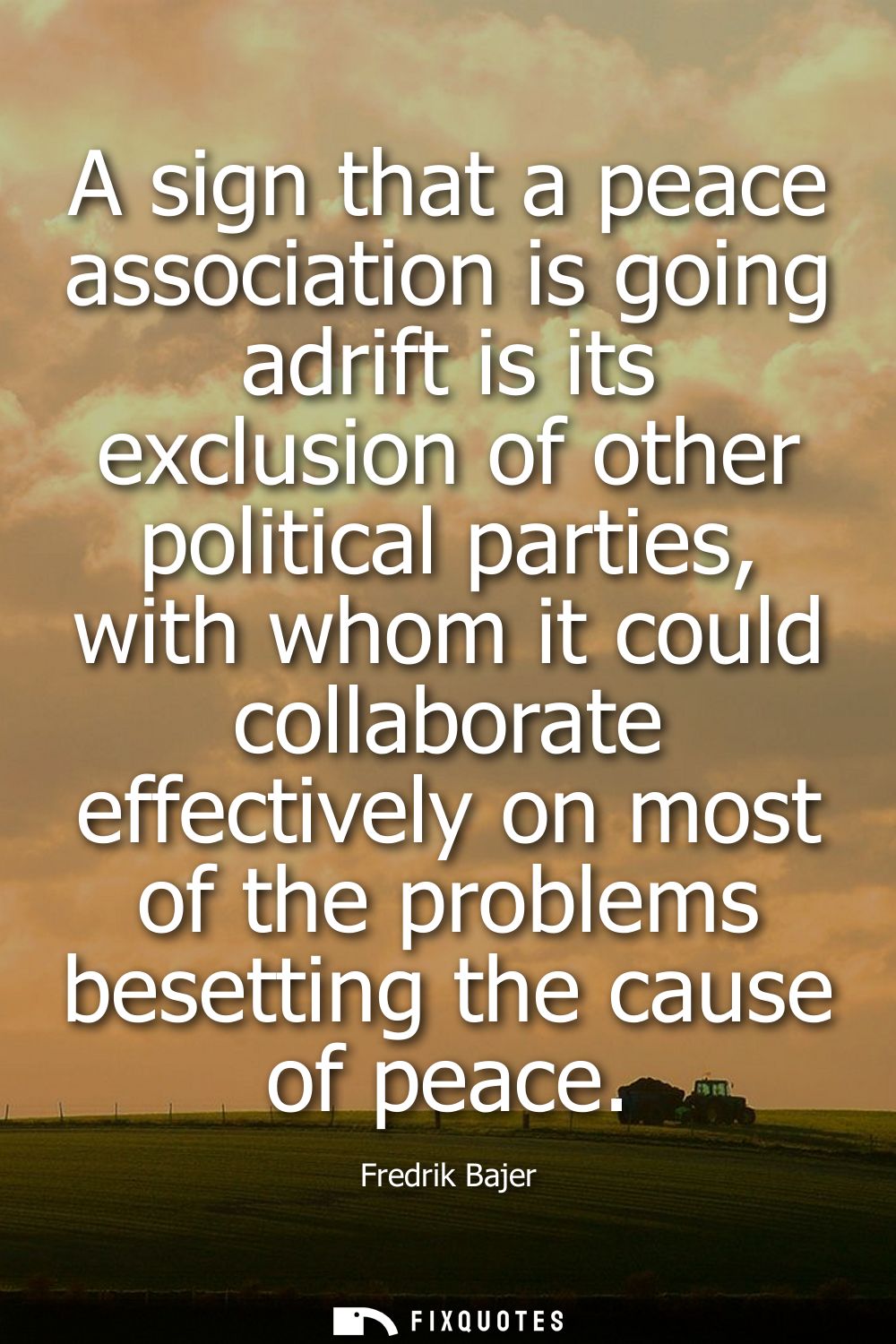
"A sign that a peace association is going adrift is its exclusion of other political parties, with whom it could collaborate effectively on most of the problems besetting the cause of peace"
About this Quote
The phrasing is quietly surgical. “A sign” frames sectarianism as a symptom, not a principle. “Going adrift” suggests an organization no longer steered by outcomes but by identity, afloat on purity and internal consensus. The sharpest turn is “exclusion of other political parties” paired with the pragmatic jab that collaboration would work “effectively on most of the problems.” Bajer is puncturing the comforting fantasy that peace can be pursued as a standalone virtue, detached from policy fights over budgets, militarism, education, labor, nationalism, and empire. Those are political problems; peace associations that refuse politics end up practicing a politics of refusal.
The subtext is a warning against the seductive coherence of an in-group. Movements love the clarity of enemies and the thrill of being uncompromised. Bajer argues that this clarity is a trap: if your peace organization can’t sit at a table with imperfect allies, it will end up as a club for the already convinced, mistaking exclusion for integrity. In an era of party formation, rising nationalism, and mass politics, he’s insisting that the cause of peace is too big to be treated as a factional brand.
Quote Details
| Topic | Peace |
|---|---|
| Source | Help us find the source |
| Cite |
Citation Formats
APA Style (7th ed.)
Bajer, Fredrik. (2026, January 15). A sign that a peace association is going adrift is its exclusion of other political parties, with whom it could collaborate effectively on most of the problems besetting the cause of peace. FixQuotes. https://fixquotes.com/quotes/a-sign-that-a-peace-association-is-going-adrift-150640/
Chicago Style
Bajer, Fredrik. "A sign that a peace association is going adrift is its exclusion of other political parties, with whom it could collaborate effectively on most of the problems besetting the cause of peace." FixQuotes. January 15, 2026. https://fixquotes.com/quotes/a-sign-that-a-peace-association-is-going-adrift-150640/.
MLA Style (9th ed.)
"A sign that a peace association is going adrift is its exclusion of other political parties, with whom it could collaborate effectively on most of the problems besetting the cause of peace." FixQuotes, 15 Jan. 2026, https://fixquotes.com/quotes/a-sign-that-a-peace-association-is-going-adrift-150640/. Accessed 12 Feb. 2026.