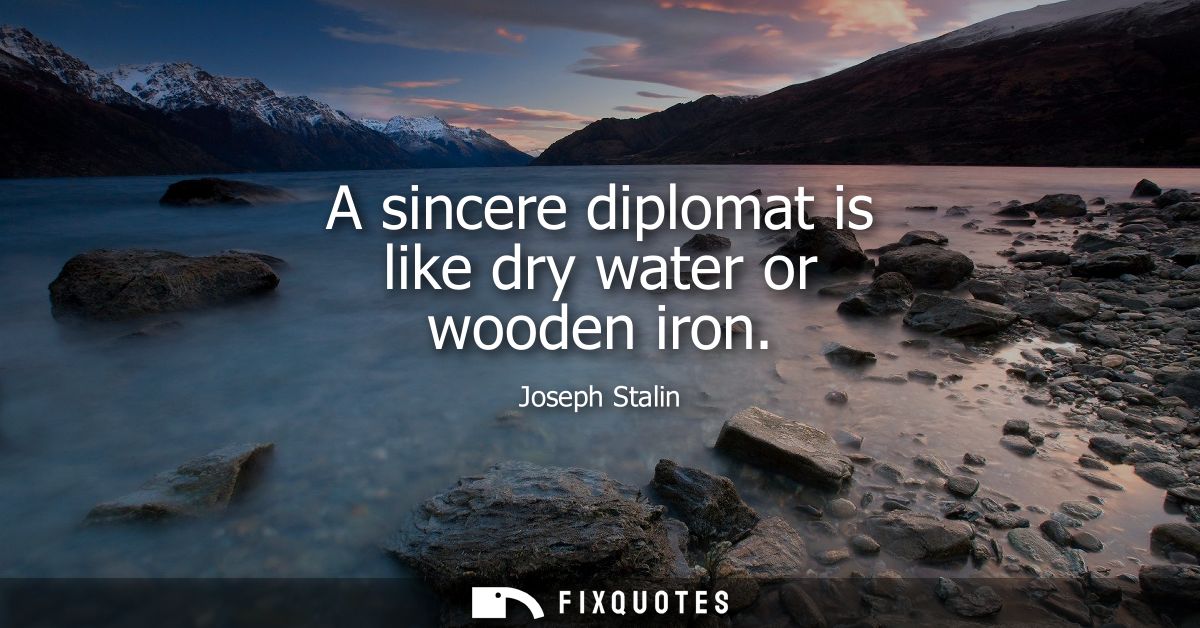
"A sincere diplomat is like dry water or wooden iron"
About this Quote
A sincere diplomat, Stalin suggests, is a contradiction dressed up as a job title. The punchline lands because it’s built like a physical impossibility: “dry water” and “wooden iron” aren’t just rare, they’re incoherent. By choosing materials you can almost feel in your hands, he frames diplomacy as alchemy without the magic - an arena where words are engineered, not confessed.
The intent is blunt: strip diplomacy of its moral veneer. In Stalin’s worldview, international relations are not a seminar on mutual understanding but a terrain of leverage, deception, and calibrated ambiguity. Calling a diplomat “sincere” isn’t praise; it’s proof you don’t understand the assignment. The subtext is a warning to his own apparatus as much as a jab at foreign counterparts: do not be seduced by polite language, treaties, or smiles. Assume interests, read for power, prepare for betrayal.
Context matters. Stalin’s Soviet Union survived and expanded through a mix of ideological certainty and tactical zigzags: nonaggression pacts, wartime alliances, postwar partitioning, purges at home and pressure abroad. Diplomacy, in that setting, wasn’t the alternative to coercion - it was coercion by other means, the velvet glove that still expects a fist underneath.
Rhetorically, the line works because it turns cynicism into common sense. It doesn’t argue; it ridicules the very possibility of good faith, making suspicion feel like intelligence. That’s the chilling efficiency of the aphorism: it’s not merely descriptive, it’s disciplinary.
The intent is blunt: strip diplomacy of its moral veneer. In Stalin’s worldview, international relations are not a seminar on mutual understanding but a terrain of leverage, deception, and calibrated ambiguity. Calling a diplomat “sincere” isn’t praise; it’s proof you don’t understand the assignment. The subtext is a warning to his own apparatus as much as a jab at foreign counterparts: do not be seduced by polite language, treaties, or smiles. Assume interests, read for power, prepare for betrayal.
Context matters. Stalin’s Soviet Union survived and expanded through a mix of ideological certainty and tactical zigzags: nonaggression pacts, wartime alliances, postwar partitioning, purges at home and pressure abroad. Diplomacy, in that setting, wasn’t the alternative to coercion - it was coercion by other means, the velvet glove that still expects a fist underneath.
Rhetorically, the line works because it turns cynicism into common sense. It doesn’t argue; it ridicules the very possibility of good faith, making suspicion feel like intelligence. That’s the chilling efficiency of the aphorism: it’s not merely descriptive, it’s disciplinary.
Quote Details
| Topic | Sarcastic |
|---|
More Quotes by Joseph
Add to List