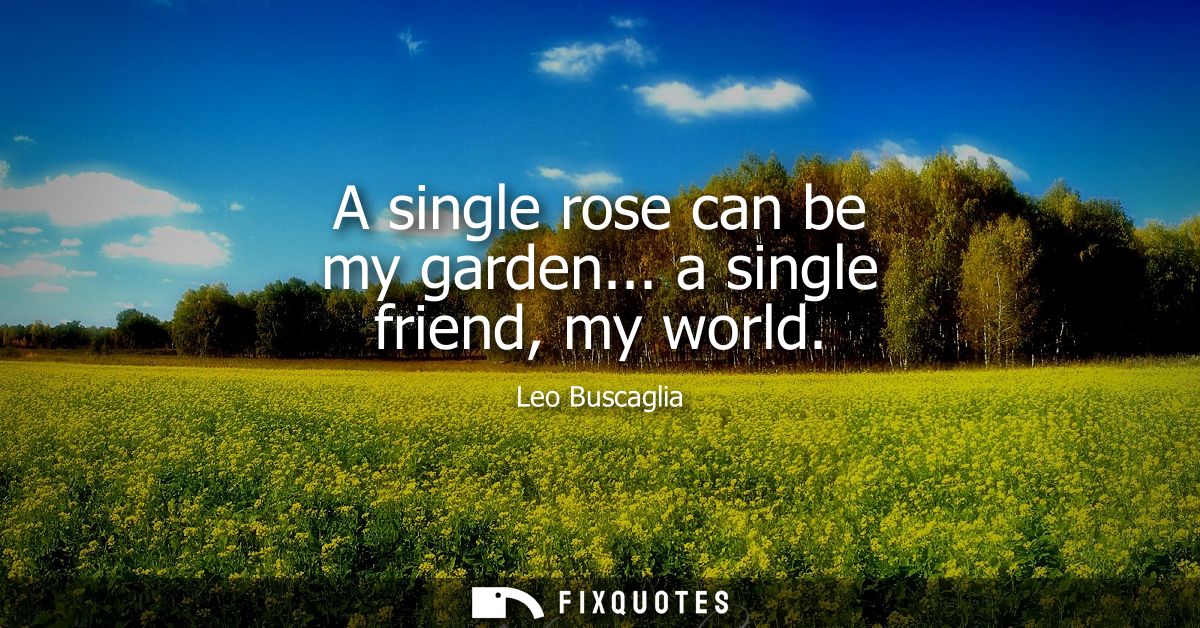
"A single rose can be my garden... A single friend, my world"
About this Quote
Minimalism dressed as romance: Buscaglia’s line isn’t just praising gratitude, it’s redefining scale. By shrinking “garden” to a single rose and “world” to a single friend, he quietly challenges the consumer instinct that more is safer, richer, truer. The ellipsis is the tell. It’s a hinge, a breath that lets the reader feel the leap from object to relationship, from beauty you can hold to belonging you can’t.
Buscaglia wrote in an era when American self-help and human-potential talk was becoming mainstream, and he became one of its most recognizable voices: warm, plainspoken, unembarrassed about tenderness. That matters because the quote works like a piece of counter-programming against late-20th-century loneliness and acquisitiveness. It doesn’t argue. It seduces with an image.
The subtext is less Hallmark than it looks. A rose is famously fragile, temporary, thorned. Calling it a “garden” isn’t naivete; it’s a choice to treat smallness as sufficient. The friend-as-world metaphor raises the stakes even more: it suggests that the right relationship can reorganize your entire sense of reality, not by expanding your social calendar but by changing your center of gravity.
There’s also a risk embedded here that Buscaglia leaves unspoken: if one friend is your world, what happens when they leave? The quote’s power comes from that tension - it sells intimacy as abundance while hinting, softly, at the vulnerability intimacy requires.
Buscaglia wrote in an era when American self-help and human-potential talk was becoming mainstream, and he became one of its most recognizable voices: warm, plainspoken, unembarrassed about tenderness. That matters because the quote works like a piece of counter-programming against late-20th-century loneliness and acquisitiveness. It doesn’t argue. It seduces with an image.
The subtext is less Hallmark than it looks. A rose is famously fragile, temporary, thorned. Calling it a “garden” isn’t naivete; it’s a choice to treat smallness as sufficient. The friend-as-world metaphor raises the stakes even more: it suggests that the right relationship can reorganize your entire sense of reality, not by expanding your social calendar but by changing your center of gravity.
There’s also a risk embedded here that Buscaglia leaves unspoken: if one friend is your world, what happens when they leave? The quote’s power comes from that tension - it sells intimacy as abundance while hinting, softly, at the vulnerability intimacy requires.
Quote Details
| Topic | Best Friend |
|---|---|
| Source | Help us find the source |
| Cite |
Citation Formats
APA Style (7th ed.)
Buscaglia, Leo. (2026, February 19). A single rose can be my garden... A single friend, my world. FixQuotes. https://fixquotes.com/quotes/a-single-rose-can-be-my-garden-a-single-friend-my-32493/
Chicago Style
Buscaglia, Leo. "A single rose can be my garden... A single friend, my world." FixQuotes. February 19, 2026. https://fixquotes.com/quotes/a-single-rose-can-be-my-garden-a-single-friend-my-32493/.
MLA Style (9th ed.)
"A single rose can be my garden... A single friend, my world." FixQuotes, 19 Feb. 2026, https://fixquotes.com/quotes/a-single-rose-can-be-my-garden-a-single-friend-my-32493/. Accessed 9 Mar. 2026.
More Quotes by Leo
Add to List