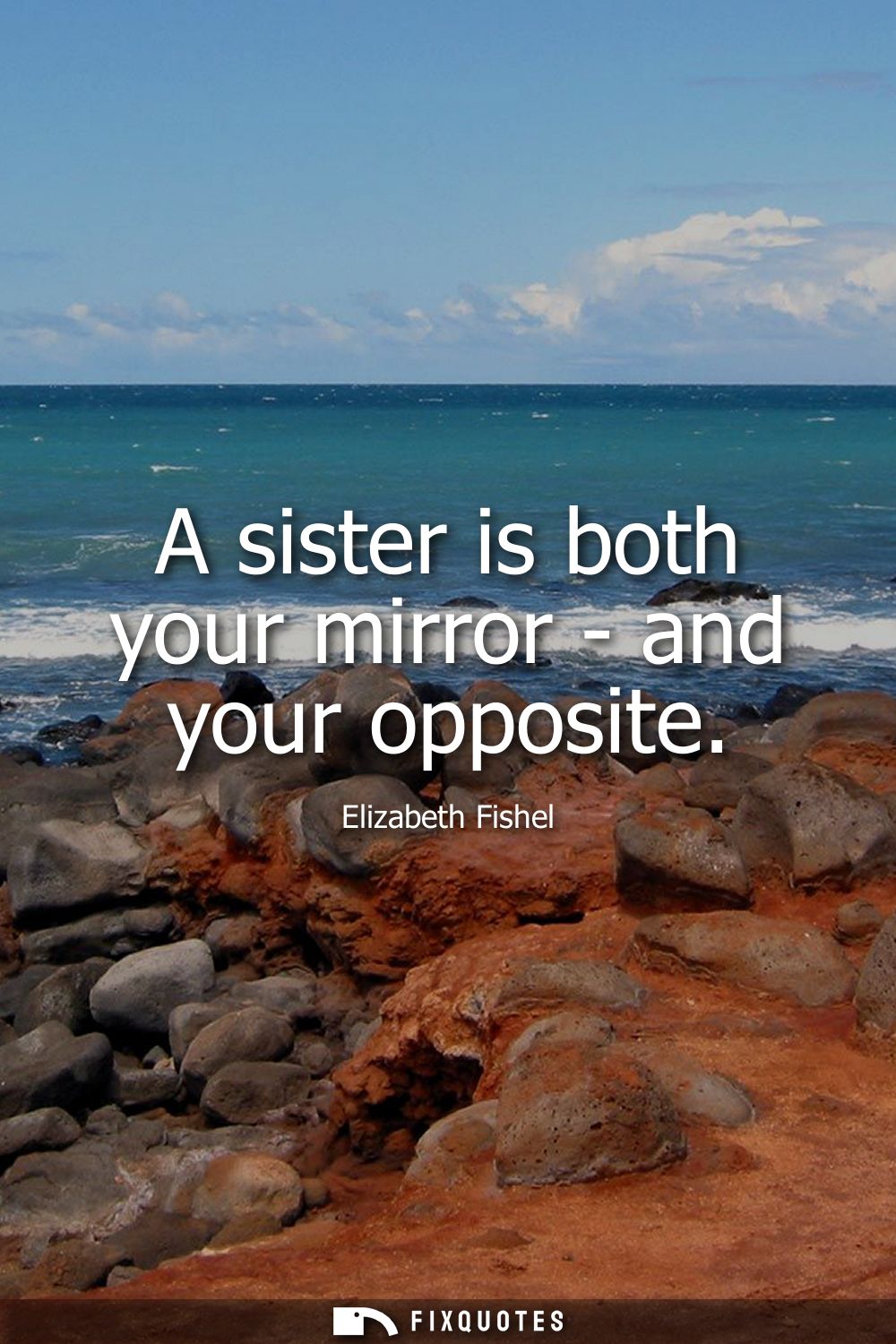
"A sister is both your mirror - and your opposite"
About this Quote
Sisters are the rare relationship that can validate your self-image and sabotage it in the same breath. Elizabeth Fishel’s line works because it captures that double exposure: the sister as “mirror” (the person who reflects your family’s culture back at you) and as “opposite” (the proof that the same home can produce a different self). It’s a compact way to describe how intimacy and rivalry aren’t contradictions in siblinghood; they’re often co-dependent.
“Mirror” carries the emotional charge of recognition. A sister remembers the versions of you that predate your curated adult identity: the childhood habits, the private humiliations, the family myths. That reflection can be comforting or invasive, depending on whether you’re trying to feel known or trying to feel new. The subtext is that a sister sees through your narrative because she helped write the early chapters.
Then Fishel flips the blade with “opposite.” Even with shared parents and shared history, sisters frequently become contrasting strategies for survival: the responsible one and the rebellious one, the peacemaker and the truth-teller, the one who stays and the one who leaves. “Opposite” points to differentiation as a kind of love - and sometimes as a kind of escape. You don’t just grow alongside a sister; you grow against her, using contrast to define your own edges.
The dash matters, too. It’s a pause that feels like lived experience catching up with sentimentality. This isn’t a greeting-card ideal. It’s an honest thesis about how sisterhood shapes identity: by reflecting you back, and by refusing to be you.
“Mirror” carries the emotional charge of recognition. A sister remembers the versions of you that predate your curated adult identity: the childhood habits, the private humiliations, the family myths. That reflection can be comforting or invasive, depending on whether you’re trying to feel known or trying to feel new. The subtext is that a sister sees through your narrative because she helped write the early chapters.
Then Fishel flips the blade with “opposite.” Even with shared parents and shared history, sisters frequently become contrasting strategies for survival: the responsible one and the rebellious one, the peacemaker and the truth-teller, the one who stays and the one who leaves. “Opposite” points to differentiation as a kind of love - and sometimes as a kind of escape. You don’t just grow alongside a sister; you grow against her, using contrast to define your own edges.
The dash matters, too. It’s a pause that feels like lived experience catching up with sentimentality. This isn’t a greeting-card ideal. It’s an honest thesis about how sisterhood shapes identity: by reflecting you back, and by refusing to be you.
Quote Details
| Topic | Sister |
|---|---|
| Source | Help us find the source |
More Quotes by Elizabeth
Add to List