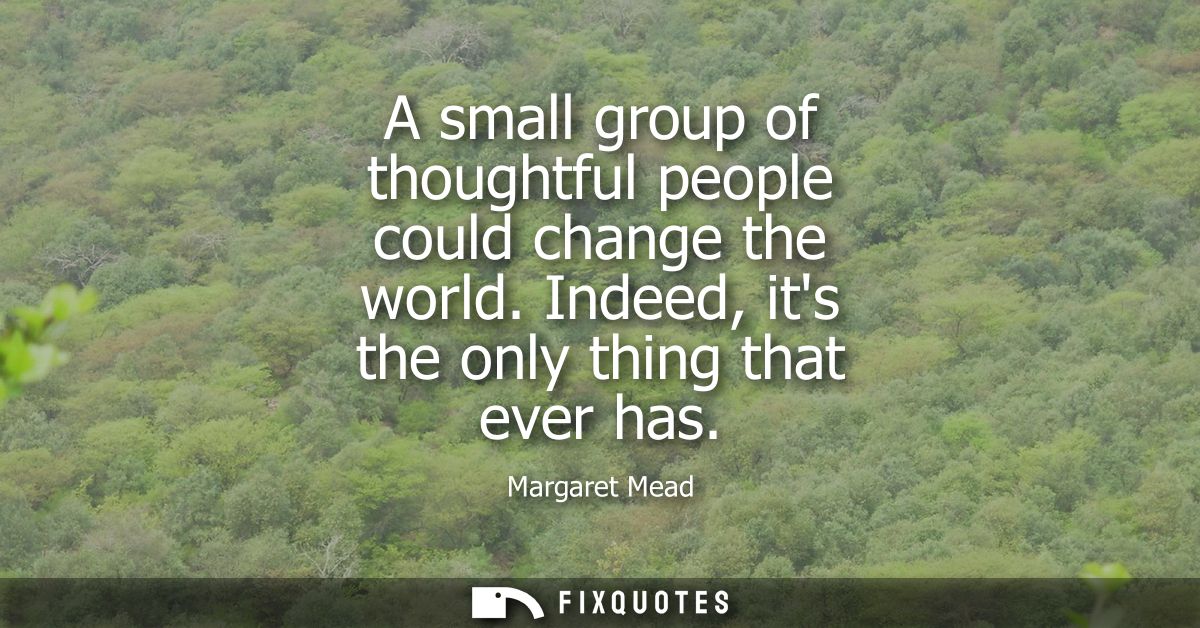
"A small group of thoughtful people could change the world. Indeed, it's the only thing that ever has"
About this Quote
The subtext is anthropological as much as political. Mead spent her career watching how norms get built, enforced, and remodeled inside communities. Her point isn’t that masses are irrelevant, but that cultures don’t reinvent themselves by committee. A handful of people decide a practice is intolerable or a possibility is real; they demonstrate it, name it, repeat it, and make it legible enough for others to adopt. “Thoughtful” matters here: not merely passionate, not merely loud, but strategically attentive to the social fabric - to symbols, incentives, shame, pride, ritual.
Context sharpens the edge. Mead’s 20th century was a parade of organized persuasion: wartime mobilization, civil rights campaigns, second-wave feminism, anti-colonial movements, the rise of mass media. The quote reads like a field note from someone who saw how quickly “common sense” can be rewritten once a committed minority finds the right moral language and the right spectacle.
It also contains a warning: small groups change the world whether we like them or not. The sentence works because it’s both invitation and accountability clause. If history is moved by the few, opting out is its own decision.
Quote Details
| Topic | Change |
|---|---|
| Source | Later attribution: Margaret Mead (Margaret Mead) modern compilation
Evidence:
ver doubt that a small group of thoughtful committed citizens can change the world indeed it is the only thing that ever |
| Cite |
Citation Formats
APA Style (7th ed.)
Mead, Margaret. (2026, February 9). A small group of thoughtful people could change the world. Indeed, it's the only thing that ever has. FixQuotes. https://fixquotes.com/quotes/a-small-group-of-thoughtful-people-could-change-14814/
Chicago Style
Mead, Margaret. "A small group of thoughtful people could change the world. Indeed, it's the only thing that ever has." FixQuotes. February 9, 2026. https://fixquotes.com/quotes/a-small-group-of-thoughtful-people-could-change-14814/.
MLA Style (9th ed.)
"A small group of thoughtful people could change the world. Indeed, it's the only thing that ever has." FixQuotes, 9 Feb. 2026, https://fixquotes.com/quotes/a-small-group-of-thoughtful-people-could-change-14814/. Accessed 14 Mar. 2026.