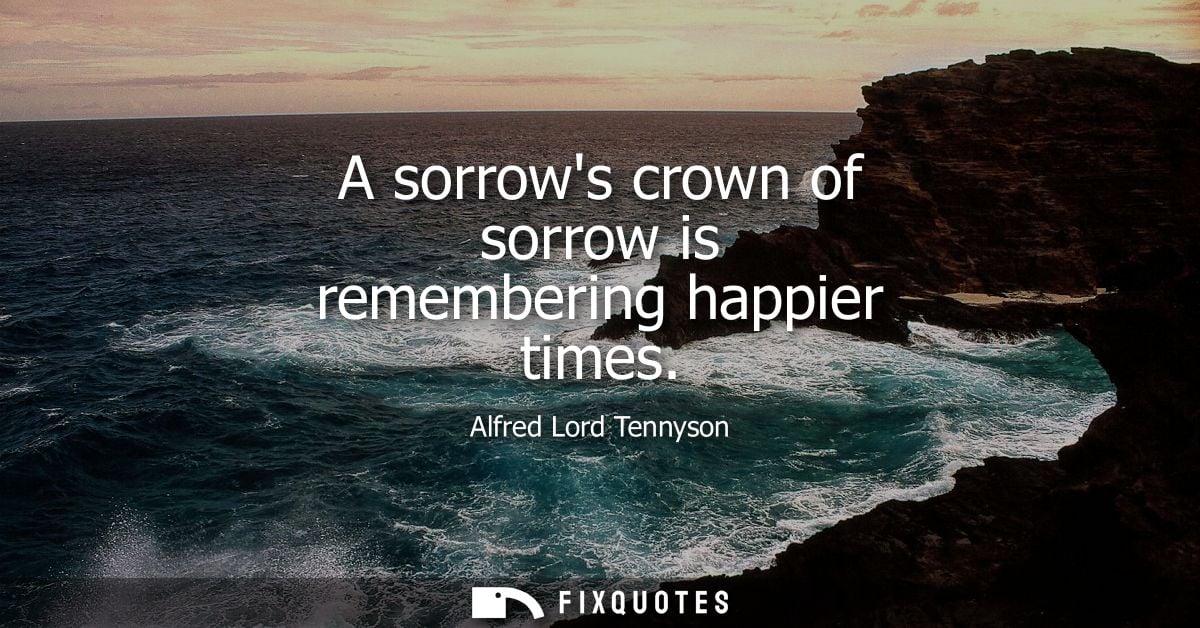
"A sorrow's crown of sorrow is remembering happier times"
About this Quote
Grief, Tennyson suggests, doesn’t just hurt; it sharpens itself by looking backward. The “crown” is a dark joke with Victorian bite: a symbol of honor and completion turned into the final, perfected form of suffering. Sorrow isn’t merely present-tense pain. It becomes regal, totalizing, when memory supplies a contrast so vivid it feels like insult. The line understands that nostalgia is not a gentle glow but a weapon grief hands you, polished with detail.
The phrasing does sneaky work. “A sorrow’s crown of sorrow” loops like rumination itself, the mind circling the same thought until it becomes ornate and heavy. Then Tennyson lands on the simple mechanism: “remembering happier times.” Nothing supernatural, nothing melodramatic. Just the ordinary human capacity to replay, compare, and realize the past is unavailable. That’s the subtext: happiness can survive as an image after it dies as a fact, and that survival is part of the punishment.
Context matters because Tennyson isn’t writing abstract sadness; he’s a poet of bereavement in a century that romanticized feeling yet was intimate with death. The line resonates with the emotional architecture of In Memoriam, shaped by the loss of his friend Arthur Hallam and the long, slow Victorian process of mourning. It also anticipates a modern insight: memory is not a comfort function. Under pressure, it becomes a high-definition reminder of what reality no longer grants. The cruelest thing about time isn’t that it passes; it’s that it leaves souvenirs.
The phrasing does sneaky work. “A sorrow’s crown of sorrow” loops like rumination itself, the mind circling the same thought until it becomes ornate and heavy. Then Tennyson lands on the simple mechanism: “remembering happier times.” Nothing supernatural, nothing melodramatic. Just the ordinary human capacity to replay, compare, and realize the past is unavailable. That’s the subtext: happiness can survive as an image after it dies as a fact, and that survival is part of the punishment.
Context matters because Tennyson isn’t writing abstract sadness; he’s a poet of bereavement in a century that romanticized feeling yet was intimate with death. The line resonates with the emotional architecture of In Memoriam, shaped by the loss of his friend Arthur Hallam and the long, slow Victorian process of mourning. It also anticipates a modern insight: memory is not a comfort function. Under pressure, it becomes a high-definition reminder of what reality no longer grants. The cruelest thing about time isn’t that it passes; it’s that it leaves souvenirs.
Quote Details
| Topic | Nostalgia |
|---|---|
| Source | Help us find the source |
| Cite |
Citation Formats
APA Style (7th ed.)
Tennyson, Alfred Lord. (2026, January 14). A sorrow's crown of sorrow is remembering happier times. FixQuotes. https://fixquotes.com/quotes/a-sorrows-crown-of-sorrow-is-remembering-happier-16745/
Chicago Style
Tennyson, Alfred Lord. "A sorrow's crown of sorrow is remembering happier times." FixQuotes. January 14, 2026. https://fixquotes.com/quotes/a-sorrows-crown-of-sorrow-is-remembering-happier-16745/.
MLA Style (9th ed.)
"A sorrow's crown of sorrow is remembering happier times." FixQuotes, 14 Jan. 2026, https://fixquotes.com/quotes/a-sorrows-crown-of-sorrow-is-remembering-happier-16745/. Accessed 31 Mar. 2026.
More Quotes by Alfred
Add to List