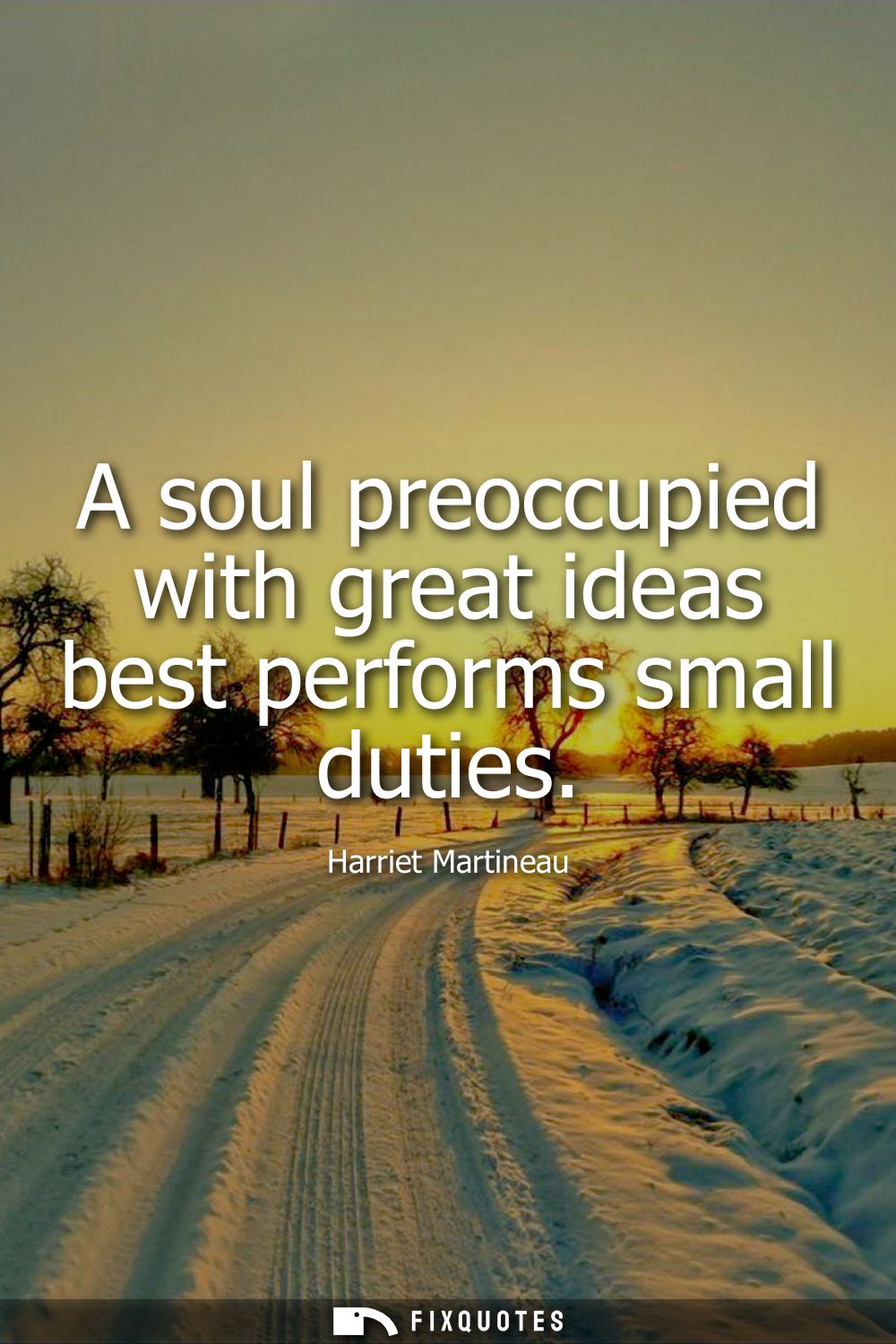
"A soul preoccupied with great ideas best performs small duties"
About this Quote
The line has the clipped confidence of a Victorian moralist who distrusts both grandstanding and aimlessness. Martineau’s point isn’t that big thinking is more important than chores; it’s that large, clarifying ideas act like a compass for the mundane. “Preoccupied” is doing sly work here. It suggests not a hobbyist’s interest but a mind colonized by principle, purpose, conviction. In that mental weather, “small duties” stop feeling like drudgery or social performance and start reading as practice: evidence of character, not just compliance.
Martineau wrote in an era that loved sermons about duty, especially for women, and she’s subtly rerouting that tradition. The domestic and the everyday are not being romanticized as naturally feminine virtues; they’re being justified as the visible output of intellectual seriousness. That’s a sharp repositioning for a female writer in the 19th century: insisting that the life of the mind doesn’t excuse you from practical obligation, while also implying that practical competence can be an expression of intellect rather than a substitute for it.
There’s a quiet rebuke embedded here for two types: the dreamer who uses “great ideas” as an alibi for unreliability, and the rule-follower who treats duty as mindless habit. Martineau’s sentence welds the ethical to the operational. If your ideas are truly “great,” they should make you better at returning emails, caring for people, meeting commitments - not worse.
Martineau wrote in an era that loved sermons about duty, especially for women, and she’s subtly rerouting that tradition. The domestic and the everyday are not being romanticized as naturally feminine virtues; they’re being justified as the visible output of intellectual seriousness. That’s a sharp repositioning for a female writer in the 19th century: insisting that the life of the mind doesn’t excuse you from practical obligation, while also implying that practical competence can be an expression of intellect rather than a substitute for it.
There’s a quiet rebuke embedded here for two types: the dreamer who uses “great ideas” as an alibi for unreliability, and the rule-follower who treats duty as mindless habit. Martineau’s sentence welds the ethical to the operational. If your ideas are truly “great,” they should make you better at returning emails, caring for people, meeting commitments - not worse.
Quote Details
| Topic | Wisdom |
|---|---|
| Source | Help us find the source |
| Cite |
Citation Formats
APA Style (7th ed.)
Martineau, Harriet. (2026, January 15). A soul preoccupied with great ideas best performs small duties. FixQuotes. https://fixquotes.com/quotes/a-soul-preoccupied-with-great-ideas-best-performs-61736/
Chicago Style
Martineau, Harriet. "A soul preoccupied with great ideas best performs small duties." FixQuotes. January 15, 2026. https://fixquotes.com/quotes/a-soul-preoccupied-with-great-ideas-best-performs-61736/.
MLA Style (9th ed.)
"A soul preoccupied with great ideas best performs small duties." FixQuotes, 15 Jan. 2026, https://fixquotes.com/quotes/a-soul-preoccupied-with-great-ideas-best-performs-61736/. Accessed 25 Mar. 2026.
More Quotes by Harriet
Add to List