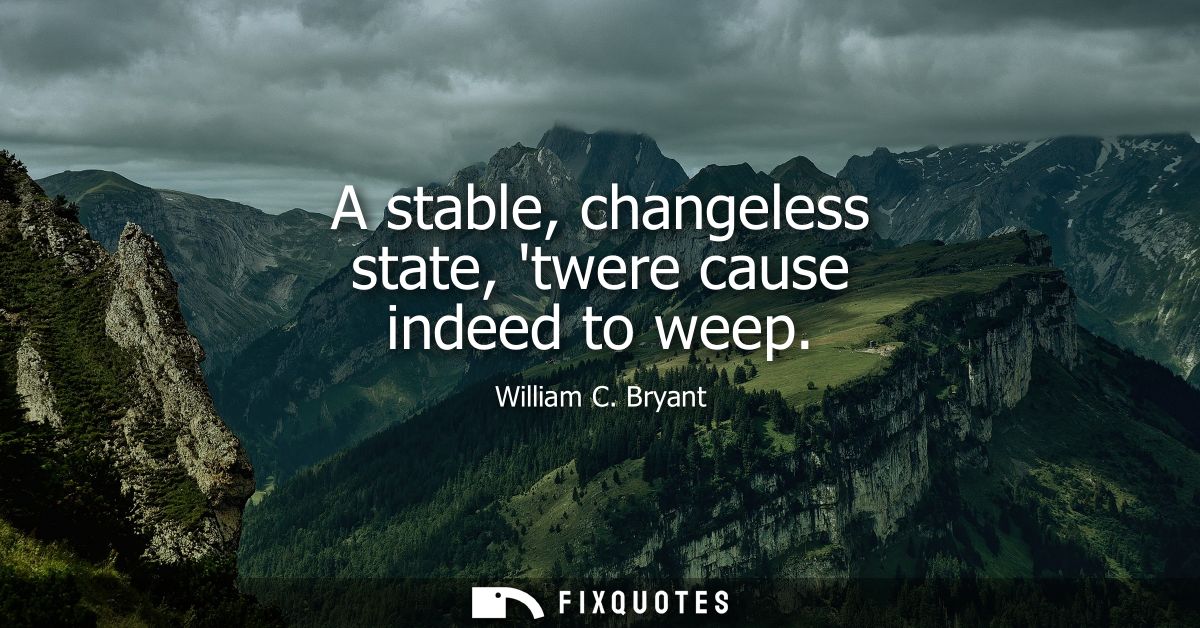
"A stable, changeless state, 'twere cause indeed to weep"
About this Quote
Restlessness is framed here not as a personal flaw but as the pulse of a healthy world. Bryant’s line takes a seemingly comforting ideal - stability - and flips it into something mournful: if life ever became truly “stable” and “changeless,” grief would be the only reasonable response. The archaic contraction “‘twere” lends a biblical, elegiac gravity, as if the speaker is pronouncing a moral law rather than an opinion. That elevated diction matters: it makes change feel less like chaos and more like ordained motion.
Bryant, a leading American poet of the early 19th century, was writing in a culture busy mythologizing progress while still haunted by fragility: early industrialization, territorial expansion, epidemic disease, political upheaval. Against that backdrop, “changeless” doesn’t read like peace; it reads like stagnation, even death. Nature, one of Bryant’s central reference points, is never static. Seasons turn, rivers move, bodies decay and replenish. A world without alteration would be a world without that cycle - a museum of itself.
The line’s subtext is also a quiet critique of complacency. In a young nation tempted to treat its current arrangements as destiny, Bryant hints that permanence is not a prize but a trap. To weep at changelessness is to recognize that meaning depends on movement: growth requires the risk of loss, and hope requires the possibility of difference. The cleverness is how gently he says it. No manifesto, no sermon - just a calm, devastating reframing of what we’re taught to want.
Bryant, a leading American poet of the early 19th century, was writing in a culture busy mythologizing progress while still haunted by fragility: early industrialization, territorial expansion, epidemic disease, political upheaval. Against that backdrop, “changeless” doesn’t read like peace; it reads like stagnation, even death. Nature, one of Bryant’s central reference points, is never static. Seasons turn, rivers move, bodies decay and replenish. A world without alteration would be a world without that cycle - a museum of itself.
The line’s subtext is also a quiet critique of complacency. In a young nation tempted to treat its current arrangements as destiny, Bryant hints that permanence is not a prize but a trap. To weep at changelessness is to recognize that meaning depends on movement: growth requires the risk of loss, and hope requires the possibility of difference. The cleverness is how gently he says it. No manifesto, no sermon - just a calm, devastating reframing of what we’re taught to want.
Quote Details
| Topic | Change |
|---|---|
| Source | Help us find the source |
| Cite |
Citation Formats
APA Style (7th ed.)
Bryant, William C. (2026, January 16). A stable, changeless state, 'twere cause indeed to weep. FixQuotes. https://fixquotes.com/quotes/a-stable-changeless-state-twere-cause-indeed-to-96499/
Chicago Style
Bryant, William C. "A stable, changeless state, 'twere cause indeed to weep." FixQuotes. January 16, 2026. https://fixquotes.com/quotes/a-stable-changeless-state-twere-cause-indeed-to-96499/.
MLA Style (9th ed.)
"A stable, changeless state, 'twere cause indeed to weep." FixQuotes, 16 Jan. 2026, https://fixquotes.com/quotes/a-stable-changeless-state-twere-cause-indeed-to-96499/. Accessed 12 Feb. 2026.
More Quotes by William
Add to List