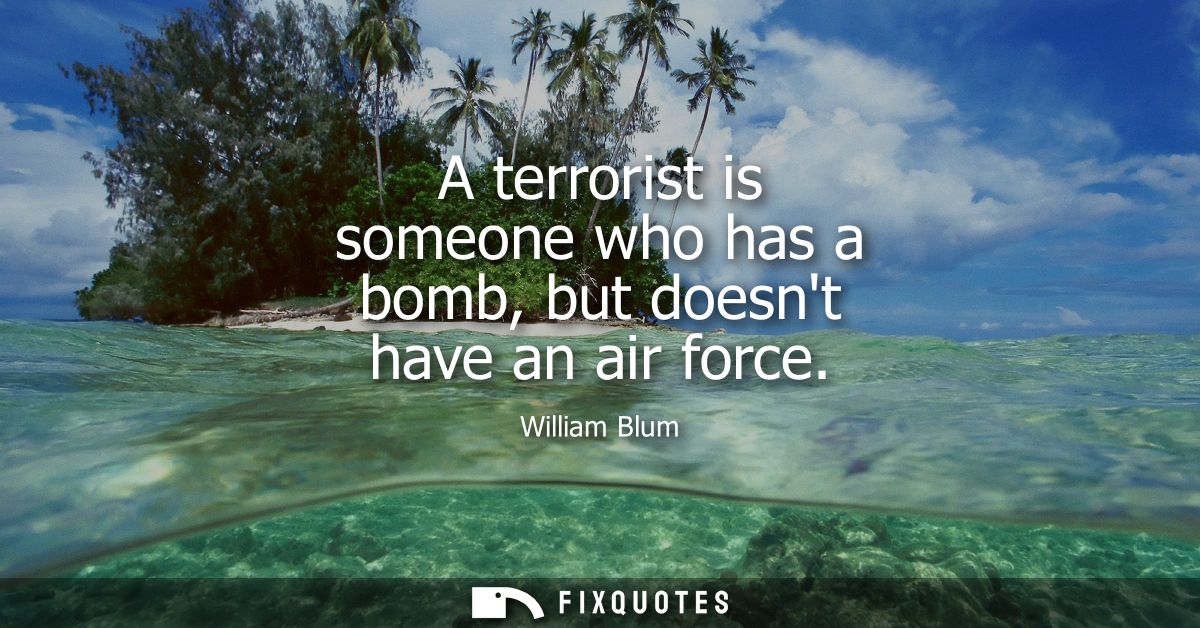
"A terrorist is someone who has a bomb, but doesn't have an air force"
About this Quote
Blum’s line is a dare disguised as a definition: it yanks “terrorist” out of the moral panic box and drops it into the ledger of power. The barb lands because it’s structurally unfair in a way that mirrors the world it’s critiquing. If violence is judged by methods alone, then a bomb is a bomb. If it’s judged by who gets to deploy it at scale, then the label becomes less about ethics than about jurisdiction.
The intent is to puncture the sanctimony of state rhetoric, especially the post-Cold War, post-9/11 habit of treating terrorism as a uniquely non-state pathology. By invoking “an air force,” Blum points to the industrialization of force: bureaucratized killing, sanitized by uniforms, briefings, and strategic acronyms. Air power is the ultimate credential of legitimacy in modern war-making; it turns destruction into policy rather than criminality. The subtext is blunt: the same act is condemned or celebrated depending on whether it comes with flags, budgets, and press conferences.
The joke’s cynicism is doing serious work. It exposes how language functions as a weapon system: “terrorist” doesn’t merely describe an enemy; it authorizes exceptional measures and forecloses empathy. Blum’s framing also refuses the comforting story that “we” use violence reluctantly while “they” use it irrationally. He’s not absolving non-state attacks; he’s indicting the double standard that launders state violence through legality and distance. The punchline is that legitimacy isn’t innocence - it’s air superiority.
The intent is to puncture the sanctimony of state rhetoric, especially the post-Cold War, post-9/11 habit of treating terrorism as a uniquely non-state pathology. By invoking “an air force,” Blum points to the industrialization of force: bureaucratized killing, sanitized by uniforms, briefings, and strategic acronyms. Air power is the ultimate credential of legitimacy in modern war-making; it turns destruction into policy rather than criminality. The subtext is blunt: the same act is condemned or celebrated depending on whether it comes with flags, budgets, and press conferences.
The joke’s cynicism is doing serious work. It exposes how language functions as a weapon system: “terrorist” doesn’t merely describe an enemy; it authorizes exceptional measures and forecloses empathy. Blum’s framing also refuses the comforting story that “we” use violence reluctantly while “they” use it irrationally. He’s not absolving non-state attacks; he’s indicting the double standard that launders state violence through legality and distance. The punchline is that legitimacy isn’t innocence - it’s air superiority.
Quote Details
| Topic | War |
|---|---|
| Source | Evidence: A terrorist is someone who has a bomb but doesn't have an air force (Chapter 11, "Bombings," p. 85). I found the quote in William Blum's own book Rogue State: A Guide to the World's Only Superpower (Common Courage Press, 2000). In a scanned copy of the book, the line appears on p. 85 in Chapter 11, "Bombings," immediately before Blum lists countries bombed by the United States. This is the earliest primary-source instance I could verify from Blum's own work. I did not find a reliably documented earlier speech, interview, or article by Blum containing this wording. Later reuse appears in Blum's Anti-Empire Report #120 (September 3, 2013), but that is clearly later than the 2000 book. Source support: the PDF scan shows the quote on p. 85, and library catalogs confirm the 2000 publication data. ([cia.gov](https://www.cia.gov/library/abbottabad-compound/5F/5FC9177D115DFAE199E5204183A6F3E2_Rogue_state__By_sout_al_khilafah.pdf)) Other candidates (1) Quotations on Terrorism (Harry Kawilarang, 2004) compilation95.4% ... A terrorist is someone who has a bomb but doesn't have an air force . William Blum TERRORISTS: Supposed leader ha... |
| Cite |
Citation Formats
APA Style (7th ed.)
Blum, William. (2026, March 9). A terrorist is someone who has a bomb, but doesn't have an air force. FixQuotes. https://fixquotes.com/quotes/a-terrorist-is-someone-who-has-a-bomb-but-doesnt-152817/
Chicago Style
Blum, William. "A terrorist is someone who has a bomb, but doesn't have an air force." FixQuotes. March 9, 2026. https://fixquotes.com/quotes/a-terrorist-is-someone-who-has-a-bomb-but-doesnt-152817/.
MLA Style (9th ed.)
"A terrorist is someone who has a bomb, but doesn't have an air force." FixQuotes, 9 Mar. 2026, https://fixquotes.com/quotes/a-terrorist-is-someone-who-has-a-bomb-but-doesnt-152817/. Accessed 31 Mar. 2026.
More Quotes by William
Add to List