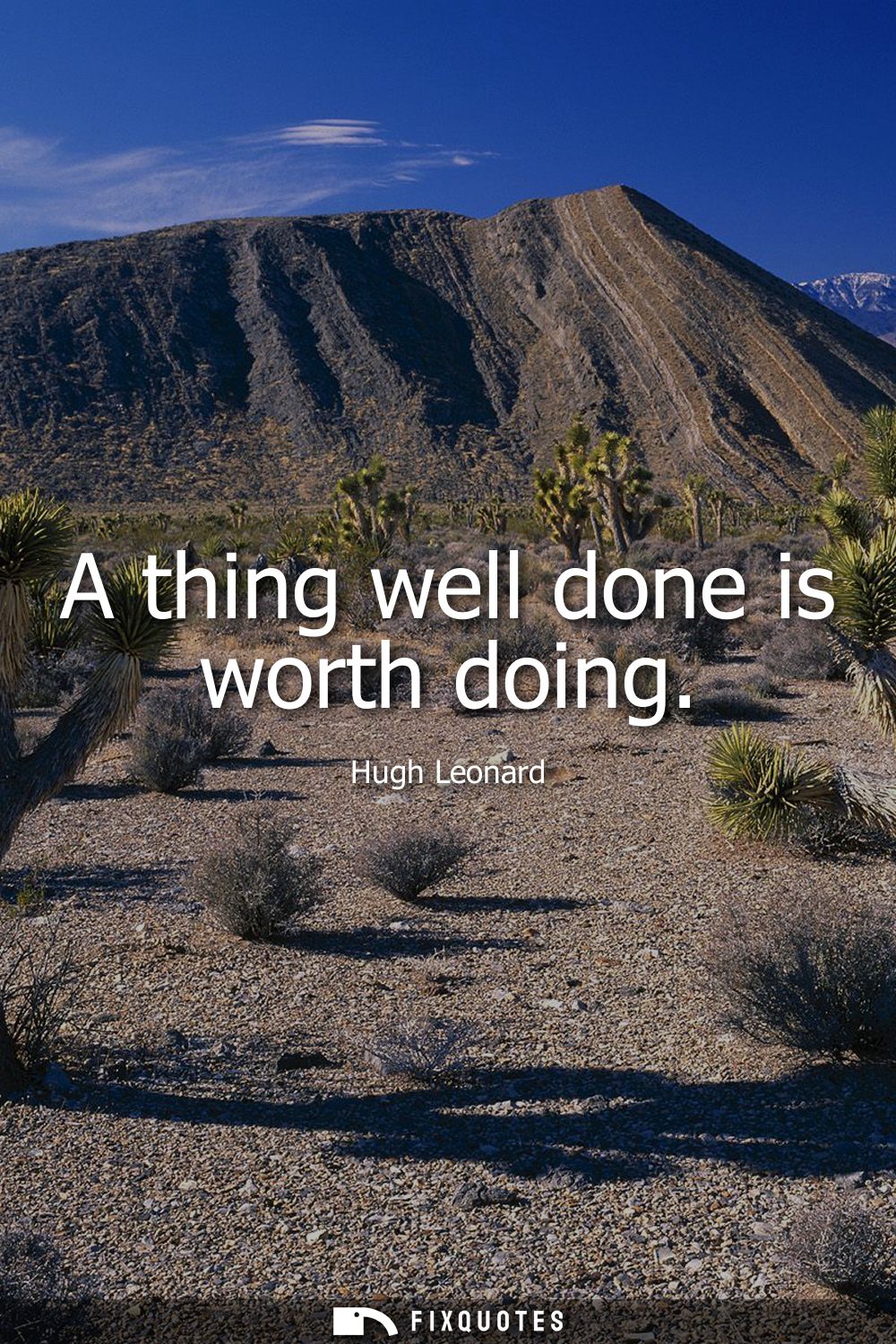
"A thing well done is worth doing"
About this Quote
Perfectionism, in Hugh Leonard's hands, isn't a self-help slogan; it's a hard-nosed defense of craft. "A thing well done is worth doing" rewires the more common proverb ("worth doing well") into something blunter and more theatrical: the value isn't in the task itself, but in the competence brought to it. It's an ethic that flatters no one. If you can't or won't do it properly, the line implies, maybe don't do it at all.
That edge makes sense coming from a dramatist, where "doing" is never just doing. A play is an assembly of invisible labor - pacing, subtext, timing, the slight turn of a line that keeps an audience leaning forward. Stage work punishes sloppiness in real time: a weak scene doesn't stay private, it collapses in front of people. Leonard's phrasing carries that rehearsal-room realism. "Well done" is not abstract excellence; it's the unglamorous discipline of revision, the willingness to be edited, the humility to treat small choices as decisive.
The subtext also pushes back against a culture that romanticizes spontaneity. It doesn't celebrate the spark; it celebrates the follow-through. There's even a sly moral note: doing something "well" suggests integrity as much as skill - doing right by the material, the collaborators, the audience.
In an era of quick takes and visible hustle, Leonard's line reads like a quiet insult: effort isn't the point. Standards are.
That edge makes sense coming from a dramatist, where "doing" is never just doing. A play is an assembly of invisible labor - pacing, subtext, timing, the slight turn of a line that keeps an audience leaning forward. Stage work punishes sloppiness in real time: a weak scene doesn't stay private, it collapses in front of people. Leonard's phrasing carries that rehearsal-room realism. "Well done" is not abstract excellence; it's the unglamorous discipline of revision, the willingness to be edited, the humility to treat small choices as decisive.
The subtext also pushes back against a culture that romanticizes spontaneity. It doesn't celebrate the spark; it celebrates the follow-through. There's even a sly moral note: doing something "well" suggests integrity as much as skill - doing right by the material, the collaborators, the audience.
In an era of quick takes and visible hustle, Leonard's line reads like a quiet insult: effort isn't the point. Standards are.
Quote Details
| Topic | Work Ethic |
|---|---|
| Source | Help us find the source |
| Cite |
Citation Formats
APA Style (7th ed.)
Leonard, Hugh. (2026, January 18). A thing well done is worth doing. FixQuotes. https://fixquotes.com/quotes/a-thing-well-done-is-worth-doing-14035/
Chicago Style
Leonard, Hugh. "A thing well done is worth doing." FixQuotes. January 18, 2026. https://fixquotes.com/quotes/a-thing-well-done-is-worth-doing-14035/.
MLA Style (9th ed.)
"A thing well done is worth doing." FixQuotes, 18 Jan. 2026, https://fixquotes.com/quotes/a-thing-well-done-is-worth-doing-14035/. Accessed 12 Feb. 2026.
More Quotes by Hugh
Add to List