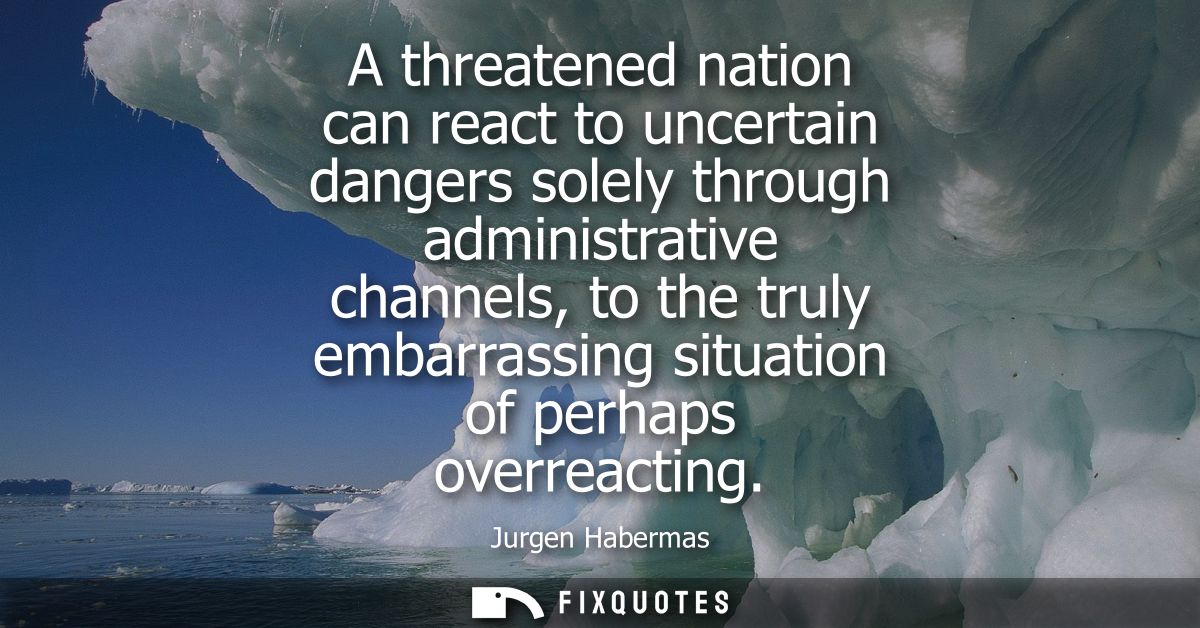
"A threatened nation can react to uncertain dangers solely through administrative channels, to the truly embarrassing situation of perhaps overreacting"
About this Quote
The sting sits in his phrase “truly embarrassing.” Habermas isn’t primarily worried about inefficiency; he’s worried about legitimacy. Overreaction isn’t merely a policy mistake, it’s a public humiliation for a democracy that claims to act through reasoned will-formation. His broader project has long been about the difference between power that persuades and power that manages. Here, management wins by default: administrative action becomes a way to avoid the messier work of democratic deliberation, where uncertainty would have to be admitted and contested.
The subtext is postwar Europe’s lived memory of what happens when states normalize exceptional measures, then keep them. Habermas writes in the shadow of terrorism, security states, and the EU’s technocratic drift: governance by experts and agencies that can accelerate quickly, while public debate lags behind or is treated as a luxury. The line is a warning about the asymmetry of modern politics: fear is immediate, accountability is slow, and bureaucracy is the perfect vehicle for turning “maybe” into policy.
Quote Details
| Topic | War |
|---|---|
| Source | Help us find the source |
| Cite |
Citation Formats
APA Style (7th ed.)
Habermas, Jurgen. (2026, January 15). A threatened nation can react to uncertain dangers solely through administrative channels, to the truly embarrassing situation of perhaps overreacting. FixQuotes. https://fixquotes.com/quotes/a-threatened-nation-can-react-to-uncertain-152415/
Chicago Style
Habermas, Jurgen. "A threatened nation can react to uncertain dangers solely through administrative channels, to the truly embarrassing situation of perhaps overreacting." FixQuotes. January 15, 2026. https://fixquotes.com/quotes/a-threatened-nation-can-react-to-uncertain-152415/.
MLA Style (9th ed.)
"A threatened nation can react to uncertain dangers solely through administrative channels, to the truly embarrassing situation of perhaps overreacting." FixQuotes, 15 Jan. 2026, https://fixquotes.com/quotes/a-threatened-nation-can-react-to-uncertain-152415/. Accessed 30 Mar. 2026.