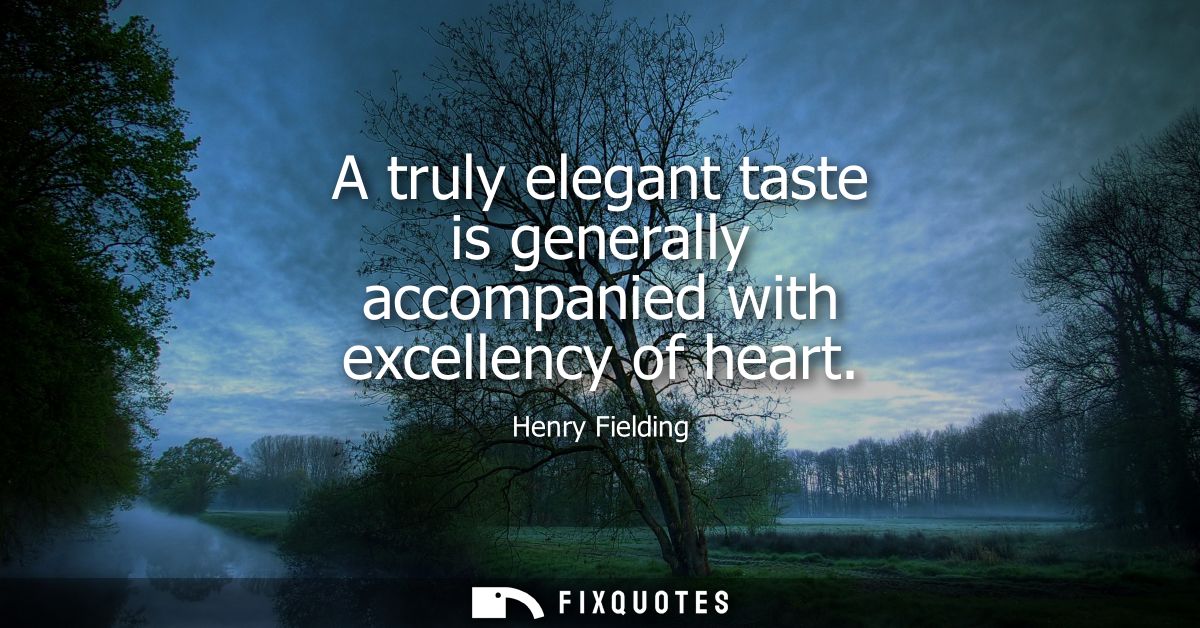
"A truly elegant taste is generally accompanied with excellency of heart"
About this Quote
In the 18th-century world Fielding helped define, “taste” wasn’t just about art or dinnerware; it was a social technology. Taste sorted people. It justified hierarchy. It turned private preference into public proof of worth. Fielding’s move is to moralize that system from the inside: if taste is going to be used as a badge of superiority, he insists it should at least be tethered to kindness, integrity, and fellow-feeling. The phrase “accompanied with” is doing quiet work too, suggesting a pairing rather than a causal chain. Good taste doesn’t automatically manufacture a good heart; it walks beside it when taste is “truly” elegant, not merely fashionable.
There’s also a novelist’s agenda here. Fielding wrote about hypocrisy and performance, about people who learn the gestures of virtue without the substance. This line draws a bright boundary between polish and pose. It flatters the reader into aspiring to “elegance,” then raises the price of admission: without moral excellence, your refinement is just decoration.
Quote Details
| Topic | Kindness |
|---|---|
| Source | Help us find the source |
| Cite |
Citation Formats
APA Style (7th ed.)
Fielding, Henry. (2026, January 15). A truly elegant taste is generally accompanied with excellency of heart. FixQuotes. https://fixquotes.com/quotes/a-truly-elegant-taste-is-generally-accompanied-67528/
Chicago Style
Fielding, Henry. "A truly elegant taste is generally accompanied with excellency of heart." FixQuotes. January 15, 2026. https://fixquotes.com/quotes/a-truly-elegant-taste-is-generally-accompanied-67528/.
MLA Style (9th ed.)
"A truly elegant taste is generally accompanied with excellency of heart." FixQuotes, 15 Jan. 2026, https://fixquotes.com/quotes/a-truly-elegant-taste-is-generally-accompanied-67528/. Accessed 12 Feb. 2026.