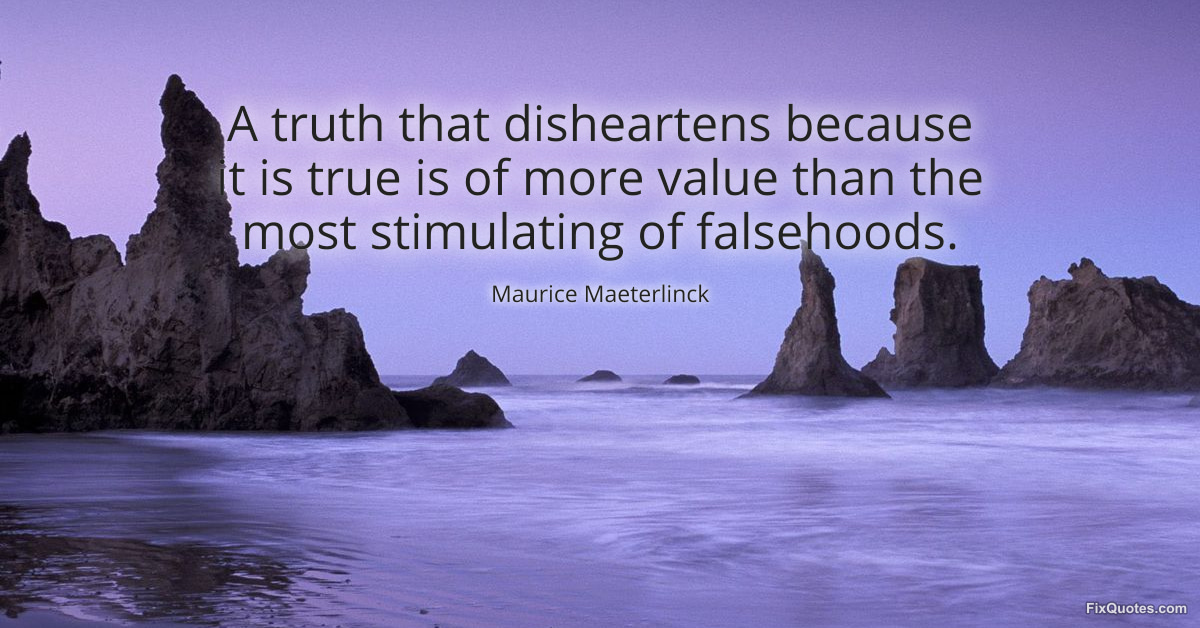
"A truth that disheartens because it is true is of more value than the most stimulating of falsehoods"
About this Quote
As a Symbolist dramatist working in a fin-de-siecle Europe fascinated by mysticism, spectacle, and the newly marketable pleasures of distraction, Maeterlinck understood how art can anesthetize. His theater often trades in atmosphere and dread, but it’s never merely decorative; it insists that unseen forces - time, death, desire, fate - are the actual plot. This aphorism feels like a backstage note to his own project: don’t mistake sensation for insight. A “stimulating” lie can be theatrically brilliant and socially convenient, the kind of story a culture repeats to avoid change. A disheartening truth, by contrast, strips away the props. It’s not entertainment; it’s orientation.
The subtext is almost accusatory: if you prefer the uplift, you’re choosing hypnosis. Maeterlinck isn’t arguing for pessimism as a vibe; he’s arguing for reality as a discipline. The value of truth is practical, not pious. It’s the difference between feeling energized and being equipped.
Quote Details
| Topic | Truth |
|---|---|
| Source | Help us find the source |
| Cite |
Citation Formats
APA Style (7th ed.)
Maeterlinck, Maurice. (2026, January 15). A truth that disheartens because it is true is of more value than the most stimulating of falsehoods. FixQuotes. https://fixquotes.com/quotes/a-truth-that-disheartens-because-it-is-true-is-of-79991/
Chicago Style
Maeterlinck, Maurice. "A truth that disheartens because it is true is of more value than the most stimulating of falsehoods." FixQuotes. January 15, 2026. https://fixquotes.com/quotes/a-truth-that-disheartens-because-it-is-true-is-of-79991/.
MLA Style (9th ed.)
"A truth that disheartens because it is true is of more value than the most stimulating of falsehoods." FixQuotes, 15 Jan. 2026, https://fixquotes.com/quotes/a-truth-that-disheartens-because-it-is-true-is-of-79991/. Accessed 29 Mar. 2026.