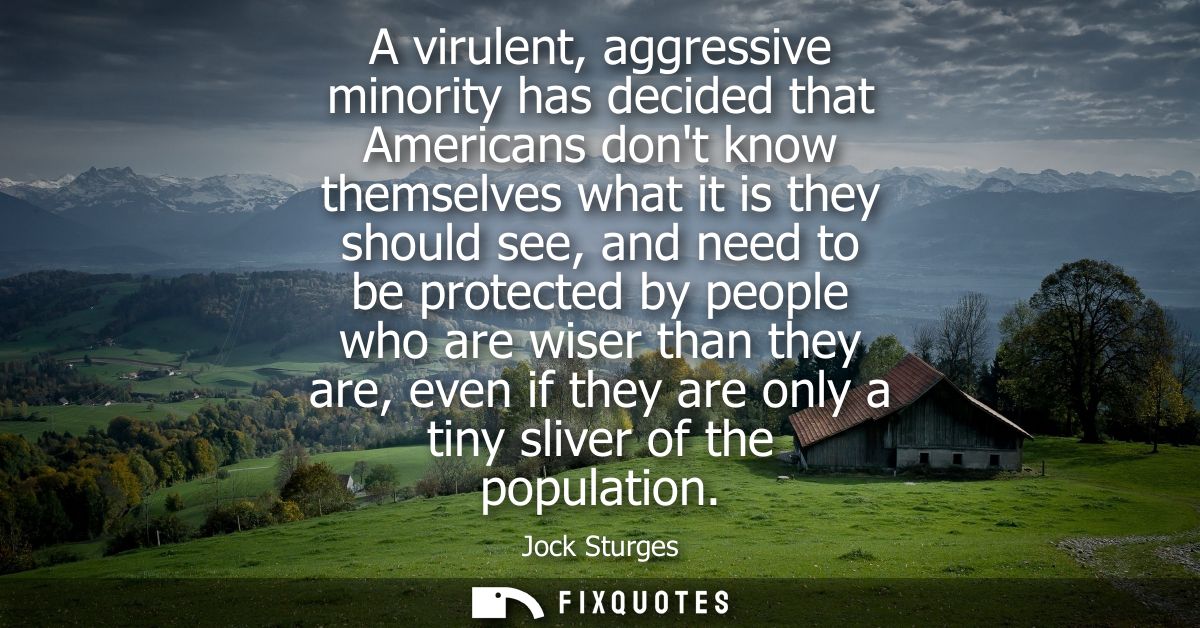
"A virulent, aggressive minority has decided that Americans don't know themselves what it is they should see, and need to be protected by people who are wiser than they are, even if they are only a tiny sliver of the population"
About this Quote
The subtext is personal and strategic. As a photographer whose work has been dogged by accusations of impropriety and obscenity, Sturges speaks from the pressure point where art, sexuality, and public anxiety collide. His phrasing turns legal or ethical scrutiny into a legitimacy crisis for the scrutinizers: they aren’t merely wrong, they’re anti-democratic. By emphasizing that they are “only a tiny sliver of the population,” he invokes a majoritarian common sense that’s supposed to feel reassuring: most people can handle complexity, most people don’t need censors.
What makes the line work is how it recasts “protection” as domination. It suggests that the real object being protected isn’t the public, but an ideology of innocence, one that treats viewers as children and images as threats. That’s a potent reversal, especially in American debates about obscenity, youth, and free expression, where the language of safeguarding often doubles as a tool for removing uncomfortable art from view.
Quote Details
| Topic | Freedom |
|---|---|
| Source | Help us find the source |
| Cite |
Citation Formats
APA Style (7th ed.)
Sturges, Jock. (2026, January 18). A virulent, aggressive minority has decided that Americans don't know themselves what it is they should see, and need to be protected by people who are wiser than they are, even if they are only a tiny sliver of the population. FixQuotes. https://fixquotes.com/quotes/a-virulent-aggressive-minority-has-decided-that-4099/
Chicago Style
Sturges, Jock. "A virulent, aggressive minority has decided that Americans don't know themselves what it is they should see, and need to be protected by people who are wiser than they are, even if they are only a tiny sliver of the population." FixQuotes. January 18, 2026. https://fixquotes.com/quotes/a-virulent-aggressive-minority-has-decided-that-4099/.
MLA Style (9th ed.)
"A virulent, aggressive minority has decided that Americans don't know themselves what it is they should see, and need to be protected by people who are wiser than they are, even if they are only a tiny sliver of the population." FixQuotes, 18 Jan. 2026, https://fixquotes.com/quotes/a-virulent-aggressive-minority-has-decided-that-4099/. Accessed 5 Mar. 2026.